Agentic Commerce Protocol (ACP) is basically the “language” and rules that let AI agents, people, and online stores talk to each other so a full purchase can happen safely end‑to‑end. It takes the classic ecommerce flow you already know search, compare, add to cart, pay, fulfill and turns it into something AI agents can do on your behalf without breaking security, trust, or merchant control.
What ACP actually is
- Agentic commerce = AI agents doing shopping work for you: finding options, comparing, and even completing purchases.
- Agentic Commerce Protocol (ACP) = the open standard that defines how those agents, merchants, and payment systems talk to each other in a safe, structured way to complete transactions.
So instead of you opening 10 tabs, logging into three stores, and typing your card details again, you just say something like: “Find me a 32GB RAM MacBook Pro for under $2,000 with next‑day delivery, and if my usual store can match that, buy from them.”
The AI agent then does the messy work. ACP is what makes that messy work reliable, auditable, and actually acceptable for banks, merchants, and platforms.
Why agentic commerce is a big deal
A quick way to think about it:
- Search engines optimized the web for “pages.”
- Agentic commerce is pushing the web to optimize for “actions” and “decisions,” especially purchases.
- ACP is the infrastructure that lets those actions run safely in the background while still respecting user consent, merchant rules, and payment rails.
For businesses, that means:
- AI assistants can become real revenue channels, not just “inspiration tools.”
- You can keep your existing role as merchant of record tax, compliance, refunds, fulfillment stay with you while AI handles conversations and intent capture.
For users, it means:
- Less friction. You talk to an AI assistant in natural language, and the purchase “just happens,” with clear confirmations.
- Better matching. Agents can consider context, constraints, and preferences much deeper than a simple keyword search.
Core idea: who does what
Here’s the mental model that keeps things sane.
- The user: expresses intent (“I need…”, “Buy…”, “Renew…”), and approves payment and policy rules.
- The AI agent: translates that intent into structured actions, requests offers, checks availability, respects policies, and calls ACP endpoints.
- The merchant: exposes ACP‑ready endpoints and product feeds, stays merchant of record, handles tax, shipping, returns, risk, and compliance.
- The payment infrastructure: processes real money using tokens, not raw card details, and applies fraud and risk rules.
ACP’s job is to make sure this whole dance happens in a predictable, secure, and repeatable way, regardless of which assistant, which merchant, or which payment provider is involved.
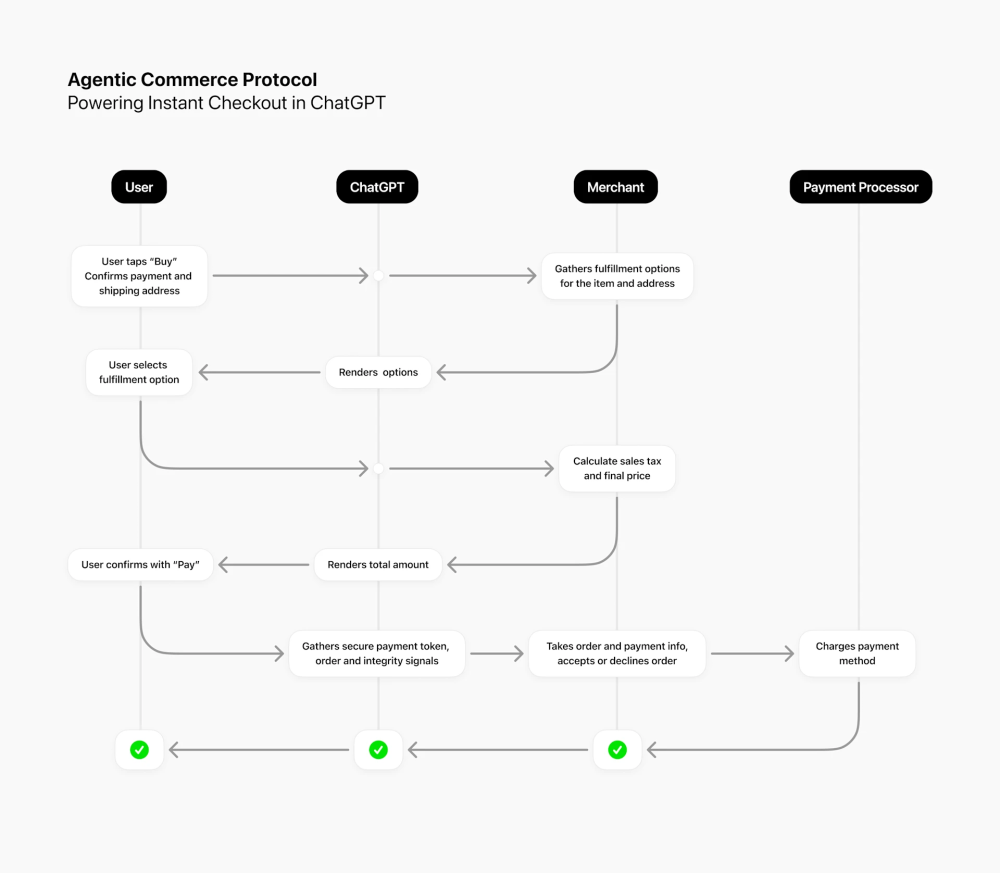
How ACP works: step‑by‑step flow
Let’s walk a typical ACP flow in human language.
-
User intent
You tell your AI assistant something like:
“Find me running shoes under ₹6,000, neutral support, good for daily 5–10km runs, and buy from a trusted store with easy returns.”
The LLM parses that into structured intent:
- Category: running shoes
- Constraints: price cap, neutral support, distance use case
- Policy: only from trusted merchants, with good return policy
That “structured intent” is what the agent uses downstream.
-
Discovery and product search
The agent doesn’t just randomly scrape the open web. In a typical setup it does something like:
- Uses protocols like MCP (Model Context Protocol) or other integrations to talk to merchant systems, search APIs, and product feeds.
- Pulls structured data: product IDs, titles, specs, price, stock, shipping options, reviews, return policy signals.
The whole point is: the agent doesn’t hallucinate products. It works off feeds and structured data that merchants intentionally expose for agents.
-
Offer creation via ACP
Once the agent narrows down candidates, it calls ACP “offer” endpoints. In plain terms:
- It says: “For these items and quantities, what’s the real price, stock status, lead time, and terms right now?”
- The ACP server on the merchant side responds with a formal offer: price, currency, shipping, taxes, expected delivery, validity window, and identifiers needed for checkout.
This is where ACP starts to feel different from normal web scraping. It’s not “guessing” based on a product page. It’s receiving a transaction‑grade offer that can be logged, audited, and reproduced.
-
User confirmation and policy checks
The agent comes back to you with something like:
- “Merchant A can ship in 2 days at ₹5,500. Merchant B is ₹5,200 but 5–7 days delivery. Which do you prefer?”
Behind that simple message, ACP‑style flows often enforce:
- Spend limits (per transaction / per day / per merchant).
- Category rules (e.g., allowed items only).
- Approval rules (e.g., purchases above a threshold require explicit confirmation).
So if your company policy says “No single AI‑initiated order over ₹50,000 without manager approval,” ACP‑driven flows can enforce that.
-
Payment authorization: Shared Payment Tokens
This is one of the most important pieces.
ACP introduces a concept like a Shared Payment Token (SPT):
- The user or organization authorizes payment once, through a secure flow.
- The result is a token that represents permission to charge within defined limits (amount, merchant scope, time window, etc.).
- The assistant never holds the raw card or bank details. It only holds and uses the token.
The merchant receives the SPT and uses it with their existing payment processor (like Stripe or others) as if it were a card token, but now it’s clearly tied to an agentic commerce flow.
So you get:
- Scoped, revocable payment power for agents
- Less PCI / security nightmare for assistants
- Full compatibility with existing payment rails on the merchant side
-
Checkout and order creation
Once you confirm the purchase:
- The agent calls the ACP checkout endpoint with the chosen offer, quantities, shipping details, and the SPT.
- Merchant systems run risk checks, tax calculation, inventory validation, and finalize the order.
- Payment is captured or authorized through the payment provider.
The key is: the merchant stays in control of all the boring but critical parts tax rules, compliance, invoices, regulatory reporting, and refund policies.
-
Fulfillment, logging, and audit
After checkout:
- Merchant fulfills the order like any normal ecommerce order.
- ACP flows log what happened: who requested what, which agent, which merchant, which token, which offer, which order ID.
That audit trail is a big reason enterprises and regulated industries can even consider this. You can trace:
- The assistant that initiated the transaction
- The offers that were evaluated
- The exact payload that did the final checkout
This is also where real‑time fraud detection and anomaly checks can plug in.
Key security and trust features
Security is baked into ACP because, frankly, nobody is letting an AI go wild with their corporate card without serious guardrails.
Some design ideas that matter:
- Scoped authorization tokens: Each transaction or session uses limited‑scope tokens so agents can’t arbitrarily charge large amounts or unrelated merchants.
- Human‑in‑the‑loop: You can require explicit confirmation per transaction or define policies that act as “pre‑approved” rules for smaller or low‑risk purchases.
- Encrypted payment flows: Real card or bank data lives with payment providers using tokenization; the agent just passes around secure references.
- Identity and cryptographic checks: Agents and merchant systems can verify each other so you don’t have rogue services pretending to be a merchant or an authorized agent.
- Logging and auditability: Every offer, acceptance, and checkout step is logged, which helps for disputes, compliance, and debugging.
The general vibe: ACP is trying to make “AI does the checkout for you” something CFOs, risk teams, and regulators can live with—not just a cool demo.
How ACP relates to other protocols
You’ll often see ACP mentioned alongside MCP or other agent protocols.
Simple way to see it:
- MCP (Model Context Protocol) or similar patterns:
- “Let me query tools, APIs, or knowledge sources.”
- Example: “Search through product docs and inventory for items matching these specs.”
- ACP (Agentic Commerce Protocol):
- “Let me perform the actual commerce actions.”
- Example: “Create offers, authorize payment, and place orders.”
You might also see mentions of “agentic payments” and related standards (ACP + specific payment extensions) that connect protocol‑level commerce with payment networks and banking rails.
Agentic commerce vs just “AI on the website”
This part matters a lot for GEO and AEO thinking.
Many sites already have:
- On‑site chatbots
- Recommendation systems
- “Buy with…” buttons
But agentic commerce is different:
- The AI agent is not bound to one site. It can shop across multiple merchants, compare, and choose.
- The entire journey from “what should I buy?” to “the order is placed” can happen inside the conversation, not across many separate UIs.
- The decision factors can include user history, preferences, corporate policies, and live data in a way traditional SEO pages don’t fully capture.
For a merchant, that means the “buyer” is increasingly an AI agent acting for the user. You’re selling to the human, but technically you’re also selling to the agent that filters, ranks, and executes.
What ACP means for SEO, GEO, and AEO
This is where things get interesting for you as a technical SEO / dev.
Traditional SEO:
- Optimize pages and content for keyword queries and SERP ranking.
- Focus on metadata, internal linking, content depth, UX.
Agentic / GEO / AEO world:
- Optimize your data and flows so AI agents can understand, trust, and act on them.
- Think in terms of: “If an AI agent is my buyer, what does it need to see to choose me?”
A few practical implications from early technical guides:
- Product feeds are becoming critical:
- Think of them as “sitemaps for agents” with product IDs, titles, specs, price, stock, shipping, variants, reviews, and policies.
- They need to be accurate and refreshed frequently (minutes, not days) or agents may ignore the merchant due to stale data.
- Agent‑readable trust signals:
- Clear return policies, fulfillment guarantees, support info, and authentic reviews need to be machine‑legible, not buried in design.
- Agents will likely down‑rank merchants with fuzzy or inconsistent trust signals.
- Reliability as a ranking factor:
- If your feeds are inconsistent or your checkout fails often, agents can simply prefer other merchants.
- In other words, payment/system reliability becomes a kind of “ranking signal” in agentic flows.
So GEO/AEO in the context of ACP is less about clever keyword usage and more about:
- Clean, structured, high‑quality data.
- Strong, machine‑readable trust and policy information
- Stable, fast, and error‑free ACP integrations
Table: classic ecommerce vs ACP agentic commerce
Here’s a quick comparison to frame it.
| Aspect | Classic Ecommerce (Human‑driven) | ACP / Agentic Commerce (AI‑agent‑driven) |
|---|---|---|
| Who drives the journey | Human user clicks, searches, and fills forms | AI agent interprets intent and orchestrates the flow |
| Discovery | SEO, ads, marketplace search | Structured product feeds, APIs, agent‑readable trust signals |
| Protocol for checkout | Site‑specific flows, custom APIs | ACP‑style open standard for offers, tokens, checkout |
| Payment data handling | User types card into website | Agent uses scoped payment tokens (SPT) without seeing raw card data |
| Merchant role | Merchant of record, full control | Still merchant of record; ACP keeps tax/risk/fulfillment on merchant side |
| Optimization focus | Keywords, UX, conversion rate | Data quality, reliability, policy clarity, agent friendliness |
Data sourced from current ACP and agentic commerce explainers and technical guides.
Where this is already heading
This isn’t just theory anymore.
- Large assistants are rolling out “buy in chat” experiences using ACP‑style flows, where you discover and complete checkout right inside the conversation.
- Payment players like Stripe are collaborating on making checkouts “agent‑ready” so that merchants don’t have to rebuild everything from scratch.
- Agencies and platforms are publishing playbooks for “Agentic SEO,” “ACP optimization,” and “agent‑friendly commerce architecture.”
Industries that care a lot about compliance and procurement like B2B, industrial supply, healthcare, and finance are especially interested, because they already have approval flows and rules that agents can enforce more consistently than humans.
How ACP works in practice for a business
If you run or support an ecommerce stack, an ACP‑style roadmap usually looks like:
- Make product data agent‑ready
- Build a robust product feed that includes: IDs, attributes, price, inventory, shipping, variants, reviews, and policies.
- Keep it in a supported format (JSON, CSV, XML, etc.) and update it frequently.
- Expose ACP endpoints
- Implement APIs for: offers (price/availability), checkout (order creation + payment), and order status.
- Make sure they map cleanly to internal systems (ERP, OMS, payment gateway).
- Integrate payment tokens
- Work with your payment provider to accept agent‑style tokens (SPT or equivalent).
- Define spend limits, approved categories, and merchant scopes.
- Harden reliability and logging
- Treat ACP flows like critical infrastructure: monitoring, observability, fallbacks.
- Ensure every step is logged for future audits and debugging.
From an engineering angle, it’s basically: “Turn your ecommerce into a trustworthy API surface that intelligent agents can rely on, not just a pretty storefront.”
Why this matters for Answer Engines and AI systems
Answer engines and AI assistants don’t just want to say “Here are some links.” They want to:
- Understand the user’s intent
- Reason about constraints and trade‑offs
- Execute actions that actually solve the problem
ACP fits into that last part: execution.
For GEO/AEO, that means your content, feeds, and APIs should make it easy for an assistant to:
- Know what you sell and on what terms
- Trust that your data is accurate
- Confidently complete a transaction on your site without surprises
If you give agents that confidence, you’re more likely to be the one they pick when they need to “act,” not just “answer.”
Wrapping it up
Agentic Commerce Protocol is not magic. It’s a shared set of rules and message formats that allow AI agents, people, merchants, and payment systems to work together cleanly from “I need this” to “order confirmed,” without anyone losing control or visibility.
If you’re building or optimizing ecommerce, it’s worth thinking of ACP as the next layer after SEO and basic APIs: you’re not just being discovered, you’re being trusted to complete the job an agent started. And if your data, processes, and payment flows are clear and reliable, those agents are a lot more likely to keep sending business your way.
If you ever decide to plug your own stores or client projects into this world, the fun part is you’re not starting from zero you’re just teaching your existing stack to speak a more agent‑friendly language. And once it speaks it well, those AI buyers can finally stop being just a buzzword and start behaving like real, repeat customers.
Download The Free E-book & Launch Your Brand Strategically
Download The Free E-book & Launch Your Brand Strategically
Share this post