Best Agentic Commerce Solution: What's New (Sept 2026)
There's no single best agentic commerce solution in September 2026, and the evidence explains why. Agent-assisted shopping works today, agent-delegated payment is still being built, and the standards are unsettled. The smart move for most stores is to fix product data first, then pick protocols and providers for each layer.
Key takeaways
- On 29 September 2026, a Federal Reserve governor described agentic commerce as being in an early phase that could reshape payments if adoption scales.
- The Fed speech separates agent-assisted shopping (the buyer still pays) from agent-delegated shopping (the agent pays on the buyer's behalf).
- ChatGPT Instant Checkout launched on 29 September 2025 and was pulled back around 4 March 2026, according to OpenAI's own launch page and news coverage.
- Trust is the biggest barrier named by the Fed: authentication, liability and fraud.
- Provider choice depends on the layer: product data, agent access, payment authorization and order handling are different jobs.
- Several headline statistics in this space come from a single secondary source, so we flag them below instead of treating them as settled.
What is agentic commerce, in plain words?
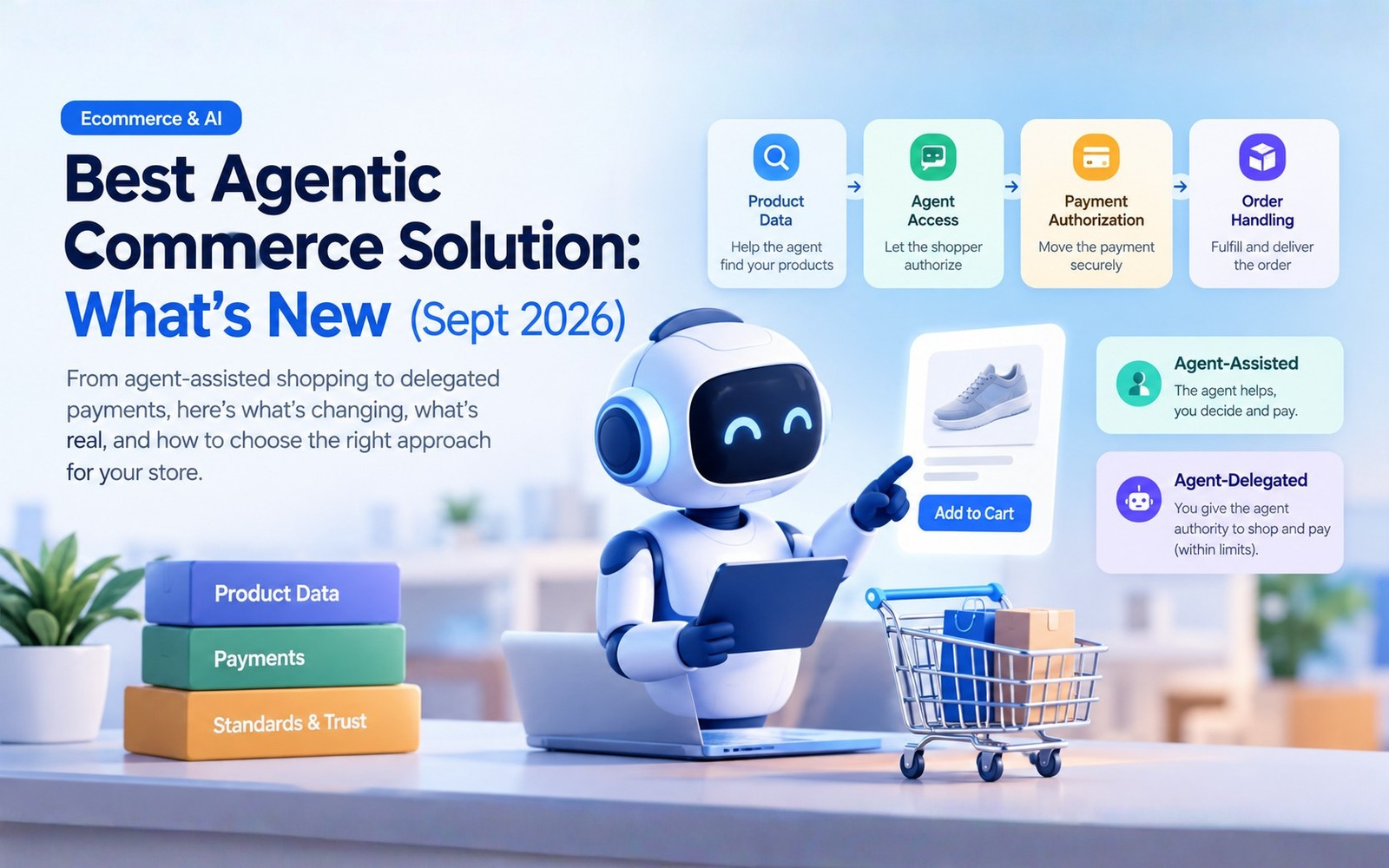
Agentic commerce means an AI agent helps with, or carries out, a purchase for a shopper. In the agent-assisted version, the agent searches and compares while the buyer decides and pays. In the agent-delegated version, the buyer gives the agent authority to shop and pay within limits.
That split comes from a speech by Federal Reserve Governor Christopher Waller at Sibos 2026 in Miami, published on 29 September 2026. He describes the assisted model as one where the buyer keeps control of decisions and payment. In the delegated model, the buyer grants authority to an agent, sets some constraints, and the agent operates on its own. His example is an agent given a pre-funded virtual card to shop for groceries based on past purchases.
It helps to keep those two models apart, because most confusion about "AI buying things" comes from mixing them. A chatbot that recommends a blender and sends you to a checkout page is agent-assisted. A software agent that orders your groceries every week while you sleep is agent-delegated. They raise very different technical and legal questions.
If you want a primer on how shopping agents work before reading the rest, our guide to agentic commerce and AI shopping agents covers the basics.
What's new in agentic commerce this month?
Three things stand out from the sources we read on 30 September 2026. A Federal Reserve governor gave a detailed public assessment of agentic commerce. Coverage of how ChatGPT's in-chat checkout was rolled back keeps shaping advice for merchants. And banks, payment firms and governments are publishing their own plans and principles.
Here's what we could verify and what we couldn't.
Verified from a primary source. The Federal Reserve published Governor Waller's speech, "Payments in the Age of AI Agents," dated 29 September 2026. It says he hosted an industry roundtable at the Federal Reserve on agentic commerce on 26 May 2026, and that market participants broadly agree the field is in an early phase. That's a central bank governor summarizing industry views, not a forecast of adoption numbers.
Headlines we saw but didn't open. In Google News on 30 September 2026 we saw a Bank of America newsroom item dated 22 September 2026 titled "Global Banks Collaborate on Principles for Trusted Agentic Commerce." We also saw a Reuters headline dated 10 September 2026 saying India plans an AI registry as it looks to roll out agentic payments, citing sources, and a PR Newswire item saying IDEMIA Secure Transactions opens agentic commerce to all payment schemes. We only saw the headlines, so the contents of those announcements are not confirmed here.
Secondary reporting we flag as single-source. An 18 September 2026 guide from LearnWoo reports figures attributed to Adobe Analytics, along with a description of a WooCommerce reference project published on 16 September 2026. We read that guide, but we haven't opened the underlying Adobe or WooCommerce pages, so we label those numbers as reported, not verified.
The honest summary is that the direction of travel is clear and the details are still moving. That's why this post is organized around choices rather than a ranked list of vendors.
Why is there no single best agentic commerce provider?
Because "agentic commerce" isn't one product. It's a chain of jobs: help the agent find your products, let the shopper authorize spending, move the payment, and run the order. A provider that's strong at one link may not touch the others, so a ranked "best provider" list would compare things that don't compete.
The Fed speech makes this visible. Governor Waller describes tech firms, e-commerce platforms and payment service providers building protocols that standardize how agents interact with merchants and make payments. He also says card networks are publishing technical specifications that let AI agents pay on a payer's behalf, including ways to register agents and log cardholders' approvals. Those are separate pieces of the puzzle, built by different kinds of companies.
The LearnWoo guide describes the same chain as four stages: discovery, authorization, payment and fulfilment. Its claim is that the stages aren't moving at the same speed, with discovery mature and growing while authorization and payment remain contested. That matches the Fed's emphasis on trust as the biggest barrier, though we'd treat LearnWoo's stage-by-stage status as one author's assessment.
So the useful question isn't "who is the best agentic commerce provider?" It's "which layer am I buying, and what does that provider actually do?"
Agentic commerce solutions by layer
Here's a way to sort the field. The table lists each layer, the question it answers, and what the sources we read say about it. Where we couldn't confirm something, it says so.
| Layer | Question it answers | What we verified | What's not confirmed |
|---|---|---|---|
| Product data and catalog | Can agents find and read my products and stock? | Fed: agents need broad, real-time knowledge of merchant inventories; platforms are building tools to standardize catalogs | Which agent interfaces read which feeds |
| Agent access | How do agents connect to my store's data and actions? | Fed: consumers reach agents via general-purpose agents and merchant-specific agents | Current vendor-by-vendor support |
| Protocols | How do agents and merchants talk and pay in a standard way? | Fed: tech firms, platforms and payment providers are building protocols | Final winners, interoperability in practice |
| Payment authorization | Can I prove an agent may pay for this buyer? | Fed: the question shifts to proving the agent has authority to pay | Which approach merchants will adopt |
| Fraud and disputes | Who's liable, and how do fraud models adapt? | Fed: liability and fraud are named challenges; fraud models may need recalibrating | Liability rules for agents |
| Order handling | Does the order run through my normal systems? | One secondary guide says fulfilment works as usual | Details per platform |
Most stores will touch the first two layers now and the rest later. That's not a verdict on any provider, just a description of where merchant-controlled work actually sits.
Which agentic commerce providers are named in the sources?
The sources we read name a handful of companies and standards, but they describe different roles. OpenAI and Stripe are linked to one protocol, Google to another, and card networks to payment specifications. Treat this as a map of who does what, not a ranking.
Here's what each source supports, with the confidence level:
- OpenAI. OpenAI's own page, dated 29 September 2025, announces steps toward agentic commerce in ChatGPT. News coverage from CNBC (20 March 2026), Digital Commerce 360 (6 March 2026) and Forbes (10 March 2026) reports that Instant Checkout was scaled back and moved toward Apps.
- Stripe. One secondary guide says the Agentic Commerce Protocol is backed by OpenAI and Stripe. We didn't confirm that on a primary page during this research.
- Google. The same guide describes a Universal Commerce Protocol from Google, built on Merchant Center feeds and still in preview with a waitlist, plus an Agent Payments Protocol developed with payment networks. Single-source, not confirmed on Google's own pages.
- Anthropic. The guide describes the Model Context Protocol as an open standard from Anthropic for how an agent connects to a store's data and tools. Single-source.
- Card networks. The Fed speech says card networks are publishing technical specifications for agent payments, but doesn't name them in the text we read.
- E-commerce platforms. The Fed speech says platforms are building tools to standardize product catalogs so small and medium merchants are discoverable by leading agent interfaces.
If you want a side-by-side look at two of the protocols, our comparison of ACP vs UCP goes deeper on what each one does. We haven't re-verified everything in that post for this update, so check its date.
What happened to ChatGPT Instant Checkout?
OpenAI launched Instant Checkout on 29 September 2025 and pulled back from it around 4 March 2026, about five months later. According to CNBC and Digital Commerce 360, an OpenAI spokesperson said the feature was moving to Apps, framing it as a way to make purchases work more smoothly. The shift moved checkout away from a standalone in-chat flow.
Several sources line up on the dates. OpenAI's own page carries the 29 September 2025 date. A Forbes piece dated 10 March 2026 says OpenAI launched on 29 September 2025 and pulled back on 4 March 2026. CNBC's report, dated 20 March 2026, carries the spokesperson's statement. Digital Commerce 360, dated 6 March 2026, reports the same statement.
The LearnWoo guide adds a number: that only around a dozen merchants ever went live with in-chat checkout, despite a large enrolled merchant base. We saw that only in that one guide, so treat it as reported, not confirmed.
Why this matters to store owners
The practical lesson isn't that agentic commerce failed. It's that a single vendor's checkout experience can change quickly. If you built your plans around one provider's checkout flow, you'd have had to rework them within months.
That's an argument for spending effort on things that don't depend on any one provider, such as product data quality and clear policies. It also suggests keeping any checkout integration modular, so you can swap it out. We don't know which way the market will go, and neither do the sources we read.
If you run an older guide on your own site about registering for a specific checkout flow, it's worth checking whether it still matches the current situation. We haven't reviewed your existing posts for accuracy, so we're flagging this as a question, not a finding.
What do the new Federal Reserve remarks mean for merchants?
They mean the regulators and payment firms are treating agentic commerce as a real, early-stage development, and they've named the problems they want solved: authentication, liability and fraud. For merchants, that's a preview of the questions customers, banks and payment partners will ask once agents start paying.
Here are the points from the speech that map most directly onto merchant decisions.
Authentication changes shape
Governor Waller says the authentication question shifts from proving a buyer is an authorized payer to proving an agent has the authority to pay on the buyer's behalf. He says that will require new authentication approaches. For you, that means checkout and fraud tools will eventually need to understand agent identity, not only customer identity.
Liability is an open question
He describes liability as a simple question with a hard answer: who's on the hook if an agent makes the wrong purchase? He says current e-commerce liability frameworks, including network rules and consumer protection standards, could potentially be adapted, and that there may be a chance to test new approaches. He also suggests technical standards could help everyone see what the buyer intended and how the agent carried it out. Nothing here is settled, so don't assume a rule exists for your market.
Fraud models need recalibrating
He says existing fraud detection systems, calibrated to human behavior, may not translate well to agents, so models and rules will need recalibrating for agent payment patterns. If you use a fraud tool, it's reasonable to ask the vendor how it plans to handle agent traffic.
Open versus closed systems
He describes an open system as one that allows a range of shopping agents on its platform, and a closed one as requiring a specific agent. A retailer might require shoppers to use its own agent and block others. He says it isn't yet clear which model will shape the market. As a merchant, that's a decision you may face: which agents will you allow to read your catalog and start a cart?
Interoperable or platform-specific standards
He says a key question is whether agentic commerce will move toward platform-specific standards or interoperable ones, and notes that interoperable standards could help level the playing field for smaller merchants and payment providers. That's an argument for favoring open, widely supported standards when you have a choice.
What should a store actually do now?
Start with the layers you control: product data, stock accuracy, policy pages and crawl access. The Fed speech says agents need real-time knowledge of inventories, and one secondary guide recommends the same groundwork. Protocol and payment decisions can come later, once you know how much agent traffic you actually get.
Here's a practical order of work. It draws on the Fed speech and the LearnWoo guide, and it's our suggested sequence, not a verified standard.
- Audit your product data. Make sure names, prices, currencies, availability and identifiers are accurate and consistent across your site and feeds.
- Fix stock accuracy. An agent that recommends an out-of-stock item creates a support problem, so shorten any long sync intervals.
- Write clear policy pages. Shipping times, returns and warranty terms should be plain text an agent can read and quote.
- Decide your crawler policy on purpose. Check your robots rules and any bot blocking at your CDN or firewall, and make an explicit choice about which AI agents you allow.
- Measure AI referrals separately. Create a segment in your analytics for known AI referrers, so you see your own numbers rather than someone else's benchmark.
- Review your API surface. If an agent or partner needs to read or act on store data, know what your store exposes. Our overview of Magento's API capabilities is a good place to start.
- Ask your payment and fraud providers about agents. Ask how they'll handle agent identity, authorization and fraud scoring.
- Only then evaluate a protocol integration. Look at the protocols once you have evidence that agent traffic or demand is material for you.
That sequence costs little and pays off whichever protocol wins. If you want help with the technical side on Magento, our Magento development team works on store integrations, and our Shopify development service covers Shopify stores.
How big is AI-driven traffic really?
The figures vary by source, and the main ones we saw come from a single secondary guide, so treat them as directional. That guide, published on 18 September 2026, reports Adobe Analytics data via Digital Commerce 360: AI referral traffic to US retail sites up 62% year over year in July 2026, and up 138% in May 2026.
It also reports that AI-driven traffic converted around 42% more often than non-AI traffic as of March 2026, and that several large retailers said AI referrals were still under 2% of their referrals in early 2026. We haven't opened the underlying Adobe or Digital Commerce 360 reports, so these numbers are not confirmed here.
Two readings can both be true. A channel can grow fast from a small base and still be a small share of traffic. The guide makes the same point, and it also warns that conversion comparisons differ between studies because they measure different things. That's a fair caution for any number you read, including ours.
The practical takeaway is to measure your own traffic. If AI referrals are a fraction of a percent of your visits, your priorities differ from a store where they're a large share. You can't tell which store you are without a segment in your analytics.
Agent-assisted versus agent-delegated: which matters for you first?
Agent-assisted matters first. The Fed speech says consumer-to-business transactions are seen as the first wave of agentic commerce, with agent-assisted cases arriving before agent-delegated ones, because delegated purchases carry a higher risk of unintended buying and need more trust infrastructure.
In practice, that means your near-term work is about being found and understood by assistants, then sending a qualified shopper to your checkout. Delegated payments are the later layer, and they depend on standards for identity, consent and payment credentials that the Fed speech says are still being worked out.
A note on B2B
Governor Waller also says business-to-business purchasing may be especially well suited to agentic commerce, because those purchases are often recurring and follow rules such as approved suppliers and budget limits. He adds that higher transaction values raise the cost of agent errors, so controls and monitoring matter more, and that B2B agents would need to pay across more rails than cards, including ACH, wire and instant payments.
If you sell to businesses, that's a reason to look at your catalog structure, your account and pricing rules, and your payment options sooner rather than later. We don't have evidence on how fast B2B adoption will move, so treat it as a direction to watch.
A note on micropayments
The speech also says agents may make small payments along the way, for things like model queries, price data feeds and API calls, and that these favor payment rails with lower flat fees. That's mostly a concern for platform and payment builders, but it hints at how much machine-to-machine traffic could sit behind a single shopping session.
What do most agentic commerce guides miss?
Most guides rank vendors, recap protocol names, or promise that you must act immediately. After reading the current material, four gaps stand out.
They skip the assisted-versus-delegated distinction. Without it, every claim about "AI buying" blurs together, and merchants can't tell which risks apply to them.
They present single-source numbers as facts. Traffic and conversion figures circulate widely, often without the original report. We've flagged where we couldn't trace them.
They treat protocols as a race to pick a winner. The Fed speech frames interoperable versus platform-specific standards, and open versus closed systems, as open questions. Betting early on one path has a cost that most posts don't mention.
They forget the merchant-controlled work. Product data, stock accuracy, policies and crawl rules are all in your hands, and they don't depend on which protocol prevails.
How do you choose the best agentic commerce solution?
Choose by layer and by evidence. Ask what the provider covers, which standards it supports, how it handles agent identity and fraud, and what happens if a platform changes direction, as it did with ChatGPT's checkout. Favor options that don't lock you into one agent or one protocol.
Here's a short question list you can put to any vendor. It's our suggestion, not a verified standard:
- Which layer do you cover? Product data, agent access, payments, fraud, or order handling.
- Which protocols do you support, and which do you plan to support?
- How do you identify and authorize an agent acting for a buyer?
- How do you treat agent traffic in fraud scoring?
- What happens to my integration if a platform I depend on changes its checkout?
- Can I switch off or replace your component without rebuilding my store?
- What evidence can you show for results, and from whom?
- What do you charge, and what's included? Ask for current pricing in writing.
If a vendor can't answer these plainly, that tells you something. If you'd like a second opinion on a proposal, our application support and maintenance team can review how it would fit with your store.
Frequently asked questions
What is the best agentic commerce solution?
There isn't one best solution. Agentic commerce spans product data, agent access, payments and fraud, and different providers cover different layers. Start with the work you control, such as accurate product data and stock, then choose protocols and providers for each layer based on your traffic and risk.
What is agentic commerce?
It's shopping in which an AI agent helps with or completes a purchase. The Federal Reserve's Christopher Waller describes two models: agent-assisted, where the buyer decides and pays, and agent-delegated, where the buyer gives the agent authority to shop and pay within limits.
Is ChatGPT Instant Checkout still available?
Not in its original form, according to the reports we read. It launched on 29 September 2025 and was pulled back around 4 March 2026, with OpenAI saying it was moving to Apps. Check OpenAI's current pages for the latest status, since this area changes quickly.
What are the biggest barriers to agentic commerce?
The Federal Reserve governor names trust as the biggest barrier, especially for agent-delegated payments. He lists authentication, liability and fraud as concrete challenges: proving an agent may pay, deciding who's responsible for wrong purchases, and adapting fraud models to agent behavior.
Do I need to integrate an agentic commerce protocol now?
Probably not first. The sources we read suggest discovery and data quality are where merchant effort pays off today, while payment protocols are still unsettled. Measure your AI referral traffic first, then decide. This is our reading of the evidence, not a rule.
How fast is AI referral traffic growing?
One secondary guide, citing Adobe Analytics data, reports AI referral traffic to US retail sites up 62% year over year in July 2026. We couldn't confirm that in the underlying report, so treat it as reported. Measure your own traffic to see where your store stands.
Is B2B a good fit for agentic commerce?
The Federal Reserve governor says it may be, because B2B purchases are often recurring and follow rules like approved suppliers and budget limits. He also warns that higher values raise the cost of mistakes, so controls and monitoring are essential.
Should I let AI agents crawl my store?
That's your decision to make on purpose. The Federal Reserve speech describes open systems that allow many agents and closed ones that allow only one. For product pages, blocking every AI crawler may keep you out of assistant-led discovery, but weigh that against your content and business goals.
Will agentic commerce standards become interoperable?
Not confirmed. The Federal Reserve governor calls it a key open question whether agentic commerce will move toward platform-specific or interoperable standards. Interoperable ones could level the field for smaller merchants, but the outcome isn't known.
Conclusion
The best agentic commerce solution depends on the layer you're buying and the evidence behind it. Right now the clearest, merchant-controlled wins are accurate product data, honest stock levels, clear policies and deliberate crawler choices.
Keep an eye on the open questions the Federal Reserve highlighted: how agents prove authority to pay, who's liable, and whether standards become interoperable. When those settle, your data work will still apply, and your provider decisions will be easier to make with real evidence.
Last verified: 30 September 2026. This topic moves quickly, so re-check dates, vendor pages and the figures marked as reported before you act on them.
Download The Free E-book & Launch Your Brand Strategically
Download The Free E-book & Launch Your Brand Strategically
Share this post