

Agentic Commerce: How to Make Your Store Sellable to AI Shopping Agents
Introduction
Shopping is changing. Instead of typing a query into Google and clicking through ten tabs, more consumers are simply telling an AI assistant what they want — and letting it find, compare, and even buy the product for them. This shift is called agentic commerce, and it’s rewriting the rules of ecommerce visibility.
If your store isn’t structured for AI agents to read, understand, and trust, you risk becoming invisible in the next generation of shopping — even if you rank well on Google today.
TL;DR Summary
- Agentic commerce means AI agents shop, compare, and check out on a customer’s behalf.
- AI shopping agents rely on structured data, not just keywords, to understand products.
- Open protocols — OpenAI and Stripe’s Agentic Commerce Protocol (ACP) and Google’s Universal Commerce Protocol (UCP) — now let agents browse and buy directly inside ChatGPT and Gemini.
- Winning stores have clean product schema, accurate feeds, real reviews, fast pages, and clear pricing/inventory data.
- Optimizing for AI agents also improves traditional SEO, since both reward clarity and trust.
What Is Agentic Commerce?
Agentic commerce is the process by which AI agents — not humans directly — search for, evaluate, and purchase products on a shopper’s behalf. The agent acts as an intermediary between the customer’s intent (“find me a durable, affordable stand mixer”) and the merchant’s catalog.
Rather than a person browsing a website, an AI system interprets the request, queries multiple retailers, compares attributes and prices, and can complete checkout — sometimes without the shopper ever visiting the store’s site.
What Are AI Shopping Agents?
AI shopping agents are conversational assistants — such as ChatGPT, Gemini, Perplexity, and Microsoft Copilot — that can discover products, answer questions about them, and in many cases complete a purchase. Some, like Amazon’s Rufus, operate inside a single marketplace; others, built on open protocols, can shop across many merchants at once.
Direct-answer summary: An AI shopping agent is software that shops for a human, using natural-language understanding to interpret intent and structured product data to find matching items.
How AI Shopping Agents Work
Most agents follow a similar pipeline:
- Intent parsing — the agent interprets what the shopper actually needs, including implicit constraints like budget or urgency.
- Retrieval — the agent queries merchant feeds, product schema, and sometimes a retailer’s own commerce API using retrieval-augmented generation (RAG) or vector search over embeddings.
- Ranking and comparison — products are scored on relevance, price, reviews, and availability.
- Presentation or checkout — the agent either recommends items or, where a checkout protocol is integrated, completes the transaction directly.
This is a major shift from traditional SEO, where a human reads a results page. Here, the “reader” is a model deciding what to recommend — and it needs machine-readable signals to do that reliably.
Why Agentic Commerce Matters for Online Stores
Momentum is real, not hypothetical. ChatGPT already lets U.S. shoppers buy directly from Etsy sellers, with Shopify’s roughly one million merchants set to follow, while Microsoft Copilot Checkout is live with Shopify, PayPal, Stripe, and Etsy. Analysts expect AI platforms to drive close to $21 billion in retail spending in 2026 — nearly four times the prior year’s figure.
Two open standards are driving interoperability: OpenAI and Stripe’s Agentic Commerce Protocol has been live in ChatGPT since September 2025, while Google’s coalition-backed Universal Commerce Protocol, announced in January 2026, is arriving in Google Search’s AI Mode and Gemini. Most brands will ultimately need to support both, since ACP favors conversational discovery and UCP captures high-intent search queries. Notably, Amazon has not joined either protocol and instead builds proprietary agents like Rufus, Alexa+, and Buy for Me inside its own ecosystem.
If your store only optimizes for human eyeballs, you’re optimizing for half the market that will exist a year from now.
How AI Agents Discover Products
AI agents discover products primarily through:
- Structured product feeds (similar to Google Merchant Center feeds)
- Schema.org markup, especially Product, Offer, and Review schema
- APIs exposed via commerce protocols (ACP, UCP)
- Crawled web content, when structured data is missing or incomplete
- Third-party data, like review platforms and price-comparison sites
Stores that expose clean, consistent data across all of these channels are far more likely to be surfaced accurately.
Key Elements That Make Your Store AI-Ready
Structured Data
Schema markup is the backbone of machine-readability. Without it, an agent has to guess.
Product Schema
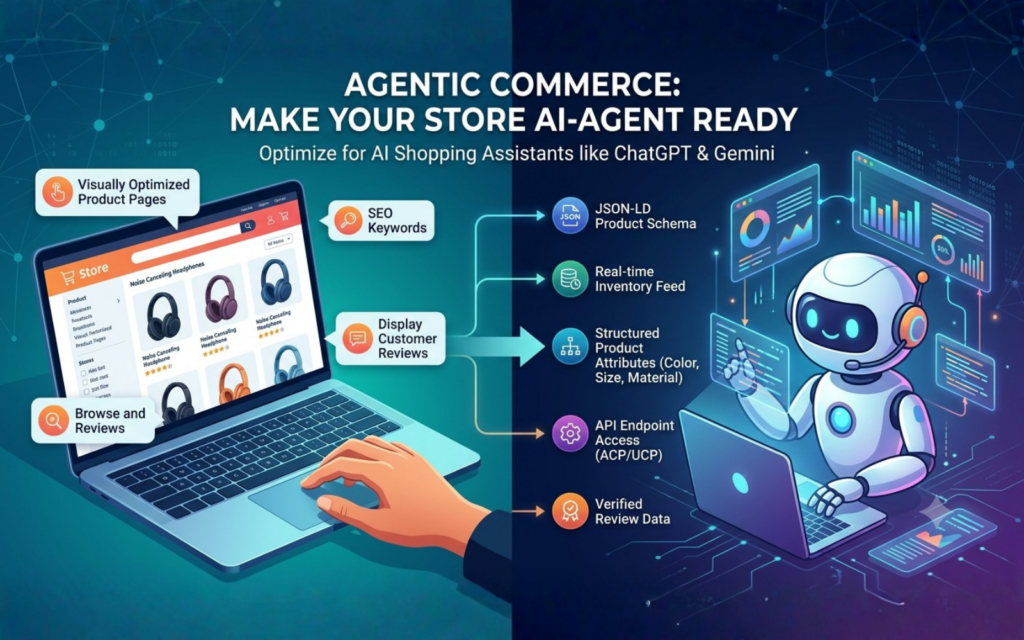
Use JSON-LD Product schema with accurate name, brand, SKU, GTIN, price, availability, and rating fields.
Merchant Feeds
Keep your Google Merchant Center or platform feed synced in real time — stale feeds cause agents to recommend out-of-stock or mispriced items.
Product Metadata
Attributes like size, material, color, and compatibility should be explicit fields, not buried in a description paragraph.
Customer Reviews
Reviews are a major trust signal for both ranking algorithms and AI agents evaluating credibility.
Product Images
High-resolution, multi-angle images with descriptive alt text help both accessibility and AI image understanding.
Pricing & Inventory
Real-time accuracy prevents an agent from recommending something it can’t actually buy.
Site Performance
Slow pages hurt crawlability and the reliability of any live API calls an agent makes.
Content Quality
Clear, factual product descriptions written for humans also happen to be easiest for models to parse.
Trust Signals
Secure checkout, transparent return policies, and business verification build the E-E-A-T signals both Google and AI systems weigh.
Technical SEO for AI Shopping
- Implement Product, Offer, Review, and FAQ schema in JSON-LD
- Ensure server-side rendering or pre-rendering so content isn’t hidden behind JavaScript
- Maintain a clean, crawlable site architecture with logical product taxonomy
- Submit and regularly refresh your merchant product feed
- Expose an API endpoint compatible with emerging protocols like ACP or UCP where feasible
Content Optimization for AI Commerce
- Lead product pages with a one-sentence, snippet-ready definition of what the product is and does
- Answer common buyer questions directly within the page (FAQ format)
- Use natural, conversational phrasing that matches how people talk to voice assistants
- Avoid vague marketing language in favor of specific, verifiable facts
Best Practices to Make Your Store Sellable to AI Shopping Agents
- Publish accurate, complete structured data across every product.
- Keep feeds and inventory synced in near real time.
- Encourage and display genuine customer reviews.
- Write clear, factual product copy — skip the fluff.
- Monitor emerging protocols (ACP, UCP, MCP) and adopt integrations early.
- Test how your products actually appear when queried inside ChatGPT, Gemini, and Perplexity.
Common Mistakes to Avoid
- Missing or incomplete schema markup
- Outdated pricing or inventory feeds
- Thin product descriptions with no specifications
- No review strategy, or fake/incentivized reviews
- Ignoring page speed and mobile experience
- Treating AI agents as a future problem instead of a current one
AI Commerce Checklist
- Product schema implemented sitewide
- Merchant feed synced and error-free
- Reviews visible and schema-tagged
- Pricing and stock updated in real time
- FAQ content added to key product pages
- Site speed optimized (Core Web Vitals passing)
- Tested visibility inside at least one AI shopping assistant
Future of Agentic Commerce
The infrastructure is still maturing. Executives at Google, OpenAI, Stripe, and Walmart describe the technology as months — not years — from a genuine tipping point, even as one analyst notes that “nobody has figured it out, but everyone has FOMO”. Expect wider protocol adoption, tighter payment integrations from networks like Visa and Mastercard, and growing pressure on merchants to maintain machine-readable catalogs alongside their human-facing storefronts.
Frequently Asked Questions
What is agentic commerce in simple terms?
It’s AI agents shopping and buying on behalf of a human customer, based on natural-language requests.
Do I need to support both ACP and UCP?
Most multi-channel merchants will eventually need both, since they serve different discovery patterns and different AI platforms.
Does agentic commerce replace SEO?
No — it builds on the same foundation of structured, trustworthy, well-organized content, extended with machine-readable data.
How do reviews affect AI shopping agents?
Agents use reviews as a trust and quality signal, similar to how they influence human purchase decisions.
Is Amazon part of these open protocols?
Not currently — Amazon is developing its own proprietary agents rather than joining ACP or UCP.
Final Conclusion
Agentic commerce isn’t a distant trend — it’s already routing real purchases through ChatGPT, Gemini, and Copilot. Stores that invest now in structured data, accurate feeds, genuine reviews, and clear content will be the ones AI agents recommend — and buy from — first.