ACP vs UCP: Comparing the Two Leading Agentic Commerce Protocols
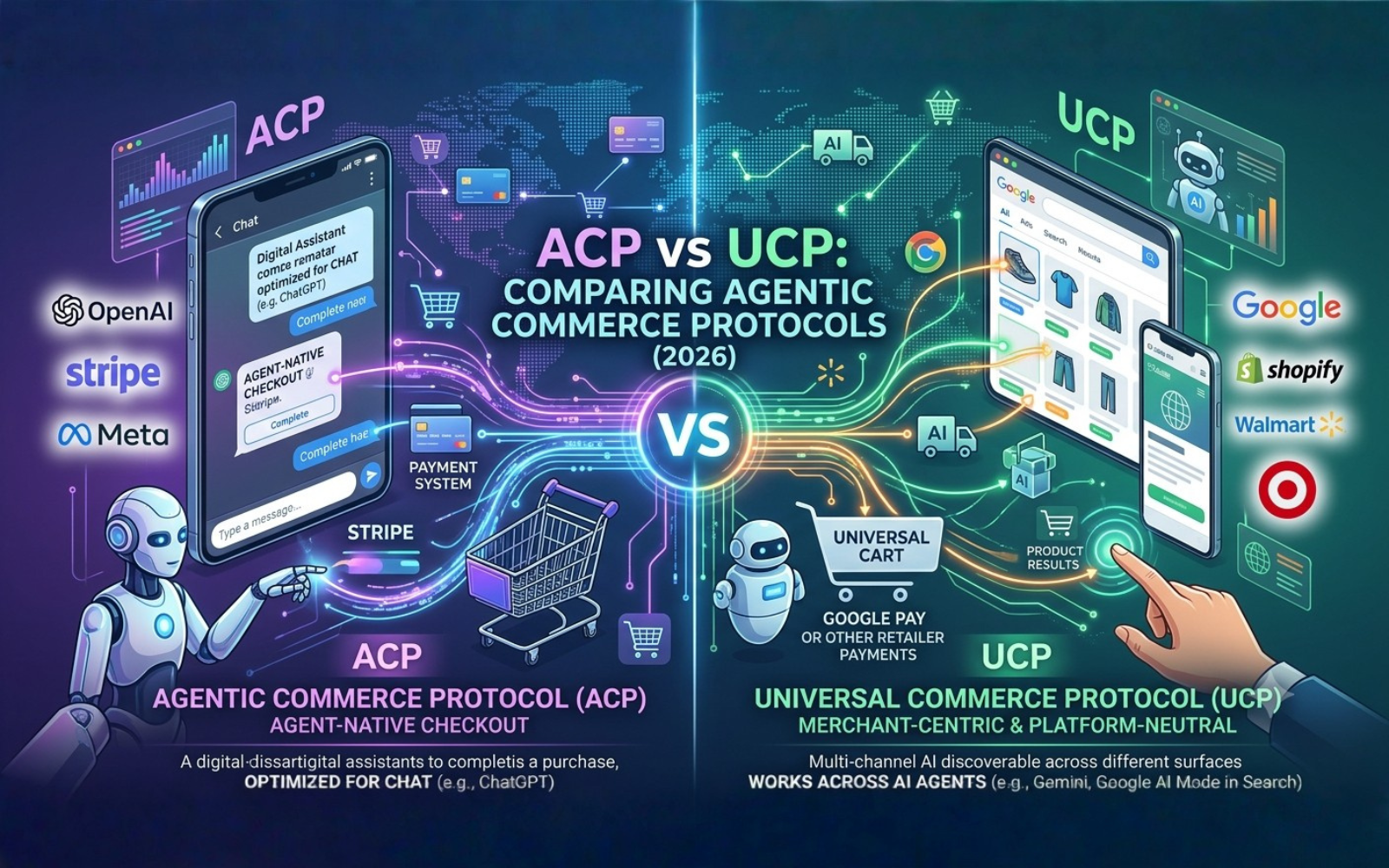
The Agentic Commerce Protocol (ACP) is an open standard co-developed by Stripe and OpenAI that lets AI agents complete purchases inside conversational interfaces like ChatGPT. The Universal Commerce Protocol (UCP) is an open standard led by Google, built with Shopify, Target, Walmart, and other retailers, that standardizes discovery, checkout, and post-purchase flows across any AI surface, including Gemini and AI Mode in Search.
TL;DR Summary
- ACP launched first (2025), grew out of Stripe and OpenAI's payments partnership, and is optimized for agent-native buying inside ChatGPT.
- UCP launched later, is Google-led, and is built to be merchant-centric and platform-neutral — designed to work across many AI agents, not just one.
- Both protocols cover product discovery, checkout, payments, and order management, and both are open source under permissive licenses.
- Neither has "won" — many large merchants (Shopify, Etsy, Walmart, Target) support both, since they solve overlapping but distinct problems.
- Developers should choose based on where their customers are shopping (ChatGPT vs. Google surfaces) rather than picking a single "winner."
What is ACP?
The Agentic Commerce Protocol is an open standard created by Stripe, OpenAI, and Meta that defines how AI agents interact with businesses to complete purchases on behalf of buyers. It first powered Instant Checkout in ChatGPT, letting US shoppers buy from US Etsy sellers and, soon, over a million Shopify merchants directly in chat.
Key Takeaway: ACP is agent-first. It was designed so a business already accepting Stripe payments could enable agentic checkout with minimal code changes, while still owning the customer relationship and fulfillment.
ACP is an open standard for AI commerce that lets AI agents, people, and businesses work together to complete purchases, and OpenAI has open-sourced the underlying technology so other merchants and developers can build integrations. Any AI agent can call an ACP-enabled checkout, and businesses can choose to accept or decline transactions on a per-agent, per-transaction, or custom-logic basis. ACP is open source and community-designed under the Apache 2.0 license.
What is UCP?
The Universal Commerce Protocol is a new open standard for agentic commerce that enables agents and systems to work together across the commerce ecosystem, from discovery and buying to post-purchase support. It's an open-source protocol by Google and partners built to ensure secure, seamless shopping across consumer surfaces.
Key Takeaway: UCP treats the merchant, not the AI platform, as the source of truth. Retailers publish a machine-readable profile declaring which capabilities, extensions, and payment handlers they support, and agents discover these profiles and negotiate based on what both sides can handle.
UCP is compatible with existing industry protocols like Agent2Agent, Agent Payments Protocol, and Model Context Protocol, and was co-developed with Shopify, Etsy, Wayfair, Target, and Walmart, with endorsements from Adyen, American Express, Mastercard, Stripe, Visa, and others. Google's new Universal Cart works across retailers and across Search, Gemini, and other services, letting shoppers check out with Google Pay in a few taps or transfer items to a merchant's own site to finish the purchase.
Why AI Agents Need Commerce Protocols
Traditional e-commerce assumes a human clicking through a web page. Agentic commerce needs a different contract: agents must discover products, verify pricing, prove consent, and complete payment programmatically — without a browser session. Without a shared protocol, every AI platform would need a custom integration with every merchant, multiplying engineering cost. Both ACP and UCP exist to remove that N×N integration problem.
ACP Architecture Explained
ACP defines a checkout flow where the merchant's backend receives a structured order object from the AI agent. The merchant can accept or decline the order, charge the payment method, calculate and remit sales tax, and handle fulfillment and returns as they normally would. Payment credentials move through a Shared Payment Token, so a Stripe merchant can enable agentic payments in as little as one line of code, while non-Stripe merchants can still participate using that token API or an equivalent.
UCP Architecture Explained
UCP uses a layered, capability-based design. Agents discover a business's capabilities, invoke checkout, and can even apply a discount at the checkout request; UCP also supports identity linking and order management. This separation of concerns means the protocol can evolve without breaking existing integrations — a merchant can add subscription support through an extension without touching core checkout code. On the payments side, UCP's open, modular payment-handler design gives interoperability and choice of payment method, with every authorization backed by cryptographic proof of user consent.
ACP vs UCP: Key Differences
ACP and UCP represent two philosophies for agentic commerce: ACP optimizes for agent-native buying within the OpenAI ecosystem, while UCP optimizes for merchant control across any AI platform.
| Dimension | ACP | UCP |
|---|---|---|
| Led by | Stripe & OpenAI (with Meta) | Google, with Shopify, Target, Walmart, and others |
| Primary surface | ChatGPT | Gemini, Google AI Mode in Search |
| Design philosophy | Agent-native checkout | Merchant-centric, platform-neutral |
| Payments model | Shared Payment Token via Stripe or compatible PSPs | Modular payment handlers (Google Pay, Shop Pay, regional processors) |
| Compatibility | Works with any compatible PSP | Compatible with A2A, AP2, MCP |
| License | Apache 2.0 | Apache 2.0 (open source) |
| Scope | Discovery-to-checkout, fulfillment via merchant | Full lifecycle: discovery, checkout, identity, orders, post-purchase |
Security and Authentication Comparison
Both protocols push authentication and fraud decisions to the merchant or payment processor rather than the AI platform. ACP relies on the payment processor's existing fraud tooling (e.g., Stripe Radar) plus per-agent accept/decline rules. UCP layers cryptographic proof-of-consent on top of its capability negotiation, so every transaction carries verifiable evidence that the user authorized it — useful for disputes and compliance across multiple payment handlers.
Merchant and Developer Experience
For a merchant already on Stripe, ACP is close to a plug-in: minimal code, existing fraud and tax tooling reused. For a merchant wanting to reach multiple AI surfaces (Google, and potentially others) without re-implementing checkout for each one, UCP's capability-profile model reduces long-term integration overhead, at the cost of a more involved initial setup.
Enterprise Use Cases
- Retail marketplaces: Etsy and Shopify merchants selling through ChatGPT via ACP.
- Search-driven discovery: Nike, Sephora, Target, Ulta, and Wayfair testing UCP-powered checkout inside Google Search and Gemini.
- Cross-platform brands: Large retailers adopting both protocols to avoid being locked into a single AI ecosystem.
Advantages of ACP
- Fast path to production for existing Stripe merchants
- Backed by ChatGPT's large, active user base
- Simple, transaction-focused scope
Advantages of UCP
- Vendor-neutral, works across multiple AI agents and platforms
- Broad merchant and payment-network backing
- Covers the full journey, including post-purchase and identity
ACP vs UCP: Which Should You Choose?
Checklist for developers:
- Are most of your customers discovering products through ChatGPT? → Start with ACP.
- Do you need one integration that works across Google Search, Gemini, and future agents? → Start with UCP.
- Are you already processing payments with Stripe? → ACP integration is faster.
- Do you need multi-payment-provider flexibility (Google Pay, regional processors)? → UCP is more flexible.
- Can you support both? → Many large merchants are adopting both protocols in parallel.
Common Challenges
- Fragmentation risk: merchants may need to support multiple protocols as more AI platforms launch their own.
- Fraud and chargeback questions in agent-initiated purchases are still maturing.
- Analytics gaps: transactions completed inside chat interfaces bypass traditional web analytics, complicating attribution.
Future of Agentic Commerce
Expect continued convergence: both protocols already interoperate with adjacent standards like MCP and A2A, and payment networks (Mastercard, Visa, Stripe) support both ecosystems. Long term, agentic commerce likely settles into a small number of interoperable standards rather than one winner, similar to how the web supports multiple payment and identity standards today.
Frequently Asked Questions
Is ACP or UCP better?
Neither is universally better — ACP suits ChatGPT-first commerce, UCP suits merchants wanting reach across multiple AI platforms.
Can a merchant support both ACP and UCP?
Yes, and several major retailers already do.
Do these protocols replace normal checkout pages?
No — both route orders to the merchant's existing backend, payment processor, and fulfillment systems.
Are ACP and UCP open source?
Yes, both are released under open licenses (Apache 2.0) with public specifications.
Final Conclusion
ACP and UCP both solve the same underlying problem — letting AI agents buy things on a shopper's behalf — but from different starting points: ACP from the ChatGPT/Stripe payments relationship, UCP from Google's merchant-and-retailer coalition. Rather than betting on a single winner, most businesses will benefit from understanding both and integrating with whichever protocol matches where their customers are already chatting.
Download The Free E-book & Launch Your Brand Strategically
Download The Free E-book & Launch Your Brand Strategically
Share this post