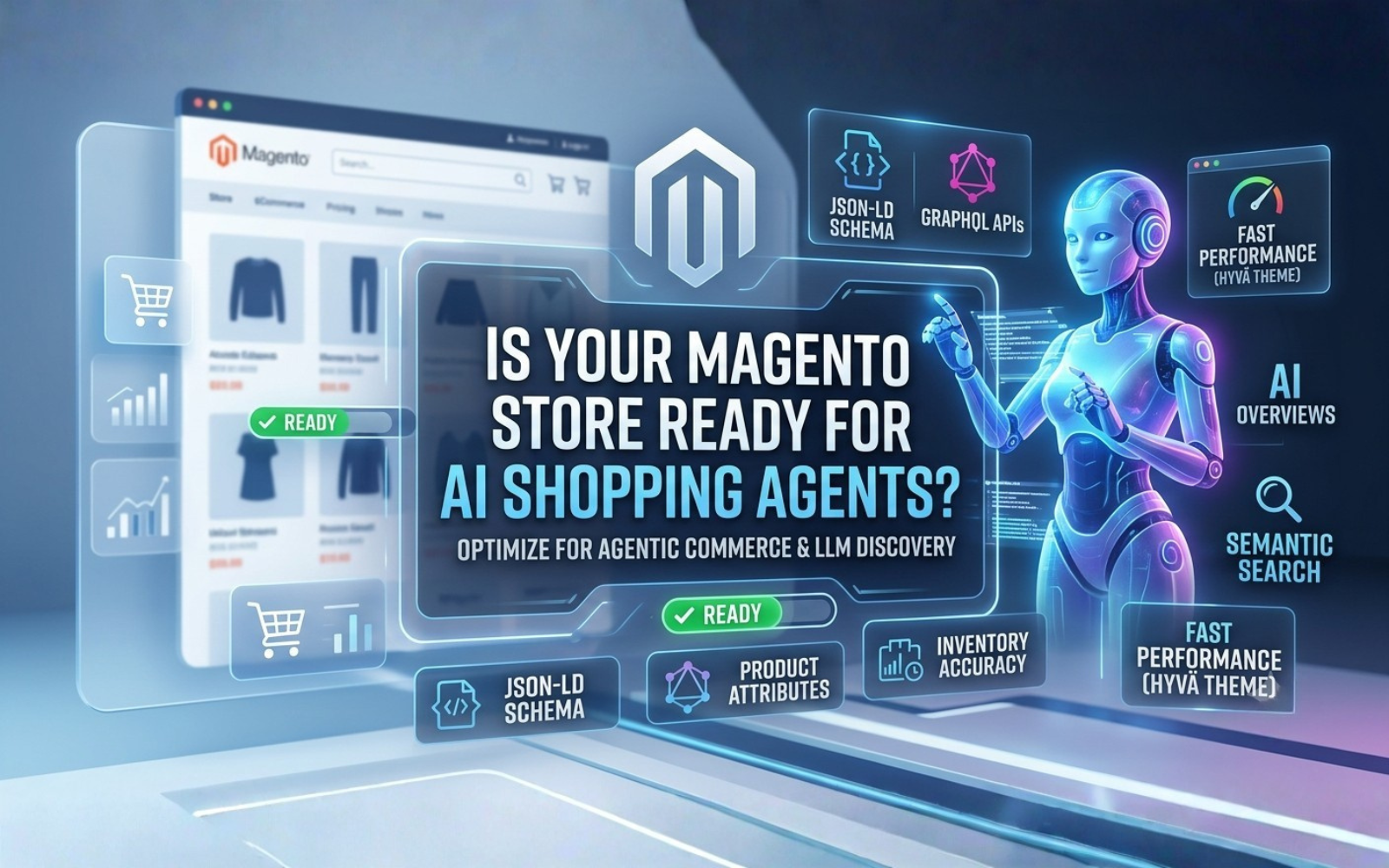
Is Your Magento Store Ready for AI Shopping Agents?
The landscape of eCommerce is undergoing a paradigm shift. We are rapidly transitioning from an era where human consumers manually browse category pages to an era dominated by agentic commerce. In this new ecosystem, autonomous AI software assistants execute searches, evaluate options, and complete purchases on behalf of users.
For enterprise merchants running Magento Open Source or Adobe Commerce, this shift completely transforms the discipline of search engine optimization. It is no longer enough to optimize exclusively for human eyes and traditional Google algorithms. Today, you must make your digital storefront visible, intelligible, and trusted by Large Language Models (LLMs) and autonomous AI buying assistants.
This comprehensive guide breaks down what it takes to build an AI-ready Magento store, ensuring your product catalog remains discoverable in the age of AI-driven commerce.
TL;DR Summary
- The Shift: AI shopping agents (like ChatGPT Shopping, Perplexity Shopping, and Google AI Overviews) are replacing traditional keyword search by acting as autonomous buyers.
- The Core Requirement: To be discovered by AI agents, Magento stores must move beyond basic HTML scraping. They must provide flawless JSON-LD structured data, hyper-optimized GraphQL APIs, clean product attributes, and high-speed delivery frameworks like the Hyvä Theme.
- Open Source vs. Adobe Commerce: Adobe Commerce offers native, out-of-the-box AI tools via Adobe Sensei, while Magento Open Source requires strategic, custom integrations to achieve the same level of AI readiness.
- Action Plan: Merchants must prioritize inventory precision, feed management via Google Merchant Center, semantic data structure, and API accessibility to prevent being hidden from AI recommendation engines.
What Are AI Shopping Agents?
Definition: An AI shopping agent (also known as an AI buying assistant or autonomous shopping bot) is an AI-powered software application that utilizes Large Language Models (LLMs), semantic search, and tool-use capabilities to discover, evaluate, compare, and purchase products autonomously on behalf of a human consumer.
Unlike traditional search engines that simply return a list of blue links based on keyword matches, an AI shopping assistant parses complex natural language queries (e.g., "Find me a durable, waterproof winter jacket suitable for sub-zero temperatures in Chicago under $300").
[User Query] ➔ [AI Shopping Agent] ➔ [Parses Intent & Context]
                                              │
         ┌────────────────────────────────────┴──────────────────────────────────┐
         ▼                                    ▼                                  ▼
[Scrapes Rich Snippets]             [Queries Product APIs]            [Analyzes Merchant Feeds]
         │                                    │                                  │
         └────────────────────────────────────┬──────────────────────────────────┘
                                              ▼
                             [Evaluates & Ranks Products]
                                              ▼
                             [Delivers Personalized Answer]
These agents programmatically query product catalogs, evaluate technical attributes, read customer reviews, cross-reference real-time pricing, and present a highly curated selection directly to the user within chat interfaces like ChatGPT, Claude, Gemini, and Perplexity.
Why AI Shopping Agents Matter for Magento Stores
Traditional eCommerce relies on the customer journey of searching, filtering, clicking, and browsing. AI-powered shopping collapses this funnel. When a consumer asks an LLM for a product recommendation, the AI agent filters out 99% of available web options, presenting only the top two or three choices.
If your Magento architecture cannot easily feed data to these LLM engines, your brand becomes invisible. Optimizing for Magento AI commerce is not an experimental growth hack; it is foundational structural insurance against zero-click searches and AI-driven product discovery.
As agentic commerce matures, a significant percentage of your store’s traffic will not be humans browsing pages—it will be AI bots programmatically evaluating your catalog via APIs and structured datasets.
How AI Shopping Agents Find and Recommend Products
AI shopping agents do not interact with your website the way humans do. They ingest data through three primary vectors:
- Semantic and Vector Search Caching: LLMs continuously ingest the web. They build multi-dimensional vector maps of product spaces. If your product descriptions lack rich, contextual, and semantic descriptions, they fail to cluster correctly within the LLM's vector database.
- Structured Data Ingestion: Agents crawl websites looking specifically for explicit data arrays, primarily JSON-LD Schema Markup. This provides an unambiguous payload of price, availability, material, and performance ratings.
- Real-Time API Interrogation: Advanced AI agents utilize integration frameworks like the Model Context Protocol (MCP) and developer plugins to query your store's database in real time. They check exact inventory levels and shipping variables through headless endpoints like GraphQL APIs.
Is Magento Ready for AI Commerce?
The short answer is yes, but it requires deliberate optimization.
By default, the core database schema of Magento is highly structured, utilizing an EAV (Entity-Attribute-Value) model. This makes Magento inherently capable of supporting complex, data-rich product relationships. However, out-of-the-box installations often suffer from slow front-end delivery, bloated DOM structures, and unoptimized APIs.
To transform a standard deployment into an AI-ready Magento store, you must systematically optimize how your application exposes data to the automated web.
Essential Requirements for an AI-Ready Magento Store
To secure top placement in AI-generated shopping answers, your Magento environment must satisfy several technical benchmarks.
Structured Data (JSON-LD)
AI engines do not guess. They rely on explicit markup. Your Magento store must output deep, nested JSON-LD schema on every product page. This includes not just the basic name and price, but detailed offers, aggregateRating, brand, mpn, gtin, and specific product attributes like color, size, and material.
Product Feed Optimization
AI engines like Google AI Overviews and ChatGPT Shopping pull heavily from centralized data hubs. Maintaining an accurate, high-fidelity XML and delta product feed linked to Google Merchant Center is critical. If your feed contains conflicting data compared to your live landing pages, AI agents will flag your store as unreliable.
GraphQL APIs
As headless commerce grows, AI agents use specialized tools to interact directly with storefronts. A clean, highly performant GraphQL API allows an AI agent to fetch real-time product configurations, verify stock levels, and estimate shipping costs without parsing heavy HTML layouts.
# Example: Optimized GraphQL query used by AI agents to verify real-time stock and price
query GetProductAiData($sku: String!) {
  products(filter: { sku: { eq: $sku } }) {
    items {
      name
      sku
      price_range {
        minimum_price {
          final_price {
            value
            currency
          }
        }
      }
      stock_status
      meta_description
    }
  }
}
Clean Product Attributes
If your Magento backend classifies a product color as "Midnight Sky" without explicitly mapping it to a standardized parent attribute like "Black" or "Dark Blue," semantic search engines may fail to return your product for users searching for standard color variations. Clean up your EAV attribute sets.
Product Content Quality
Ditch the generic, manufacturer-supplied copy. AI engines perform deep semantic analysis. Write comprehensive, authoritative product descriptions that explicitly address use cases, pros and cons, material compositions, and compliance standards.
Inventory Accuracy
AI buying assistants will not recommend a product if they cannot conclusively verify that it is in stock. Real-time inventory synchronization across your ERP, warehouse management systems, and Magento indexers is foundational for agentic trust.
Merchant Center Integration
Ensure your Google Content API for Shopping is configured correctly. Google’s AI shopping features rely almost exclusively on the real-time processing graph maintained inside the Merchant Center dashboard.
Fast Performance
AI agents operate under strict timeout limits when scanning live pages. If your Time to First Byte (TTFB) or Largest Contentful Paint (LCP) is sluggish, the bot's crawling container will drop the connection and move to a competitor.
Mobile Experience
AI interfaces are overwhelmingly mobile-first or chat-centric. The responsive rendering of your pages must be flawless, light, and optimized for quick resource parsing.
Technical SEO
Ensure your robots.txt file does not accidentally block AI crawlers like GPTBot, PerplexityBot, ClaudeBot, or Google-Extended. You must allow these user-agents access to your product pages and public API endpoints while maintaining appropriate firewalls against malicious scraping.
AI Shopping Agents vs. Traditional Search
| Feature / Metric | Traditional Search (Google Blue Links) | AI Shopping Agents (Agentic Commerce) |
| User Intent Parsing | Strict keyword matching and basic proximity queries. | Deep semantic, contextual, and intent-driven comprehension. |
| Primary Data Source | HTML content, page titles, and backlink profiles. | Structured JSON-LD schema, API endpoints, and data feeds. |
| Result Format | Paginated lists of URLs requiring user clicks. | Direct, single-sentence recommendations or tabular comparisons. |
| Conversion Funnel | Multi-step click-through, manual filtering, manual checkout. | Zero-click discovery, automated evaluation, programmatic checkout. |
| Interaction Style | Passive browsing and transactional searching. | Conversational commerce via interactive, multi-turn dialogues. |
Common Reasons AI Shopping Agents Ignore Magento Stores
Many enterprise Magento deployments are completely invisible to LLM recommendation engines due to critical configuration oversights:
- Broken or Missing JSON-LD: Relying entirely on old Microdata formats embedded in HTML tags rather than a clean, isolated JSON-LD script block.
- Excessive Bot Blocking via Firewalls: Aggressive Web Application Firewall (WAF) configurations (like Cloudflare or AWS WAF) that mistakenly classify legitimate AI crawler user-agents as malicious DDoS threats.
- Lazy Loading Crucial Data: Using client-side JavaScript to load pricing, stock status, or variant attributes. If an AI crawler fetches the raw HTML and finds an empty container, it assumes the information is missing.
- Unmapped Variant Products: Having complex configurable products where simple child products lack distinct GTINs, individual URLs, or unique image attributes.
How to Prepare Your Magento Store for AI Shopping
Follow this step-by-step framework to ensure your store is fully accessible to AI buying systems.
Step 1: Audit and unblock core AI web crawlers in your robots.txt file.
Step 2: Implement full, comprehensive JSON-LD product schema via a dedicated module.
Step 3: Switch to a high-performance frontend like Hyvä to achieve sub-second TTFB.
Step 4: Map all internal product attributes to standardized Google Product Categories.
Step 5: Optimize and test your Magento GraphQL endpoints for speed and payload clarity.
Step 6: Set up real-time delta feed updates to the Google Merchant Center.
1. Configure Open Access for AI Crawlers
Review your robots.txt file. Ensure you are not locking out the engines responsible for generating conversational search answers.
User-agent: GPTBot
Allow: /

User-agent: ChatGPT-User
Allow: /

User-agent: PerplexityBot
Allow: /

User-agent: ClaudeBot
Allow: /

User-agent: Google-Extended
Allow: /
2. Deploy Advanced Structured Data
Do not rely on Magento’s native, basic structural tags. Implement an enterprise-grade SEO extension or custom layout block that renders deep, nested entity schema.
Validate your output using Google’s Rich Results Test and Schema.org’s Validator. Ensure your nested Product entities correctly contain AggregateRating, Brand, and Review arrays.
3. Expose Optimized Headless Endpoints
If you run a decoupled or hybrid architecture, ensure your GraphQL schema is accessible, intuitive, and properly cached. AI agents using the Model Context Protocol (MCP) need to fetch details instantly without triggering heavy database operations that cause server latency.
How Hyvä Theme Helps AI Readiness
Modern AI readiness requires clean, lean, and highly performant code. Traditional Magento frontends (like Luma or complex, script-heavy PWA solutions) often ship with massive DOM sizes, deeply nested <div> wrappers, and megabytes of blocking JavaScript.
This layout bloat hinders AI search engines that crawl and parse live sites.
This is where the Hyvä Theme represents a major competitive advantage for Magento Open Source and Adobe Commerce merchants:
- Drastic DOM Reduction: Hyvä strips out legacy, bloated libraries, reducing the HTML payload size significantly. AI bots can scan, extract, and index text content in a fraction of the time.
- Near-Perfect Core Web Vitals: By achieving out-of-the-box light scores and exceptionally low Time to First Byte (TTFB), Hyvä ensures that live-lookup AI bots do not drop connections due to page performance timeouts.
- Natural Semantic Structure: Hyvä uses standard Tailwind CSS and modern semantic HTML elements out of the box. This clean presentation makes it easy for AI scrapers to correctly parse the page structure when structured data is missing or incomplete.
Adobe Commerce vs. Magento Open Source for AI Commerce
| Feature Set | Adobe Commerce (Enterprise) | Magento Open Source (Community) |
| Native AI Features | Powered by Adobe Sensei (Live Search, Advanced Product Recommendations). | None natively; requires third-party extension integration. |
| Search Capabilities | SaaS-based Live Search featuring automated semantic matching and visual search. | Relies on standard OpenSearch/Elasticsearch (requires manual tuning). |
| B2B Agent Integration | Advanced customer segments, company accounts, and custom price books via native APIs. | Requires extensive customization or custom GraphQL development. |
| Data Feed Pipeline | Integrated Adobe Commerce Product Service for automated cloud data syndication. | Handled via third-party extensions or custom XML feed exports. |
| Implementation Approach | Configuration-driven, cloud-hosted SaaS tools with ongoing support. | Architecture-driven, reliant on custom development and engineering. |
The Future of Agentic Commerce
The evolution of eCommerce will lead to full-circle autonomous transactions. We are moving toward a future where a user’s personal AI assistant negotiates pricing, verifies active warranty policies, checks local inventory via omni-channel endpoints, and securely executes payments using tokenized digital wallets directly inside an LLM interface.
Merchants who invest heavily in clean product data, structured schemas, open API ecosystems, and blistering performance today will become the preferred suppliers for tomorrow’s automated buyers. Those who continue to ignore their store’s underlying technical debt will find themselves cut off from a rapidly growing stream of automated consumer demand.
Frequently Asked Questions
What is the difference between AI shopping agents and traditional SEO?
Traditional SEO focuses on optimizing content rankings for specific keyword terms on search engine results pages to drive human clicks. AI shopping agent optimization concentrates on data structure, clear contextual meanings, and open API connectivity to ensure LLMs correctly interpret, trust, and surface your products directly inside conversational AI answers.
How do I know if ChatGPT or Perplexity is crawling my Magento website?
You can monitor your web server access logs and analyze incoming traffic by filtering for specific User-Agent strings such as GPTBot, ChatGPT-User, PerplexityBot, or ClaudeBot. Additionally, analyzing your referral traffic channels may reveal direct clicks originating from chat interfaces like chatgpt.com or perplexity.ai.
Does Magento Open Source support AI integration?
Yes. Magento Open Source is a highly flexible, open architecture. By utilizing its robust framework alongside modern extensions, headless GraphQL modules, and semantic search tools (like advanced OpenSearch configurations or integrations with platforms like Algolia or Klevu), you can build an AI-ready storefront without enterprise licensing costs.
How does structured data affect zero-click search results?
Zero-click search results occur when an engine answers a query directly on the search page without requiring a click to the website. Providing robust JSON-LD schema ensures that when an AI engine generates a zero-click recommendation summary, your store is accurately credited, cited, and linked as the verified source for that product data.
Can AI agents buy products automatically on Magento?
Technically, yes. If your Magento environment exposes secure, authenticated REST or GraphQL checkout endpoints, an AI agent built with tool-use permissions can add items to a cart, apply customer data, and process payments. Merchants are increasingly building specific API integrations to facilitate these autonomous B2B and B2C transactions.
Final Thoughts
The absolute worst mistake a merchant can make right now is treating AI shopping engines like a passing trend. Agentic commerce is fundamentally reshaping the transactional architecture of the web. If your product catalog remains trapped behind messy code, broken schemas, and slow database queries, AI buying assistants will simply pass you by.
Building an AI-ready storefront requires a deliberate focus on the fundamentals: clean code, fast APIs, detailed schemas, and optimized data feeds.
Download The Free E-book & Launch Your Brand Strategically
Download The Free E-book & Launch Your Brand Strategically
Share this post