How AI Is Transforming eCommerce Stores in 2026
The Intelligent Commerce Revolution Is Already Here
The way people shop online has changed more dramatically in the past two years than in the previous decade combined. Walk into any conversation about digital retail today, and one term dominates everything: artificial intelligence. But this is not the AI of science fiction, nor is it the clunky chatbot that frustrated customers a few years ago. In 2026, AI has become the invisible backbone of nearly every serious eCommerce operation from product discovery to delivery prediction, from pricing engines to fraud detection.
What makes this moment particularly significant is the scale and speed at which adoption has happened. According to a report by Statista, the global AI in retail market was valued at approximately $9.36 billion in 2024 and is projected to grow to $85.07 billion by 2032, reflecting a compound annual growth rate of more than 30 percent. That trajectory was not theoretical. By 2026, businesses of all sizes not just enterprise giants like Amazon and Walmart are deploying AI tools that would have seemed extraordinary just three years ago.
This article breaks down exactly how AI is reshaping eCommerce stores in 2026, with real applications, concrete benefits, and honest context about what these changes mean for retailers and consumers alike.
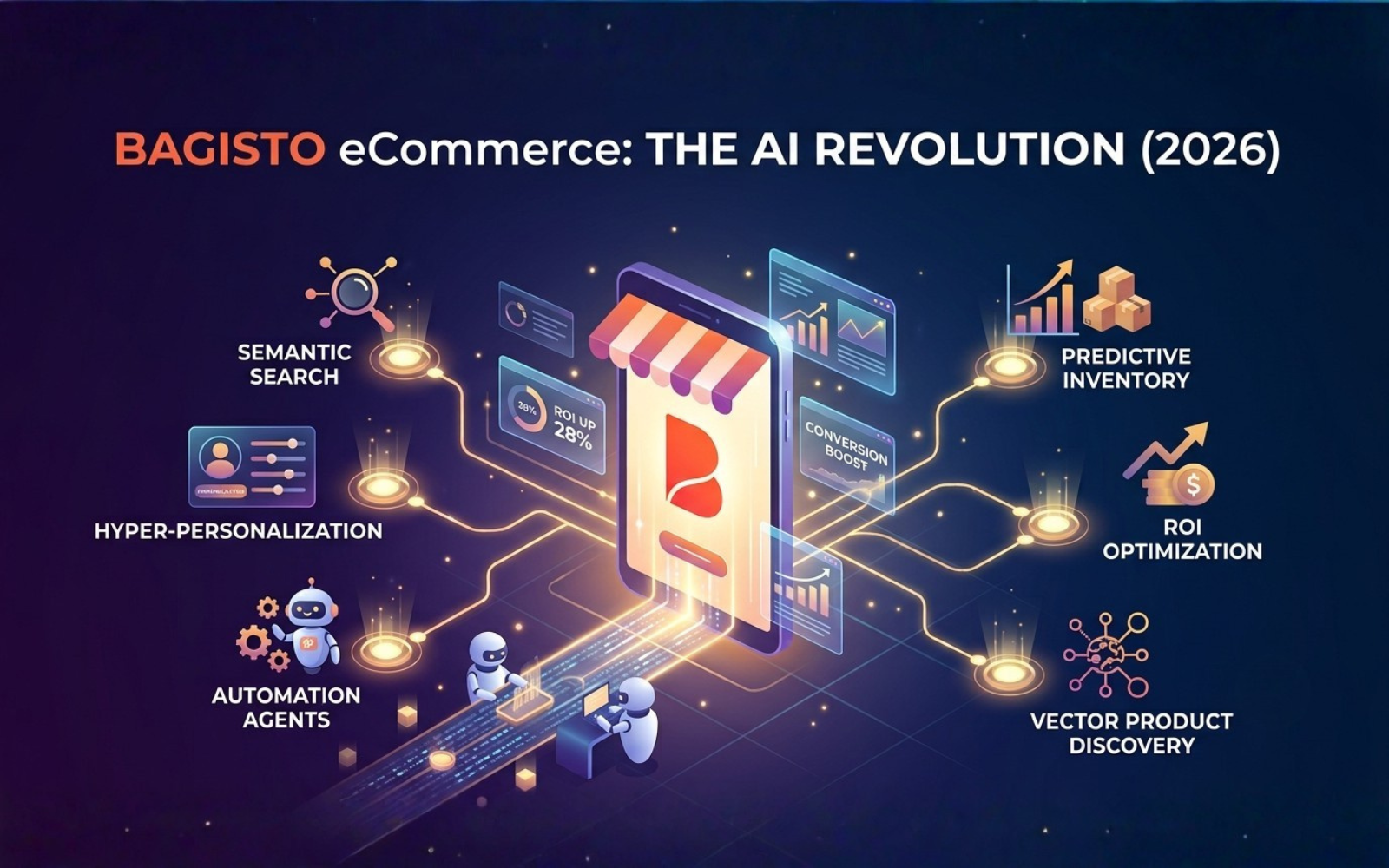
1. Hyper-Personalization Has Replaced Generic Recommendations
Remember when "customers who bought this also bought" felt innovative? That era is firmly in the past. In 2026, personalization has reached a level that feels almost intuitive. AI systems today analyze hundreds of data signals in real time browsing history, time of day, device type, location, previous purchase behavior, social media interactions, and even weather data to serve each shopper a genuinely unique storefront experience.
Companies like Salesforce Commerce Cloud, Dynamic Yield (owned by Mastercard), and Bloomreach are powering these engines for thousands of retailers globally. The results speak for themselves. McKinsey research has consistently shown that personalization can deliver a 10 to 15 percent revenue uplift for eCommerce businesses that implement it correctly.
In 2026, this goes beyond product recommendations. AI personalizes:
- Homepage layouts based on what category a shopper gravitates toward
- Email timing and content based on individual open rate patterns
- Pricing displays that show relevant bundle offers based on past spending habits
- Search results that learn from each query to improve future searches for that specific user
- Push notifications timed to the exact moment a user is most likely to engage
Retailers that have implemented deep personalization report significantly lower cart abandonment rates and higher average order values. This is not coincidental when a platform feels like it understands you, you stay longer and spend more.
2. Conversational AI and Shopping Assistants Have Gone Mainstream
Chatbots of the early 2020s were largely a frustration. They answered basic FAQ questions and little else. In 2026, conversational AI has matured into something genuinely useful. Powered by large language models (LLMs) similar to the technology behind ChatGPT and Google Gemini, modern shopping assistants can hold contextual, multi-turn conversations that guide shoppers through complex purchasing decisions.
Shopify launched its AI assistant "Sidekick" for merchants, while also integrating AI-driven shopping support directly into storefronts. Google Shopping uses generative AI to help shoppers compare products across multiple retailers with natural language queries. Even mid-sized brands have access to tools like Tidio, Gorgias, and Intercom all of which now offer AI agents capable of handling returns, product questions, and order tracking without human intervention.
What makes this meaningful in 2026 is that these systems are genuinely resolving issues, not just deflecting them. According to data from Gorgias, AI agents are now resolving up to 60 percent of customer support tickets automatically for some eCommerce clients, reducing support costs significantly while keeping customer satisfaction scores high.
Additionally, voice commerce has grown steadily alongside this trend. Consumers shopping through smart speakers and AI voice assistants now represent a meaningful revenue stream for retailers who have optimized their product listings for voice search reinforcing why AEO (Answer Engine Optimization) has become a serious priority for digital marketers in 2026.
3. Visual Search and AI-Powered Product Discovery
Text-based search has a limitation: people do not always know what to call what they want. This is where visual AI has become a game-changer. In 2026, visual search technology allows shoppers to upload a photo from Instagram, Pinterest, a screenshot, or their camera roll and immediately find matching or similar products across an eCommerce store.
Pinterest Lens, Google Lens, and platforms like Visenze have pushed visual search into the mainstream. Fashion, home décor, and furniture retailers have seen the greatest adoption, since these categories rely heavily on aesthetics that are difficult to describe in words.
IKEA's visual search tool allows customers to photograph furniture in their home and find similar items in IKEA's catalog. ASOS uses image recognition so shoppers can photograph outfits they see in public and find comparable items within ASOS's inventory. These are not experimental features they are driving measurable conversion improvements.
AI also powers augmented reality (AR) try-on tools, which became standard in beauty and eyewear by 2025 and are rapidly expanding into apparel. L'Oréal, Warby Parker, and Sephora offer AR-powered virtual try-on experiences that reduce return rates a significant cost driver for eCommerce businesses while improving purchase confidence.
4. Dynamic Pricing Powered by Machine Learning
Static pricing is becoming a competitive disadvantage. In 2026, AI-driven dynamic pricing allows eCommerce stores to adjust prices in real time based on demand signals, competitor pricing, inventory levels, time of day, and customer segments.
This practice once limited to airlines and hotel booking platforms is now accessible to mid-market retailers through tools like Prisync, Wiser, and Omnia Retail. These platforms monitor competitor pricing across thousands of SKUs continuously and recommend or automatically apply price adjustments to maximize margin or conversion rate, depending on the retailer's strategy.
Amazon famously changes prices millions of times per day. In 2026, that level of price agility is no longer exclusive to trillion-dollar companies. A retailer selling electronics or sporting goods can compete more effectively because their AI pricing engine responds to market conditions in near real time.
The ethical dimensions of dynamic pricing are also being discussed more seriously. Consumer advocates have raised concerns about price discrimination where different customers see different prices for the same product based on profiling. Regulators in the European Union have begun scrutinizing algorithmic pricing practices, making compliance a key consideration for global eCommerce businesses.
5. AI-Driven Inventory Management and Supply Chain Optimization
One of the most costly problems in eCommerce is inventory imbalance too much stock in the wrong place, or too little of a fast-moving product during peak demand. AI has become the most powerful tool available for solving this problem.
In 2026, predictive inventory systems analyze historical sales data, seasonal trends, social media buzz, economic indicators, and even geopolitical events to forecast demand with remarkable accuracy. Platforms like Blue Yonder, Relex Solutions, and Inventory Planner (popular among Shopify merchants) use machine learning models to reduce stockouts and overstock situations simultaneously.
The impact is substantial. Retailers using AI-powered demand forecasting report:
- Up to 30 percent reduction in inventory carrying costs
- Improved on-shelf availability of fast-moving products
- Fewer markdowns due to excess stock
- Better cash flow management by purchasing inventory closer to actual need
For eCommerce brands that drop-ship or work with multiple suppliers, AI is also optimizing supplier selection and order routing automatically placing orders with the supplier that can deliver fastest at the lowest cost based on real-time availability data.
6. AI Fraud Detection and Cybersecurity
eCommerce fraud remains a serious and growing threat. Card-not-present fraud, account takeovers, return fraud, and bot attacks cost the industry tens of billions of dollars annually. Traditional rule-based fraud detection systems which flag transactions based on static criteria are increasingly ineffective against sophisticated fraud schemes.
AI-powered fraud detection systems, such as those offered by Signifyd, Kount (an Equifax company), and Riskified, use machine learning to evaluate thousands of signals per transaction in milliseconds. These systems identify subtle patterns that no human analyst or rule-based system could catch unusual device fingerprints, behavioral anomalies, velocity patterns, and network connections between fraudulent accounts.
The results are significant. Signifyd reports that merchants using their AI fraud protection experience chargeback rates well below the industry average, while also approving a higher percentage of legitimate orders that older systems would have declined unnecessarily what the industry calls "false positives."
In 2026, AI fraud prevention is not optional for any serious eCommerce business. The sophistication of fraud attacks, now themselves increasingly AI-assisted, makes it a genuine technological arms race.
7. AI-Generated Content and Product Descriptions at Scale
Writing compelling product descriptions for thousands of SKUs has always been a resource-intensive challenge for eCommerce brands. In 2026, generative AI has largely solved this problem. Tools like Jasper, Copy.ai, and Shopify Magic allow merchants to generate high-quality, SEO-optimized product descriptions at scale in multiple languages in a fraction of the time and cost of traditional copywriting.
More sophisticated implementations go further. AI now writes:
- A/B tested ad copy across Google Shopping, Meta, and TikTok
- Personalized email sequences tailored to specific customer segments
- Blog content and buying guides that support organic search rankings
- Product FAQs structured specifically for featured snippets and voice search answers
This last point is particularly relevant to GEO (Generative Engine Optimization) a discipline that has emerged in response to AI-powered search engines like Google's AI Overviews and Bing Copilot, which pull answers from structured, authoritative content rather than simply ranking pages. eCommerce brands that optimize their content for these AI-driven search surfaces are gaining significant visibility advantages in 2026.
8. AI-Powered Logistics and Last-Mile Delivery
The final mile of delivery getting a package from a local warehouse to the customer's door has historically been the most expensive and unpredictable part of eCommerce fulfillment. AI is transforming this segment as well.
Route optimization algorithms from companies like Onfleet, FarEye, and Project44 dynamically calculate the most efficient delivery routes, accounting for traffic, weather, package priority, and driver availability in real time. The result is faster deliveries at lower cost.
At the macro level, AI-powered predictive logistics allows fulfillment centers to pre-position inventory closer to where demand is expected to materialize before the orders are even placed. Amazon has been doing this with its own logistics network, and third-party logistics providers are adopting similar capabilities.
Drone and autonomous vehicle delivery once firmly in the pilot stage is becoming more commercially viable in specific geographies. Amazon Prime Air, Wing (a Google subsidiary), and Zipline have expanded their delivery operations meaningfully by 2026, serving select markets with AI-guided autonomous delivery systems.
What This Means for eCommerce Businesses Right Now
The transformation driven by AI in eCommerce is not coming it is already here and accelerating. For store owners and digital marketers, the practical implications are clear:
Adopt AI tools strategically, not randomly. There are hundreds of AI tools competing for attention, but the most impactful investments tend to be in personalization, customer service automation, and inventory management areas with direct, measurable ROI.
Optimize for AI-powered search. With Google's AI Overviews and other generative AI search surfaces now influencing how shoppers discover products, traditional SEO alone is insufficient. Content must be structured to answer specific questions clearly and authoritatively.
Treat customer data responsibly. AI capabilities depend on data quality. Investing in clean, well-organized first-party data is essential and so is maintaining compliance with privacy regulations like GDPR and the growing number of US state-level data privacy laws.
Think about the customer experience holistically. The most effective AI implementations do not replace human connection they free up human teams to focus on the interactions that genuinely require empathy and creativity, while AI handles repetitive and data-intensive tasks.
Final Thoughts
In 2026, the question is no longer whether AI will transform eCommerce. It already has. The question now is how quickly individual businesses can adopt, adapt, and compete in a landscape where AI-driven personalization, automation, and intelligence have become table stakes rather than differentiators.
The retailers who will lead the next decade are those who view AI not as a cost-cutting gimmick or a marketing buzzword, but as a genuine operational capability one that makes their stores smarter, faster, and more attuned to the needs of real customers. That is what the best eCommerce experiences in 2026 look like, and the bar is only going to rise from here.
Tags
Categories
Download The Free E-book & Launch Your Brand Strategically

Download The Free E-book & Launch Your Brand Strategically
Share this post




Related Posts