What Do UK GDPR and Cookie Consent Rules Require for Magento and Shopify Stores?
Published: September 15, 2026 Last updated: September 15, 2026
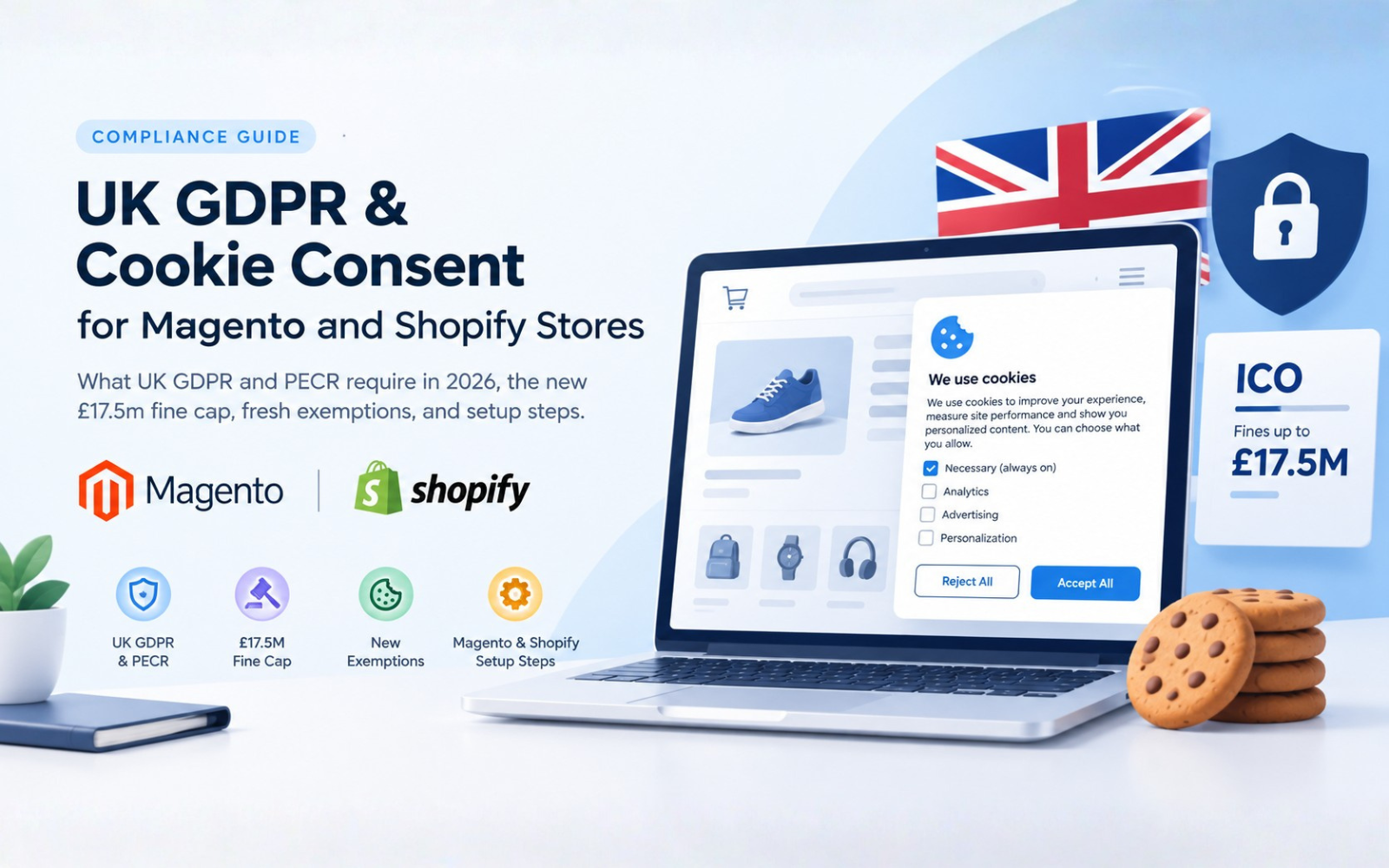
Quick answer: UK ecommerce stores must get clear, opt-in consent before setting non-essential cookies (analytics, advertising, personalization), using a banner with equally prominent "Accept All" and "Reject All" buttons — pre-ticked boxes and cookie walls are non-compliant. Since 5 February 2026, three narrow exemptions (statistical, appearance/functional, and emergency-assistance cookies) no longer require consent, but maximum PECR fines have risen from £500,000 to £17.5 million or 4% of global annual turnover, whichever is higher. Both Magento and Shopify need a dedicated consent management app wired into Google Consent Mode v2 to comply.
Why Does This Matter for Magento and Shopify Merchants Right Now?
UK cookie law sits under the Privacy and Electronic Communications Regulations (PECR), not UK GDPR directly, but the two work together: PECR governs when a store needs to collect consent, while UK GDPR defines what counts as valid consent — freely given, specific, informed, and unambiguous. Both are enforced by the Information Commissioner's Office (ICO). For a Magento or Shopify store, this matters because ecommerce platforms load dozens of third-party scripts by default: Google Analytics, Meta Pixel, TikTok Pixel, review widgets, upsell apps, live chat tools. Most of these count as "non-essential" and legally require consent before they run.
The stakes changed materially in 2026. The Data (Use and Access) Act (DUAA) raised the maximum PECR fine to UK-GDPR levels — £17.5 million or 4% of global annual turnover — a roughly 35-fold jump from the previous £500,000 cap. At the same time, the ICO finalized new guidance on 29 April 2026 that widens the scope of what counts as a regulated tracking technology, moving beyond "cookies" to cover tracking pixels, device fingerprinting, web storage, scripts, and tags generally. A store that only worries about a visible banner but still fires GA4 or a Meta Pixel on page load, before a visitor has made a choice, is very likely non-compliant under current rules.
UK Cookie Consent Rules at a Glance
| Requirement | What it means | Status in 2026 |
|---|---|---|
| Opt-in consent | Users must actively click to agree; no implied consent from browsing | Still required — pre-ticked boxes are invalid |
| Equal prominence | "Accept All" and "Reject All" must be equally visible | Required under ICO's 2026 finalized guidance |
| Granular choice | Separate toggles for analytics, advertising, personalization | A single "Accept All" switch is unlikely to satisfy PECR |
| Cookie walls | Blocking site access unless cookies are accepted | Generally seen as undermining "freely given" consent |
| Consent before load | Cookies must not fire before a choice is made | Consent must come before setting the cookie, not after |
| Statistical cookies (first-party only) | First-party analytics used only to improve the site | Exempt from consent since 5 Feb 2026, if not shared with third parties |
| Appearance/functional cookies | Language, layout, UI preferences | Exempt since 5 Feb 2026 |
| Emergency assistance cookies | Locating a device for safety purposes | Exempt since 5 Feb 2026 |
| Advertising/retargeting cookies | Meta Pixel, Google Ads remarketing, TikTok Pixel | Almost always require prior consent, first- or third-party |
| Maximum fine | Penalty ceiling under PECR | £17.5 million or 4% of global turnover, up from £500,000 |
What Counts as "Strictly Necessary" (No Consent Needed)?
Not every cookie needs a banner click. The "strictly necessary" exemption has always existed under PECR, and the DUAA clarified it further with concrete examples: cookies that automatically authenticate a returning user, cookies that detect technical faults in a service, and cookies used to detect or prevent fraud. For a Magento or Shopify checkout, this typically covers the shopping-cart session cookie, login/authentication tokens, load-balancing cookies, and fraud-prevention cookies used by your payment gateway.
The test is narrower than most merchants assume. Regulators, including the ICO, take the position that the strictly necessary exemption only applies to services the user has explicitly requested — meaning the necessity assessment is made from the shopper's point of view, not the merchant's. In practice: a cookie that keeps a shopper logged in is necessary; a cookie that lets you retarget them with an ad next week is not, even if it feels commercially essential to your marketing plan.
The Three New 2026 Exemptions — And Why They Rarely Cover Ecommerce Tracking
The DUAA added three new no-consent categories, effective 5 February 2026:
- Statistical/analytics cookies — but only where the data isn't used to track individuals across different websites or build behavioral profiles.
- Website appearance and functionality cookies — such as language preference or color-scheme settings.
- Emergency assistance cookies — used to deliver urgent safety information.
These sound like they might let a Magento or Shopify store skip its Google Analytics banner entirely. In practice, the exemption is narrower than it looks. Cookies that serve both an analytics function and an advertising-targeting function do not qualify — mixed-purpose cookies still require consent. Most default GA4 setups feed Google Ads audiences or Smart Bidding, which is an advertising purpose, so they fall outside the exemption and still need a consent click. If analytics data is shared with a third party for that third party's own purposes, consent is still required — and Google typically qualifies as such a third party. Treat the statistical exemption as covering genuinely internal, first-party-only measurement tools, not Google Analytics as most stores configure it.
How Do UK Rules Differ From EU Cookie Law for Cross-Border Stores?
Many Magento and Shopify merchants sell into both the UK and the EU, and it's tempting to assume one banner covers both. The underlying principle is similar — both regimes require opt-in consent for non-essential cookies — but the legal instruments and enforcement bodies are different. UK cookie rules run through PECR as amended by the DUAA and are enforced by the ICO, while EU cookie rules run through each member state's implementation of the ePrivacy Directive and are enforced by that country's own data protection authority (such as the CNIL in France or the Datenschutzbehörde in Austria).
This split matters practically because the UK's new 2026 statistical, appearance, and emergency-assistance exemptions do not automatically apply to EU visitors. A store that geotargets visitors and shows a lighter banner to UK traffic under the new exemptions still needs a fully consent-gated banner for EU traffic, since the ePrivacy Directive hasn't adopted the same carve-outs. Most consent management platforms handle this by detecting visitor location and applying the relevant rule set automatically, but it's worth confirming your chosen app actually does this rather than assuming a single UK-configured banner is sufficient everywhere.
What Should Developers and Agencies Check Before Launch?
Agencies building or maintaining Magento and Shopify storefronts are increasingly exposed under the DUAA's wider liability rules, since the Act now covers organizations that "instigate" tracking even if they don't directly control the site. Before handing a store back to a client, it's worth running through a short technical checklist rather than relying on the CMP app alone:
- Confirm every marketing pixel (Meta, TikTok, Pinterest, Snapchat) is registered in the tag manager and gated behind the same consent trigger as Google's tags, not hardcoded separately into the theme.
- Check that server-side tracking setups (increasingly common for Shopify stores chasing better attribution) still respect the same consent state as client-side tags — a server-side container that ignores consent signals defeats the purpose of the banner.
- Verify that the cookie policy page auto-updates, or is manually reviewed, whenever a new app or script is added, since a stale policy that doesn't match the live cookie list is itself a compliance gap.
- Test the banner and tag behavior in an incognito browser session for both UK and EU IP ranges to confirm geotargeted logic is firing the intended rule set.
- Confirm consent logs are actually being written somewhere retrievable — many free-tier apps cap log retention at 30 days, which may not be long enough to satisfy an ICO request during an investigation.
Typical Cost of Cookie Consent Tools for Magento and Shopify
Budget varies significantly by platform and by how much of the consent logic you want handled automatically versus configured manually. Shopify merchants can start with a free banner app and reach reasonable compliance for a small store within an hour, while Magento merchants should expect to budget for both an extension license and developer time to wire it correctly into an existing GTM setup.
| Store size | Shopify option | Typical cost | Magento option | Typical cost |
|---|---|---|---|---|
| Small (under 1,000 sessions/mo) | Free banner app | £0–£5/month | Free/open-source module | Developer time only |
| Mid-size store | Premium CMP with Consent Mode v2 | £15–£50/month | Paid extension (e.g., Consent Mode v2 module) | One-time license fee, roughly £150–£250 |
| Enterprise / multi-region | Enterprise CMP plan with TCF v2.3, DSAR, multi-language | £100+/month | Enterprise extension + agency implementation | License plus several days of developer time |
These figures describe typical market pricing patterns as of 2026 and will vary by vendor and by how much customization your theme requires — always confirm current pricing directly with the app or extension provider before budgeting.
Step-by-Step: Making Your Magento or Shopify Store Compliant
- Inventory every cookie and tracking script on your storefront. List Google Analytics, Google Ads, Meta Pixel, TikTok Pixel, review apps, chat widgets, A/B testing tools, and any pixel added by a marketing agency — the DUAA now also catches organizations that "instigate" tracking through a third party, so agency-installed pixels count as your responsibility too.
- Classify each cookie by purpose: strictly necessary, statistical, functional, or advertising/marketing. Flag anything that mixes analytics and ad-targeting as "advertising," since mixed-purpose cookies don't qualify for the new exemptions.
- Install a consent management platform (CMP) built for your storefront platform — for Magento, an extension offering Google Consent Mode v2 support from a vendor such as WeltPixel or Meetanshi; for Shopify, an App Store listing such as Consentmo, ConsentLite, or a comparable option.
- Configure the banner with equal-weight "Accept All" and "Reject All" buttons, plus a "Manage Preferences" link that lets shoppers toggle analytics, advertising, and personalization cookies separately.
- Block non-essential tags until consent is given. Route Google Analytics, Meta Pixel, and ad scripts through Google Tag Manager (or your platform's native tag manager) with triggers that fire only after a "granted" consent signal, not on page load.
- Wire up Google Consent Mode v2 by mapping your CMP's consent categories to the four Google signals —
ad_storage,analytics_storage,ad_user_data, andad_personalization— so Google's tags degrade gracefully instead of firing blind. - Set a default "denied" state for every non-essential signal before the shopper interacts with the banner, and only send a consent-update event once they click Accept or save granular preferences.
- Test the tag firing order using GTM's preview mode or a browser network inspector to confirm no analytics or ad request fires before the consent click.
- Log consent records with a timestamp so you can demonstrate compliance if the ICO or a customer ever asks what was agreed to and when.
- Update your privacy notice and cookie policy page to list each cookie category, its purpose, retention period, and any third parties it's shared with, and review it every time a new app or pixel is added.
- Re-audit twice a year. New apps, checkout upsell tools, and marketing pixels get added to storefronts constantly and can silently reintroduce non-compliant tracking.
Magento-Specific Considerations
Magento (Adobe Commerce) stores tend to accumulate tracking code through custom development, third-party extensions, and marketing-agency additions more than Shopify stores do, because Magento allows direct code injection almost anywhere in the theme. This makes the inventory step more time-consuming but also more important — a script hardcoded into a template file or layout XML won't show up in a simple app list the way a Shopify app would.
A typical Google Consent Mode v2 extension for Magento sets a default consent state and displays a popup or storefront widget that shoppers use to update their choice, which then relays the decision back to Google Tag Manager. Because Magento merchants often self-host and self-manage their own GTM containers, the responsibility for correct tag sequencing — blocking tags until consent arrives — sits more squarely with the merchant's developer or agency than with an out-of-the-box app default.
Shopify-Specific Considerations
Shopify has built consent handling more directly into its platform than Magento has, through the Customer Privacy API. That API supplies the current consent state, but it does not automatically update Google Tag Manager's consent variables — the merchant or their CMP app still needs to fire the corresponding event or call the relevant consent-update function. A common failure mode reported by Shopify merchants is that a GA4 tag fires before the banner has updated the analytics-storage setting, so a visit is recorded as denied even after the shopper clicks accept; the fix is to trigger GA4 on a consent-update event rather than on page load.
Google Consent Mode v2 has been mandatory since July 2025 for any store using Google services in the EEA and UK, and stores that skipped it have reported losing remarketing audiences, conversion data, and Smart Bidding performance. Shopify's App Store has multiple purpose-built options: some, like Consentmo, offer largely automatic Consent Mode v2 setup where a merchant enables the integration, adds tag IDs, and maps consent types to cookie categories with little or no theme code required, while lighter free options such as ConsentLite focus on a fast, minimal banner with built-in Consent Mode v2 signals for Analytics and Ads.
Consent Management Platform Options Compared
| Platform | Example tools | Consent Mode v2 support | Setup effort |
|---|---|---|---|
| Magento (Adobe Commerce) | WeltPixel, Meetanshi extensions | Yes, via popup/widget | Moderate–high (theme/code review needed) |
| Shopify | Consentmo, ConsentLite, GDPR Backpack | Yes, native app integration | Low–moderate (mostly no-code) |
| Shopify (free tier) | ConsentLite | Yes | Roughly 2 minutes for a basic banner |
| Shopify (paid/enterprise) | Consentmo Premium | Yes, automatic category mapping | Low, but requires a paid plan |
Fines, Enforcement, and What "Getting It Wrong" Actually Looks Like
The ICO has historically preferred warnings over fines for cookie non-compliance. Its main enforcement lever has been public reprimands and compliance letters — it wrote to a large share of the UK's top 100 websites in late 2023 and expanded the campaign to roughly the top 1,000 UK websites in early 2025. Formal monetary penalties have been reserved for the most serious cases. That calculus has shifted with the DUAA: the increase in the maximum PECR fine changes the enforcement landscape significantly, and the previous requirement to prove that a breach caused measurable damage or distress has also been removed, which lowers the bar for the regulator to act.
For an online store, the practical risk isn't necessarily a headline seven-figure fine on day one — it's a compliance letter following a routine ICO sweep, a customer complaint, or a competitor tip-off, followed by a short remediation deadline. Given the ICO's expanded powers, including the ability to compel interviews and demand technical audits at an organization's own expense, ignoring a first warning letter now carries much higher downside than it did before February 2026.
Small and mid-size Magento and Shopify merchants sometimes assume the ICO only pursues large brands, but the sweeps that led to the 2023 and 2025 compliance letters covered a wide range of company sizes, not just the largest retailers. A store doesn't need to be a household name to receive a warning letter; it mainly needs to be visible enough — through paid advertising, a popular product category, or simply organic traffic volume — to show up in an automated cookie-scanning sweep. Once a store is flagged, the remediation window in past campaigns has typically been measured in weeks, not months, which is a tight timeline if your cookie inventory and tag configuration haven't been reviewed recently.
Common Mistakes Magento and Shopify Merchants Make
- Treating "Accept All" as the only real button. A "Reject All" that's smaller, greyed out, or buried in a settings menu fails the equal-prominence expectation the ICO has repeatedly flagged.
- Firing GA4 or ad pixels on page load, then asking for consent. This sequencing is backwards — consent must come before the cookie is set, not after.
- Assuming the 2026 statistical exemption covers Google Analytics. It generally doesn't, because data shared with a third party for that party's own purposes still requires consent, and Google typically uses GA4 data for its own modeling and ad products.
- Forgetting agency-installed pixels. Marketing agencies often add a Meta Pixel or TikTok Pixel directly through Shopify's admin or a Magento GTM container; these count as the merchant's responsibility even when a third party installed them.
- Never re-auditing after adding new apps. Every new upsell, review, or chat app can silently drop a new cookie or script, quietly breaking a previously compliant setup.
Key Takeaways
- UK cookie consent is governed by PECR (the "when") working alongside UK GDPR (the "how"), both enforced by the ICO.
- Maximum PECR fines rose to £17.5 million or 4% of global turnover on 5 February 2026, up from £500,000.
- Three narrow new exemptions (statistical, appearance/functional, emergency-assistance) apply from 5 February 2026, but they rarely cover Google Analytics or ad pixels as typically configured.
- Magento and Shopify both need a dedicated consent app wired into Google Consent Mode v2, with non-essential tags blocked until the shopper actively clicks Accept.
- "Accept All" and "Reject All" must carry equal visual weight, and pre-ticked or implied consent is invalid under both PECR and UK GDPR.
Download The Free E-book & Launch Your Brand Strategically

Download The Free E-book & Launch Your Brand Strategically
Frequently Asked Questions
Share this post