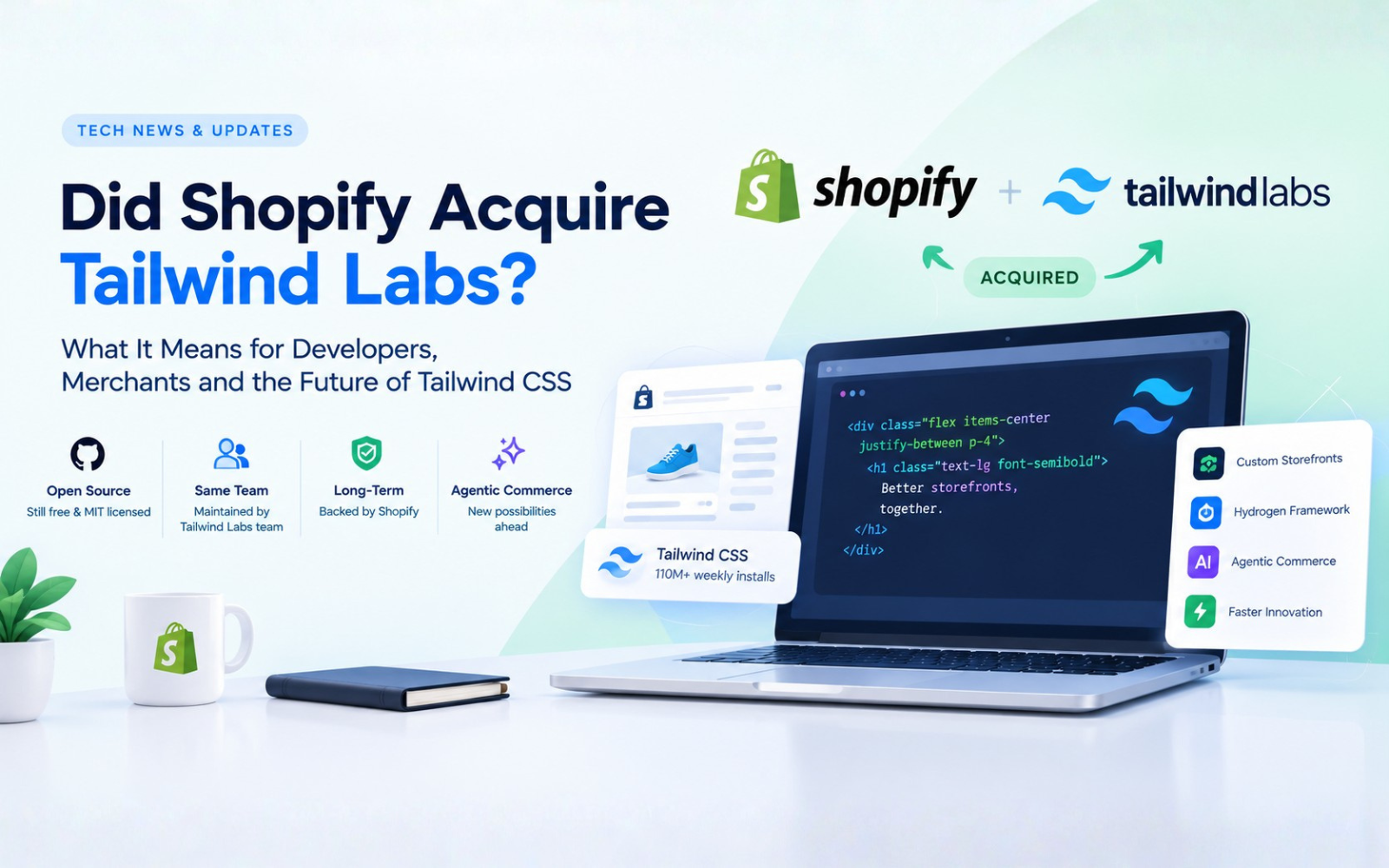
Did Shopify Acquire Tailwind Labs?
Published: September 15, 2026 Last updated: September 15, 2026
Quick answer: Yes. Shopify acquired Tailwind Labs, the company behind the Tailwind CSS framework, in a deal announced on September 9, 2026 by founder Adam Wathan. Financial terms weren't disclosed, but Tailwind CSS — installed more than 110 million times per week — stays MIT-licensed and open source, with Wathan's team continuing to maintain it under Shopify's support while Tailwind Labs' paid products close to new customers.
Why Did Shopify Acquire Tailwind Labs?
The short version is that Tailwind Labs' open-source framework was more popular than ever, but the business built around it was collapsing. Shopify stepped in to fund the framework's future while folding the team and its roadmap into its own product plans, particularly around custom storefronts and what Shopify calls "agentic commerce." Below, this post walks through the backstory, the numbers behind the deal, what changes (and doesn't), how the market reacted, and the questions developers and merchants are actually asking about it.
The Backstory: How Tailwind CSS Got Here
Adam Wathan started building what became Tailwind CSS as a side project around 2015, formally founding Tailwind Labs in 2017 as a Canadian company built around the framework. The pitch was simple: instead of writing custom CSS for every component, developers could style HTML directly using small, composable utility classes like flex, items-center, or text-lg. It was a shift in how people thought about styling the web, and it caught on fast.
By 2026, that bet had paid off in usage terms beyond almost anyone's expectations. Tailwind CSS is installed more than 110 million times per week through package managers like npm, and it styles the front ends of some of the most-visited products on the internet, including ChatGPT, X, Cloudflare, and Reddit — plus Shopify's own storefronts and admin tools. The 2025 State of CSS Survey found Tailwind CSS was the most-used framework of its kind, with 51% of surveyed developers reporting they use it. By that measure, Tailwind wasn't just successful — it was the default choice for a majority of the industry.
None of that popularity, though, was translating into a sustainable business for Tailwind Labs itself.
Why Tailwind Labs Needed a New Home
Tailwind Labs made money primarily through commercial products layered on top of the free framework — Tailwind UI (later Tailwind Plus) and a component-and-template marketplace called ui.sh. Those products were discovered mostly through people reading Tailwind's documentation and looking for ready-made components to buy instead of building their own.
Starting in 2023, that discovery funnel began breaking down. AI coding assistants got good enough to generate Tailwind-styled components on demand, which meant fewer people needed to browse documentation or buy a premium component library at all. According to Wathan's own account, shared publicly in January 2026, traffic to Tailwind's documentation had fallen roughly 40% from its early-2023 peak, even as the framework's overall install numbers kept climbing. Revenue, he said, had dropped by close to 80% over the same stretch — a business cratering underneath a framework that was more widely used than ever.
The financial strain showed up directly in the team. In January 2026, Tailwind Labs laid off three of its roughly four-person engineering team — about 75% of that group — citing the impact of "vibe coding" tools on its commercial products. That left a skeleton crew trying to maintain one of the web's most depended-upon pieces of infrastructure while its funding model kept shrinking.
By September, the math had become unavoidable: an open-source project with 110 million weekly installs needed a stable source of funding that didn't depend on people buying templates a chatbot could now generate for free. Joining a company that already relied on Tailwind at scale solved that problem directly.
Why Shopify Specifically
Shopify wasn't a stranger bidding on an unfamiliar asset — it was already one of Tailwind's biggest and earliest institutional users. Shopify started building with Tailwind CSS as far back as 2021, using it both internally and in tools it shipped to its own developer ecosystem, including its Hydrogen framework for building custom storefronts. Tailwind is described by both companies as a genuinely load-bearing part of Shopify's stack today, running across its admin interface, storefront themes, and the Shop app.
That existing dependency gave Shopify a direct incentive to keep Tailwind stable and well-maintained rather than risk it stalling out or changing hands to a less aligned buyer. Wathan's announcement post, titled "Tailwind Labs is joining Shopify," framed the move around exactly that logic: giving the framework "a stable long-term home" where it can keep being actively maintained for the people who depend on it. He also pointed to Shopify's work on agentic commerce — AI-driven shopping and storefront experiences — as a direction he wants Tailwind's future development to serve.
Shopify's leadership echoed the framing publicly the same day. Shopify President Harley Finkelstein posted that Shopify was among the first companies to bet on Tailwind "at scale," noting that years later the framework has 110 million installs a week and, in his words, "powers half the internet." Shopify CEO Tobias Lütke also confirmed the acquisition publicly on the day it was announced.
What Actually Changes (and What Doesn't)
For the overwhelming majority of people who just use Tailwind CSS in their projects, very little changes immediately. Wathan was explicit in his announcement that Tailwind CSS and Tailwind Labs' other open-source projects remain fully MIT-licensed, and that his existing team stays in place to lead and maintain them, now with Shopify's backing instead of Tailwind Labs' own shrinking revenue.
What does change is the commercial layer that used to fund the company. Tailwind Plus and ui.sh have both closed to new sign-ups — Tailwind Labs is no longer trying to grow a paid business around the framework. People who already subscribed to those products keep their existing access; the change only affects new customers going forward.
Longer term, the more interesting shift is where engineering attention goes next. Wathan said the team's focus moves toward helping Shopify merchants design and host custom storefronts, build out Shopify's admin area, and support commerce and checkout experiences — including the "agentic commerce" direction Shopify has been exploring. That's a signal, not a guarantee, but it suggests Tailwind's roadmap will increasingly reflect Shopify's product priorities alongside the general open-source community's needs.
A Timeline of How We Got Here
It's easier to understand the acquisition as the end point of a roughly three-year slide rather than a sudden decision. Here's the sequence of events as they're documented in company statements and press coverage:
| Date | Event |
|---|---|
| 2015 | Adam Wathan begins building the utility-first framework that becomes Tailwind CSS as a side project. |
| 2017 | Tailwind Labs is founded in Canada to formally develop and commercialize the framework. |
| 2021 | Shopify begins building with Tailwind CSS at scale, both internally and in its own developer tooling, including Hydrogen. |
| Early 2023 | Tailwind's documentation traffic and commercial revenue peak, coinciding with rising adoption of AI coding tools. |
| 2023–2025 | Documentation traffic declines roughly 40% and revenue declines close to 80% as AI tools reduce the need to browse docs or buy premium components. |
| January 2026 | Tailwind Labs lays off three of its roughly four engineers, about 75% of the team, citing the impact of AI ("vibe coding") tools on its commercial products. |
| September 9, 2026 | Adam Wathan announces Tailwind Labs is joining Shopify; Tobias Lütke confirms the deal; Tailwind Plus and ui.sh close to new sign-ups. |
Reading the timeline this way makes the strategic logic clearer: the framework's usage never stopped growing, but the revenue that funded its maintainers shrank for nearly three straight years before the company found a new funding structure.
What This Means for the Open-Source Business Model
Tailwind Labs' situation is a useful case study in a problem a lot of open-source-adjacent companies are quietly facing: a framework can be indispensable to the entire industry and still fail to generate enough revenue to support the people building it. Tailwind Labs tried to solve that by selling premium templates and components next to a free framework — a common model for open-source projects, sometimes called "open core."
That model depended on developers needing to discover and purchase pre-built components because building them from scratch was slow. AI coding tools removed much of that friction almost overnight, generating comparable components on demand without anyone needing to visit a documentation site or a storefront. The result wasn't that Tailwind CSS became less useful — usage kept climbing — it's that the paid layer built on top of it stopped being necessary for as many people.
Shopify's acquisition effectively replaces that broken revenue model with a different one: instead of Tailwind Labs earning money directly from developers, Shopify now funds the team because the framework is critical to Shopify's own products. It's less a triumphant turnaround story and more a structural fix — moving a piece of shared infrastructure from a shaky, ad-hoc business model onto a corporate balance sheet that has a direct reason to keep it healthy. Expect more open-source projects with similar usage-versus-revenue gaps to explore comparable arrangements, whether through direct acquisition, sponsorship, or being folded into a larger company's engineering org.
How the Developer Community Has Reacted
Reaction across developer forums and social platforms in the days after the announcement has been mixed but broadly not alarmed. Much of the conversation has focused on two questions: whether the MIT license commitment will hold over time, and what Shopify-specific features might eventually show up in Tailwind's roadmap that wouldn't have existed under independent ownership.
On the license question, community sentiment has generally treated Wathan's commitment as durable, partly because MIT-licensed code that has already shipped can't retroactively be relicensed for past versions — a point raised repeatedly in developer discussions following the announcement. On the roadmap question, some developers have noted that Shopify already shipped Tailwind internally for years before the acquisition without steering the framework in a Shopify-specific direction, which they read as a mild reassurance, while others say the real test will be which features get prioritized over the next year or two.
Deal Snapshot
| Detail | Information |
|---|---|
| Announced | September 9, 2026 |
| Acquirer | Shopify (NASDAQ: SHOP) |
| Acquired company | Tailwind Labs (Canadian, founded 2017) |
| Announced by | Adam Wathan, founder/CEO of Tailwind Labs |
| Confirmed by | Tobias Lütke, CEO of Shopify |
| Deal terms | Not publicly disclosed |
| Tailwind CSS weekly installs | 110M+ |
| Framework market share | 51% of developers (2025 State of CSS Survey) |
| License status | Unchanged — MIT-licensed, open source |
| Maintainers | Same Tailwind team, now Shopify-supported |
| Paid products affected | Tailwind Plus, ui.sh (closed to new sign-ups) |
| Existing paid customers | Keep current access |
| Notable sites using Tailwind CSS | ChatGPT, X, Cloudflare, Reddit, Shopify |
Numbers Behind the Deal: Before vs. After January 2026 Layoffs
| Metric | Before (early 2023) | By January 2026 |
|---|---|---|
| Documentation traffic | Baseline / peak | Down ~40% |
| Tailwind Labs revenue | Baseline / peak | Down ~80% |
| Engineering team size | ~4 engineers | ~1 engineer after layoffs |
| Weekly Tailwind CSS installs | Growing | 110M+, still climbing |
| Framework popularity | Rising | Most-used CSS framework (51% share) |
The table above captures the core tension that led to the deal: adoption of the framework kept rising while the business funding it kept shrinking, driven largely by AI tools replacing the need to browse documentation or buy premium components.
Step-by-Step: What to Do If You Use Tailwind CSS or Shopify
- Keep your existing Tailwind CSS setup as-is. The framework remains free, MIT-licensed, and actively maintained, so nothing in your current build pipeline needs to change because of this deal.
- Check your Tailwind Plus or ui.sh subscription status. Log into your account on either product and confirm your access is still active; existing customers keep their current entitlements regardless of the ownership change.
- Update your dependencies as usual. Continue applying Tailwind CSS version updates through your normal package manager workflow — npm, yarn, or pnpm — since the release and update process itself hasn't changed.
- Watch Shopify's developer channels if you build Shopify themes or apps. Follow Shopify's developer blog and changelogs going forward, since the Tailwind team's roadmap is shifting toward Shopify's storefront, admin, and Hydrogen tooling, and new features are more likely to surface there first.
- Reassess any paid component libraries you were relying on for new purchases. If you hadn't yet subscribed to Tailwind Plus or ui.sh, budget time to evaluate alternatives — either other open-source component sets or AI-assisted component generation — since new sign-ups for both products are closed.
- Audit any internal tooling built around Tailwind Labs' old commercial products. If your team automated purchasing, licensing checks, or renewals tied to Tailwind Plus or ui.sh, confirm those processes still work correctly under the new sign-up restrictions.
- Follow official announcements rather than secondhand summaries for roadmap changes. Given the deal's scale, expect ongoing commentary and speculation online; treat Tailwind Labs' own blog and Shopify's official statements as the primary source for what's actually changing, rather than aggregator posts or social media threads.
How the Market Reacted
Shopify's stock (NASDAQ: SHOP) opened higher on September 9, 2026, the day the acquisition was announced, reflecting an initial positive reaction to the news. That reaction didn't hold: shares reversed their intraday gains as the session went on and closed down more than 5% by the end of the day. Analysts weren't uniformly bearish on the news, though — Piper Sandler raised its price target on Shopify to $180 around the same period, implying more than 40% potential upside from where shares stood at the time.
The muted-to-negative stock reaction likely reflects the fact that this deal isn't expected to move Shopify's revenue or earnings directly in the near term. The value here is largely strategic and defensive: securing a critical piece of infrastructure Shopify already depends on, rather than adding a new, monetizable product line. That context matters if you're trying to read the acquisition as a financial event rather than a developer-tooling one.
It's also worth noting the deal landed in the middle of a broader run of strong results for Shopify. Coverage around the same period pointed to Shopify's quarterly revenue growing 34% year over year, which is part of why some analysts treated the Tailwind news as a minor, non-financial footnote rather than a signal about the company's core business trajectory.
Who Owns Tailwind Labs Going Into the Deal
Tailwind Labs' majority owner ahead of the acquisition was reported as Good Future, a family office connected to two former Shopify leaders, Arati Sharma and Satish Kanwar. That detail adds a layer of context to the deal: the company that ended up acquiring Tailwind Labs already had an indirect relationship to its ownership structure through people who'd previously worked at Shopify, even before the September announcement.
What This Means for Shopify Merchants
Most Shopify merchants don't write CSS themselves, so the direct, day-to-day impact of this deal is limited for store owners who use off-the-shelf themes from the Shopify theme store. The more relevant effect is indirect: Shopify has now brought in-house the team behind a framework it already uses to build its own admin interface, checkout flows, and storefront tooling, which the company frames as strengthening its ability to ship custom storefront features and AI-driven shopping experiences going forward.
Merchants who work with developers or agencies to build custom Shopify storefronts — particularly ones built on Hydrogen — are more likely to notice changes over time, since that's the area Wathan specifically named as a focus for the Tailwind team's work at Shopify. If your store relies on a custom-built theme or app, it's worth asking your development team whether any of their tooling depends on Tailwind Plus or ui.sh components that are now closed to new customers.
Key Takeaways
- Shopify acquired Tailwind Labs on September 9, 2026; the deal's financial terms were not disclosed.
- Tailwind CSS — used 110M+ times per week and by 51% of developers surveyed — stays MIT-licensed and open source, with the same team maintaining it.
- The deal followed a collapse in Tailwind Labs' commercial revenue: documentation traffic down ~40% and revenue down ~80% since early 2023, leading to layoffs of about 75% of its engineering team in January 2026.
- Paid products Tailwind Plus and ui.sh are closed to new customers, though existing subscribers keep access.
- Shopify (SHOP) stock closed down over 5% on announcement day despite an initial rally and a subsequent price-target increase from Piper Sandler.
- Tailwind Labs' reported majority owner, Good Future, is a family office connected to two former Shopify executives.
Download The Free E-book & Launch Your Brand Strategically
Download The Free E-book & Launch Your Brand Strategically
Frequently Asked Questions
Share this post