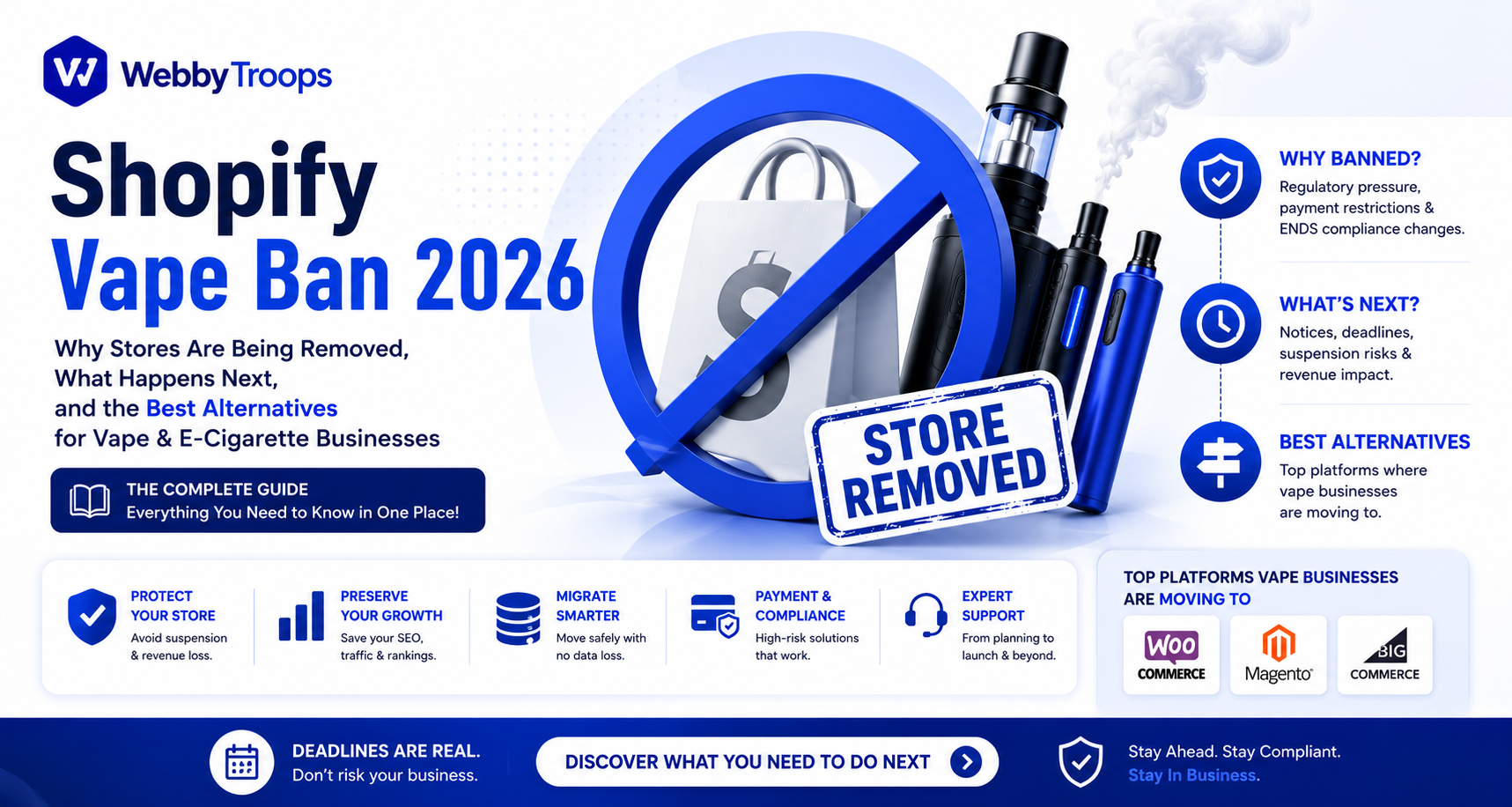
Shopify Is Banning Vape Sales in 2026: What Happened, Why, and Where Vape Brands Should Go Next
If you run a vape, e-cigarette, or ENDS (Electronic Nicotine Delivery Systems) business on Shopify, you’ve likely already heard from the platform directly: remove your nicotine products or risk losing your store. This isn’t a rumor or an overreaction to a single merchant complaint — it’s a confirmed, platform-wide enforcement action that began in late June 2026, and it’s reshaping how regulated ecommerce brands think about platform risk.
Here’s everything that’s verified so far, why it’s happening, who’s affected, and what to do next if your business depends on selling vape products online.
What Actually Happened
On June 23, 2026, Reuters reported — citing two sources familiar with the matter — that Shopify was preparing to prohibit vape sales platform-wide for U.S. merchants, regardless of whether the products carried federal FDA authorization. A Shopify spokesperson confirmed the company has “always prohibited illegal activity” but stopped short of publicly detailing the scope or timeline.
Shortly after, Shopify began sending direct notices to affected merchants. Token of Trust, which reviewed one such notice sent to an ENDS retailer, reported that Shopify stated it no longer supports the sale of Electronic Nicotine Delivery Systems — including e-cigarettes, e-liquids, vaporizers, parts, and refills — regardless of nicotine content. Merchants were instructed to remove the affected products by July 7, 2026 (UTC) or submit a successful appeal, or risk suspension.
Notably, Shopify hasn’t issued one sweeping public press release framing this as a full platform-wide vape shutdown. Instead, enforcement is happening through individual merchant notices, which means many affected store owners only learned about it directly through their Shopify admin — not through media coverage. Shopify has also reportedly offered affected Shopify Plus merchants the option to exit their contracts early without penalty if they choose to move to another platform — a strong signal that this isn’t a temporary crackdown.
It’s also worth being precise about scope: it remains unclear whether this prohibition extends beyond the United States, since Reuters’ sourcing specifically focused on U.S. sales. International merchants should monitor Shopify’s official ENDS compliance page directly rather than assume they’re covered or exempt.
Why Shopify Made This Move
This wasn’t a spontaneous business decision — it’s the result of more than a year of sustained pressure from state law enforcement and, more recently, the payments industry.
State attorneys general led the charge. In November 2025, California Attorney General Rob Bonta and the City of New York co-led a coalition of 25 state attorneys general in a letter urging Shopify to cut off merchants selling illegal tobacco products. The letter wasn’t vague — it identified 29 active illegal vape sites hosted on Shopify’s infrastructure, plus an exhibit listing more than 200 additional websites known to sell illegal tobacco products. Arizona Attorney General Kris Mayes called the trade “blatant law-breaking and a danger to the young people and teens” who shouldn’t have access to these products. Connecticut Attorney General William Tong welcomed the eventual ban, noting his office had separately investigated a dozen Connecticut smoke shops and wholesalers selling illegally imported, youth-targeted disposable vapes. Illinois AG Kwame Raoul framed the coalition’s effort as ongoing, not a one-time push — suggesting continued scrutiny of platforms in this space.
The FDA authorization gap made enforcement legally urgent. The U.S. Food and Drug Administration has authorized a very small number of e-cigarette products — reporting cites figures in the 39–45 range — and none in any flavor beyond tobacco and menthol. That means nearly all flavored disposable vapes sold online are technically “adulterated” under federal law, and interstate shipping of adulterated tobacco products is illegal. That legal exposure extends not just to sellers, but potentially to the platforms facilitating the sales — which is almost certainly why Shopify chose a blanket category ban rather than trying to police FDA status SKU by SKU across thousands of stores.
Payment networks applied pressure too. In April 2026, the same AG coalition wrote to nine major card networks and payment processors — including Visa, Mastercard, Stripe, and PayPal — pushing them to restrict processing for illegal vape merchants. Mastercard subsequently advised acquiring institutions to tighten merchant oversight and monitor transactions more closely. Since Shopify Payments sits on top of this same card-network infrastructure, tightened upstream restrictions create platform risk regardless of Shopify’s own policy stance.
Put simply: this is primarily a regulatory compliance response, not a strategic pivot — but it crystallizes a bigger trend. A coordinated, multistate campaign successfully forced a major platform into a category-wide policy change, and that’s a precedent other regulated verticals should watch closely.
Who’s Actually Affected
Any U.S.-based Shopify merchant selling ENDS products is in scope — and the policy applies at the category level, not the violation level. That means:
- Direct-to-consumer vape and e-cigarette brands — the core target, with full catalogs likely affected
- Dropshippers in the vape niche — affected even when fulfillment is outsourced
- Wholesale and B2B vape sellers — no exemption for non-retail buyers
- Manufacturers selling D2C — even FDA-authorized SKUs are reportedly covered
- Subscription vape/e-liquid clubs — recurring billing doesn’t change the classification
- Smoke shops with mixed inventory — non-vape accessories may be fine, but vape-specific SKUs need to come down
- International sellers — scope outside the U.S. is currently unconfirmed
CBD-only businesses without nicotine products are generally not targeted by this specific policy, though they remain subject to Shopify’s separate hemp/CBD compliance rules.
If you’ve received any compliance notice referencing ENDS, vape, or tobacco — or if your business model is built entirely around nicotine products — treat this as high-priority regardless of whether you’ve seen public confirmation yet.
Signs Your Store Is at Elevated Risk
Even if you haven’t received a formal notice yet, certain warning signs suggest your store should treat this as urgent rather than wait-and-see. You’re at higher risk if you sell e-cigarettes, e-liquids, vaporizers, parts, or refills to U.S. customers; if you rely on Shopify Payments rather than a dedicated high-risk processor (Shopify Payments has already excluded vape transactions from its supported categories); if your checkout lacks robust age verification; if your listings don’t clearly disclose nicotine content or FDA authorization status; or if you ship across state lines without reviewing state-specific ENDS shipping restrictions under the PACT Act.
A common mistake is assuming FDA authorization offers protection — it doesn’t under the current enforcement notices, since the policy applies to all vape products regardless of authorization status. Another is treating product removal as the complete fix. Pulling SKUs may satisfy an immediate notice, but it doesn’t resolve the underlying payment-processing and long-term platform-fit problem your business still faces.
What Happens If Your Store Gets Suspended
Shopify suspensions typically unfold in stages: a notice with a remediation deadline, a self-remediation window (per Shopify’s Acceptable Use Policy, which favors product-level enforcement before account-level action), then — if unresolved — product delisting, payment holds, and finally full account suspension with locked admin access.
The consequences compound quickly. Frozen payouts can hold funds already collected pending review. A dark storefront returns errors to search crawlers, which can trigger de-indexing within days to weeks — one of the most underestimated and hardest-to-reverse effects. And once an account is locked, self-service data export tools may become unavailable, forcing you into a support ticket queue at the worst possible time.
Export your customer list, order history, product catalog, and theme files now — before any deadline passes, not after a suspension notice arrives.
Can You Appeal, or Should You Migrate?
Appeals make sense when the issue is a removable product line or a documentation gap — not when ENDS products are your business. Because this policy is categorical rather than violation-specific, compliance for most dedicated vape brands effectively means discontinuing their core product line, which isn’t a real option. If Shopify Plus has offered you an early contract exit, that’s a clear signal the platform doesn’t intend to keep supporting your business model going forward. For most vape and ENDS-focused merchants, migration — not appeal — is the realistic path.
Where to Go Instead
Among the alternatives — BigCommerce, Magento/Adobe Commerce, Shift4Shop, OpenCart, PrestaShop, and custom builds — WooCommerce (self-hosted WordPress) is emerging as the strongest option for displaced vape merchants. The reason is structural: WooCommerce is software you install on your own hosting, not a centralized service that can issue a platform-wide removal notice for your entire product category. Your compliance obligations come from law and your payment processor’s terms — not an additional, stricter platform policy layered on top.
That gives you full control over theme, age-verification tools, shipping rules, and — critically — your choice of high-risk payment gateway, since Shopify Payments already excludes vape transactions entirely. WooCommerce also runs on WordPress, the most widely used CMS globally, which means deeper developer availability and more mature migration tooling than smaller platforms offer. BigCommerce and Magento remain solid choices for larger or more complex B2B catalogs; Shift4Shop and OpenCart suit smaller, budget-conscious operations.
Migrating Without Losing Your SEO or Revenue
A rushed migration is where most of the real damage happens — not the platform change itself. The biggest risks: unmapped URLs that break accumulated backlink equity, missing 301 redirects, lost image alt text, unrebuilt schema markup, and forgetting to reconnect Analytics and Search Console at launch.
Done right, migration follows a clear sequence: audit your current store (products, URLs, theme, customer data, current rankings), build the new store in staging, migrate data with verification at each step, map every old URL to its new equivalent before launch, integrate a high-risk-friendly payment gateway and age verification, test thoroughly, then cut over DNS during a low-traffic window — followed by close monitoring of Search Console for 60–90 days.
This is exactly the kind of work WebbyTroops specializes in: emergency Shopify migrations to WooCommerce or Magento, full SEO redirect mapping, schema and metadata preservation, high-risk payment gateway integration, and ongoing support — built specifically for merchants who can’t afford to lose rankings or revenue during a forced platform change.
Quick Answers to Common Questions
Why is Shopify banning vape sales? Shopify is removing ENDS products following sustained pressure from a 25-state attorney general coalition and payment-network risk management, targeting the roughly $9 billion illegal e-cigarette market in the U.S.
When does the Shopify vape ban take effect? Merchants who received notices were instructed to remove affected ENDS products by July 7, 2026 UTC or submit a successful appeal.
Does the ban apply to FDA-authorized vape products? Yes — reporting indicates the policy covers all vape products sold through Shopify, including FDA-authorized SKUs, since distinguishing compliant from non-compliant inventory at scale created too much legal exposure.
Will I lose my SEO rankings if I migrate platforms? Not necessarily, if the migration includes full 301 redirect mapping, schema preservation, and metadata continuity. Rankings loss almost always comes from rushed, unplanned migrations rather than the platform switch itself.
Can I still use Shopify Payments for vape products? No — vape products were already excluded from Shopify Payments’ supported categories before this broader enforcement began, so a separate high-risk gateway is required regardless.
How long does a Shopify-to-WooCommerce migration take? It depends on catalog size and complexity, but a well-planned migration for a mid-size store typically takes a few weeks from audit to full cutover — far less risky than a forced, last-minute scramble.
Is this ban official and public from Shopify? Shopify has not issued one comprehensive public press release; the policy is being enforced through individual merchant notices and was first publicly reported by Reuters on June 23, 2026.
Does this affect CBD stores? Not directly — this policy targets ENDS/nicotine vape products specifically. CBD-only merchants remain subject to Shopify’s separate hemp/CBD compliance rules.
Can I appeal Shopify’s removal notice? Merchants can submit an appeal before the deadline, but because the policy is categorical (targeting the product type itself, not individual violations), appeals are unlikely to succeed for merchants whose core business is ENDS sales.
What happens if I miss the deadline? Affected products risk removal, and continued non-compliance can lead to account-level suspension, including frozen payouts and locked admin access.
Are Shopify Plus merchants treated differently? Reportedly, yes — Shopify Plus merchants have been offered the option to exit their contracts early without penalty if they choose to move to another platform.
What is the best Shopify alternative for vape stores? WooCommerce is widely considered the strongest option because it’s self-hosted and has no platform-level product-category restrictions; BigCommerce and Magento are also viable depending on catalog size.
Can dropshippers selling vapes be affected too? Yes — the policy applies at the listing/category level regardless of fulfillment model, so dropshipped ENDS products are equally affected.
What products count as ENDS under this policy? E-cigarettes, e-liquids/e-juice, vaporizer hardware, replacement parts, coils, and refill cartridges.
Is vaping illegal in the U.S.? No — vaping is legal for adults where state law permits it, but only a small number of specific e-cigarette products are FDA-authorized; most flavored disposables are technically unauthorized under federal law.
Why did payment processors get involved? State attorneys general extended pressure to major card networks and processors (Visa, Mastercard, Stripe, PayPal) in April 2026, pushing them to restrict payment processing for illegal vape merchants.
What’s the difference between a product-level removal and an account suspension? A product-level removal hides or delists specific items; an account suspension restricts access to your entire store, including admin, payouts, and customer data.
Can I export my customer data after a suspension? Data export access can become limited or require a support request after suspension — exporting proactively, before any deadline, is strongly recommended.
Should I migrate preemptively even if I haven’t received a notice? If ENDS products are central to your business, proactive migration planning reduces risk regardless of whether you’ve personally received a notice yet.
What’s the safest payment gateway for vape ecommerce? High-risk-specialized payment processors that explicitly support vape/ENDS merchant categories are necessary, since major standard gateways generally exclude this category.
Does WooCommerce require more technical maintenance than Shopify? Yes — self-hosting requires managing updates, security, and hosting infrastructure, which is the tradeoff for the platform independence it provides.
Can Magento support a large vape wholesale catalog? Yes — Magento/Adobe Commerce is well-suited to large, complex B2B catalogs with multiple price tiers and customer groups.
Will BigCommerce also restrict vape sales eventually? There’s no confirmed policy change from BigCommerce as of this writing; merchants should monitor each platform’s individual Acceptable Use Policy.
What is the PACT Act and why does it matter for vape shipping? The PACT Act governs interstate shipping restrictions for tobacco and vape products in the U.S.; compliance is required regardless of which ecommerce platform a merchant uses.
How do I preserve my Google rankings during migration? Map every old URL to its new equivalent with 301 redirects, preserve metadata and schema, and monitor Search Console closely for the first 90 days post-launch.
Is age verification required at checkout for vape products? Yes — age verification is both a legal requirement in most jurisdictions and increasingly a payment-processor requirement for regulated nicotine products.
Can I keep selling non-vape products on Shopify while migrating my vape SKUs elsewhere? Yes — a hybrid approach (split catalog across two platforms) is common during transition periods.
What happens to my Shopify domain if my store is suspended? Access depends on where your domain is registered; domains registered externally and simply pointed at Shopify are generally easier to redirect to a new platform than domains purchased directly through Shopify.
Is this Shopify vape ban likely to expand to other regulated categories? Industry analysis suggests the precedent — coordinated state pressure compelling category-wide platform policy change — could be applied to other regulated verticals over time, though this is forward-looking analysis, not a confirmed plan.
Who should I talk to before migrating my vape store? An experienced ecommerce migration partner familiar with regulated/high-risk categories, SEO preservation, and compliant payment gateway integration.
The Bottom Line
The Shopify vape ban of 2026 shows how fast platform policy can override a business model that’s been operating compliantly for years. Waiting to see how strictly this gets enforced is a riskier strategy than building platform independence now, ahead of any forced deadline.
If your Shopify store sells vape, e-cigarette, or ENDS products, don’t wait for a suspension notice. Contact WebbyTroops for a migration assessment — we’ll help you move off Shopify safely while preserving your SEO rankings, customer data, and revenue continuity throughout the transition.
This article reflects publicly reported information and official Shopify policy documentation available as of June 30, 2026. Enforcement details may change — verify current requirements directly in your Shopify admin and consult legal counsel regarding compliance obligations specific to your business.
Download The Free E-book & Launch Your Brand Strategically

Download The Free E-book & Launch Your Brand Strategically
Share this post