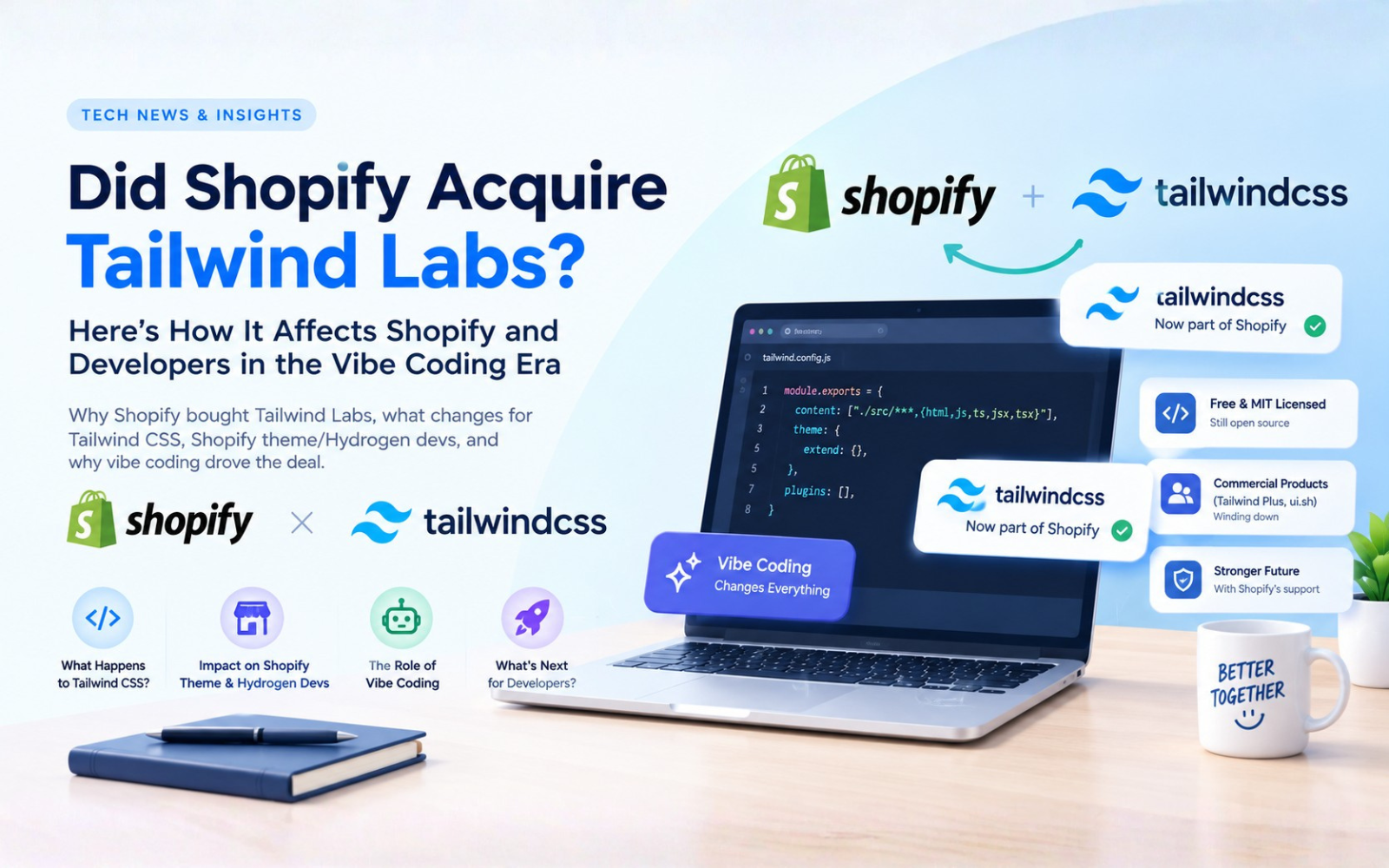
Did Shopify Acquire Tailwind Labs? Here's How It Affects Shopify and Developers in the Vibe Coding Era
Published: September 15, 2026 Last updated: September 15, 2026
Shopify acquired Tailwind Labs on September 9, 2026, bringing the team behind Tailwind CSS in-house. Financial terms weren't disclosed. Tailwind CSS, the utility-first framework installed more than 110 million times per week, stays free and MIT-licensed, while Tailwind Labs' paid products, Tailwind Plus and ui.sh, stopped accepting new signups as the commercial side of the business winds down. The deal followed a stretch where AI "vibe coding" tools ate into Tailwind Labs' paid-product revenue badly enough that the company laid off three employees in January 2026.
That one paragraph answers the search query most people type in. Everything below unpacks it: why a Canadian CSS framework company sold itself to an e-commerce platform, what actually changes for the people who write code for a living, and — because this is the question developers actually care about — who comes out ahead as AI-generated code becomes the default way software gets written.
Who Is Tailwind Labs, and Why Would It Sell?
Adam Wathan released the first version of Tailwind CSS on Halloween night in 2017. It started as a byproduct of client work he was doing with designer Steve Schoger, a set of utility classes meant to speed up their own projects, not a company. Wathan went full-time on it in January 2019, officially founding Tailwind Labs the same month. The framework's pitch was simple and, at the time, controversial: instead of writing semantic CSS classes and separate stylesheets, developers compose interfaces directly in HTML using small, single-purpose utility classes. Critics called it a step backward for separation of concerns. It won anyway, by adoption. According to the 2025 State of CSS survey, Tailwind CSS was used by 51% of respondents, making it the most popular framework of its kind, and it now ships inside products like ChatGPT, X, Cloudflare, and Reddit.
Tailwind Labs never made money from the free framework directly — that was never the plan. The company's revenue came from commercial products built on top of it: Tailwind UI (later Tailwind Plus), a paid library of pre-built HTML components, and later ui.sh. Tailwind UI reportedly brought in close to $2 million in its first five months after launching in 2020, and Tailwind Labs crossed $4 million in revenue within about two years of going full-time, run by a lean team of around seven people. That business model worked well for years: developers who didn't want to design components from scratch paid a one-time or subscription fee for professionally built ones.
Then AI coding tools got good enough to generate that same styled markup for free, on demand, inside the editor a developer was already using. That's the part that actually forced this acquisition, and it deserves its own explanation.
What "Vibe Coding" Actually Means, and Why It Hurt Tailwind Labs Specifically
Andrej Karpathy coined the term "vibe coding" in February 2025, describing a workflow where a developer describes what they want in natural language and largely accepts whatever an AI model generates, without reviewing it line by line. Collins Dictionary named it Word of the Year for 2025. By early 2026, industry surveys put the vibe coding platform market at roughly $4.7 billion, growing at an estimated 38% compound annual rate, with the broader AI coding tools market — including assistants like GitHub Copilot that developers still supervise closely — sized closer to $7.4–7.6 billion in 2025.
The distinction between "AI-assisted coding" and "vibe coding" matters for understanding what hit Tailwind Labs. Stack Overveflow's own developer survey found that when asked directly whether vibe coding — defined as generating software from LLM prompts with minimal review — was part of their professional work, 72.2% of developers said no, and another 5.3% said "no, emphatically." Only about one in seven developers vibe code at work in the strict sense. But that minority is disproportionately building the kind of small, fast, disposable interfaces that used to require buying a component library. Twenty-five percent of Y Combinator's Winter 2025 startup batch reportedly had codebases that were 95% or more AI-generated, and the estimated cost of building a functional SaaS product dropped from roughly $200,000 to about $5,000 as build timelines compressed from six months to six weeks.
Here's the direct line to Tailwind Labs' revenue problem: large language models were trained on enormous amounts of public Tailwind CSS code, because Tailwind is the most common utility-first framework on the web. That means AI coding assistants are unusually good at generating correct, idiomatic Tailwind markup on request — arguably better at it than at many other CSS approaches, simply because there's more Tailwind in the training data to learn from. Every time an AI tool generates a styled component for free, that's a component a developer didn't need to buy from Tailwind Plus. Wathan has said as much publicly, describing vibe coding tools as coming between his product and the customers who used to pay for it. The open-source framework itself didn't lose users — if anything it gained them, since AI tools kept outputting Tailwind classes by default — but the paid layer built on top of it stopped being necessary for a growing share of the market.
That's a strange, almost paradoxical form of disruption: the free product got more popular because of AI, while the paid product built on top of it got less viable, for the same reason, at the same time.
Why Shopify, Specifically
Shopify wasn't a random buyer. It was one of the earliest large companies to adopt Tailwind CSS at scale, both for its own admin interfaces and as a recommended styling approach for merchants and theme developers building storefronts. Tailwind Labs founder Adam Wathan framed the move as Tailwind finding "a stable long-term home where it will be actively maintained for the millions of people who depend on it," and pointed specifically to Shopify's "incredible surface area" — its theme ecosystem, its headless Hydrogen framework, and its admin tooling — as the reason the fit made sense. Shopify president Harley Finkelstein echoed the framing from the company's side, noting that Shopify had bet on Tailwind early and that, years later, the framework was powering roughly half the internet's utility-first styling.
There's also a strategic angle that goes beyond sentiment. Shopify has been vocal about positioning itself at what it calls the frontier of "agentic commerce" — storefronts and admin experiences designed to be built, modified, and even operated by AI agents rather than exclusively by human developers clicking through a UI. Shopify's Hydrogen framework, a React-based toolkit for building headless storefronts on top of Shopify's Storefront API, already ships Tailwind as a default styling option in its starter templates. Owning the framework outright, rather than depending on an independent company whose commercial viability was visibly wobbling, gives Shopify direct control over a piece of infrastructure its own developer tooling leans on. If Tailwind Labs had folded or been acquired by a competitor instead, Shopify's theme and Hydrogen ecosystems would have inherited that uncertainty for free.
Buying Tailwind Labs also fits a pattern industry analysts have been flagging for the AI era: widely used, hard-to-monetize open-source infrastructure increasingly needs a large corporate backer to survive, because the traditional path of selling commercial add-ons on top of a free core is being squeezed from both directions — AI tools replace the add-ons, and the free core itself needs continuous maintenance that no longer pays for itself through those add-ons.
What Actually Changes, Laid Out Plainly
| Area | Before the acquisition | After the acquisition |
|---|---|---|
| Tailwind CSS core framework | Free, MIT-licensed, maintained by Tailwind Labs | Still free, still MIT-licensed, same team, now Shopify employees |
| Company ownership | Independent Canadian company, founded 2019 | Fully owned subsidiary of Shopify |
| Tailwind Plus (formerly Tailwind UI) | Paid component library, open to new signups | New signups closed; existing customers keep access |
| ui.sh | Paid product, open to new signups | New signups closed; existing customers keep access |
| Deal value | N/A | Not disclosed |
| Weekly installs | 110M+ | 110M+ (no change from the deal itself) |
| Team size context | ~7 people in Tailwind Labs' early years; 3 layoffs in Jan 2026 | Team retained, now backed by Shopify's resources |
| Shopify's own stock (SHOP) | N/A | Opened higher on announcement day (Sept 9), then closed down more than 5% intraday |
| Analyst reaction | N/A | Piper Sandler raised its price target to $180 the same week |
| Shopify's stated dev focus | Liquid themes, Hydrogen, admin UI (Tailwind used internally) | Same, with Tailwind's roadmap now formally aligned to it |
The short version: nothing changes for the code you've already shipped. The open-source promise is explicit and repeated across every public statement from both sides — "nothing changes with Tailwind CSS," in Wathan's own words, with the MIT license staying intact for all of Tailwind Labs' open-source projects. What changes is who funds the team's paychecks and, over time, whose roadmap that team's incentives point toward.
What This Means for Different Kinds of Shopify Developers
Not every developer touches this deal the same way, so it's worth breaking apart by role rather than treating "developers" as one group.
Theme developers building on Liquid, Shopify's templating language for standard storefronts, were already likely to be using Tailwind for styling if they wanted a modern utility-first workflow, since Shopify has recommended and supported that pattern for years. For this group, the acquisition is close to a non-event in the short term — your build process, your class names, your existing themes keep working exactly as before — but it raises the odds that future Shopify theme tooling ships with tighter, more native Tailwind integration rather than treating it as a bring-your-own dependency.
Hydrogen and headless developers sit closer to the center of this story. Hydrogen is Shopify's React-based framework for building custom headless storefronts on top of the Storefront API, and its official starter templates already default to Tailwind for styling, alongside React Router and Vite. A team that now owns both the commerce framework and the styling framework its default templates ship with has an obvious incentive to make the two feel like one cohesive product rather than two separately maintained dependencies that happen to be bundled together. Expect closer version alignment between Hydrogen releases and Tailwind releases going forward, and watch for Tailwind utilities that map more directly to Shopify-specific concepts like theme color schemes, metafields, or checkout branding.
App developers building for the Shopify App Store, who mostly work against Shopify's admin APIs and Polaris design system rather than storefront styling, are the least directly affected group. Polaris and Tailwind are different layers of Shopify's design system, and this deal is about the storefront-facing and general-purpose styling layer, not Shopify's internal admin design language. That said, if Shopify does eventually pull Tailwind conventions deeper into its own tooling, app developers may see it show up indirectly through shared build tooling or documentation over time.
Agencies and freelance Shopify developers, who often maintain dozens of client themes at once, get the most practical short-term benefit: reduced platform risk. Before the acquisition, an agency betting its workflow on Tailwind was implicitly betting on an independent company's business model surviving the AI coding squeeze. That risk is now backed by Shopify's balance sheet instead of a roughly seven-to-a-few-dozen-person independent team's commercial product sales. For client work that needs to be maintainable for years, that's a meaningful de-risking, even though it doesn't change a single line of code today.
Developers who vibe code Shopify storefronts — prompting an AI assistant to generate a themed page or component with minimal manual review — are arguably the group whose behavior caused this deal in the first place, and they're also positioned to benefit most going forward. If Shopify tightens the alignment between Hydrogen, Liquid, and Tailwind, AI coding tools trained on that increasingly coherent, well-documented combination should get more reliable at generating correct Shopify-specific Tailwind code, not less. The framework becoming more central to Shopify's own official stack, rather than a loosely coupled third-party choice, generally improves how well AI models can reason about it, because official documentation and first-party examples tend to be cleaner training signal than scattered community tutorials.
Where Tailwind Sits Against Other CSS Approaches
It's worth understanding why Tailwind specifically, rather than a competing framework, became valuable enough to acquire. Utility-first styling wasn't the obvious winner when Tailwind launched in 2017 — Bootstrap and Foundation, both component-based frameworks with pre-styled buttons, cards, and navbars, dominated the market, and CSS-in-JS libraries like styled-components were the other major direction teams were exploring. Tailwind's bet was that developers would rather compose small utility classes directly in markup than fight an opinionated component library's defaults or maintain separate stylesheet files. That bet took years to pay off in sentiment even as adoption climbed, with plenty of developers publicly arguing the approach made HTML unreadable.
By 2025, that argument had mostly ended in Tailwind's favor by sheer weight of adoption. Competing utility-first tools like UnoCSS and Windi CSS exist and have loyal niche followings, largely because they promise faster build times or more configurable engines, but none has matched Tailwind's ecosystem size, plugin library, or first-party tooling like the Tailwind CSS IntelliSense editor extension. Component-based systems haven't disappeared either — Shopify's own Polaris design system for admin and app UI is component-based, not utility-first — but for general-purpose storefront and web styling, Tailwind had already become close to a default choice well before Shopify made it an owned one. That existing dominance is precisely what made the framework valuable enough to be worth acquiring rather than merely sponsoring: Shopify wasn't betting on an underdog, it was securing the incumbent.
Steps: What Shopify Developers Should Do Right Now
- Keep existing Tailwind-based themes and Hydrogen storefronts exactly as they are. The MIT license and open-source commitment mean no immediate code changes, migrations, or class-name updates are required because of this acquisition.
- Audit any active Tailwind Plus or ui.sh subscriptions. If you rely on specific paid components or templates, confirm your account still has access, and export or locally archive anything critical in case long-term support policies change later.
- Watch Shopify's Hydrogen and theme changelogs directly, not just Tailwind's release notes. Integration-specific changes — closer version alignment, Shopify-specific utilities, or new starter template defaults — are more likely to surface there first.
- Pin your Tailwind version explicitly in any production build rather than tracking "latest," so an unexpected release timed around the integration work doesn't surprise a live storefront.
- Review AI-generated Tailwind code against your actual installed version before merging it. Vibe-coded or AI-assisted contributions can default to utility classes or config patterns from a newer or older Tailwind release than the one your project uses.
- If you're starting a new Shopify project today, treat Tailwind as the default, well-supported choice rather than one option among equals, given its now-direct backing from the platform itself.
- For agencies managing multiple client themes, use this as a moment to document which projects use Tailwind and at what version, since consolidating on a more current, Shopify-aligned version becomes easier to justify to clients once the roadmap stability story is public.
Historical Context: This Pattern Isn't New
Large platforms absorbing critical open-source infrastructure companies isn't a novel move, and looking at past examples helps set expectations for what usually happens next. Microsoft's 2018 acquisition of GitHub kept Git itself independent (Git was never GitHub's to sell) but folded GitHub's hosting, and eventually its AI tooling investments, tightly into Microsoft's developer ecosystem — a multi-year process, not an overnight one. GitHub separately acquired npm in 2020 after npm, Inc. faced its own financial strain running the JavaScript ecosystem's package registry as a business, a situation with clear parallels to Tailwind Labs' commercial side struggling to fund a free, widely depended-upon core product. Cognition's 2025 acquisition of the AI coding tool Windsurf, reportedly for around $250 million when Windsurf was generating about $82 million in annual recurring revenue, shows how quickly value is being reassigned within the AI coding tooling space itself.
The consistent theme across these deals: the open-source or freely available layer almost always survives intact, because breaking it would destroy the goodwill and adoption that made the acquisition valuable in the first place. What shifts is investment priority, release cadence, and how tightly the tool gets wired into its new parent's specific ecosystem. There's no reason to expect Tailwind CSS to diverge from that pattern.
Open Questions and Reasonable Risks to Watch
A few things aren't yet settled, and it's worth naming them rather than pretending the deal removes all uncertainty. Existing Tailwind Plus and ui.sh customers keep access today, but neither company has published a long-term support timeline for those products beyond the signup closure, so anyone with an active subscription should treat continued long-term support as unconfirmed rather than guaranteed. Deal terms, including price, weren't disclosed, which makes it hard to judge how much financial runway or independence the Tailwind team actually retained inside Shopify versus how tightly its roadmap will be steered by Shopify's own priorities. And Shopify's own stock reaction — opening higher, then closing down more than 5% the same session even as at least one analyst (Piper Sandler) raised its price target to $180 — is a reminder that the market's read on this deal is genuinely mixed, not a unanimous vote of confidence.
None of that changes the free, MIT-licensed status of Tailwind CSS itself, which is the part almost every working developer actually depends on day to day.
Key Takeaways
- Shopify acquired Tailwind Labs on September 9, 2026; deal terms were not disclosed.
- Tailwind CSS, installed more than 110 million times per week, stays free and MIT-licensed under its original team.
- Tailwind Labs' paid products, Tailwind Plus and ui.sh, closed to new signups as the company's commercial side winds down; existing customers retain access for now.
- The deal followed revenue pressure from AI "vibe coding" tools, contributing to three layoffs at Tailwind Labs in January 2026.
- Hydrogen and headless Shopify developers stand to see the most direct integration changes over time; theme, app, and agency developers see mostly reduced platform risk in the near term.
- Shopify's stock opened higher on the announcement before closing down more than 5% the same session, even as Piper Sandler raised its price target to $180.
Download The Free E-book & Launch Your Brand Strategically
Download The Free E-book & Launch Your Brand Strategically
Frequently Asked Questions
Share this post