

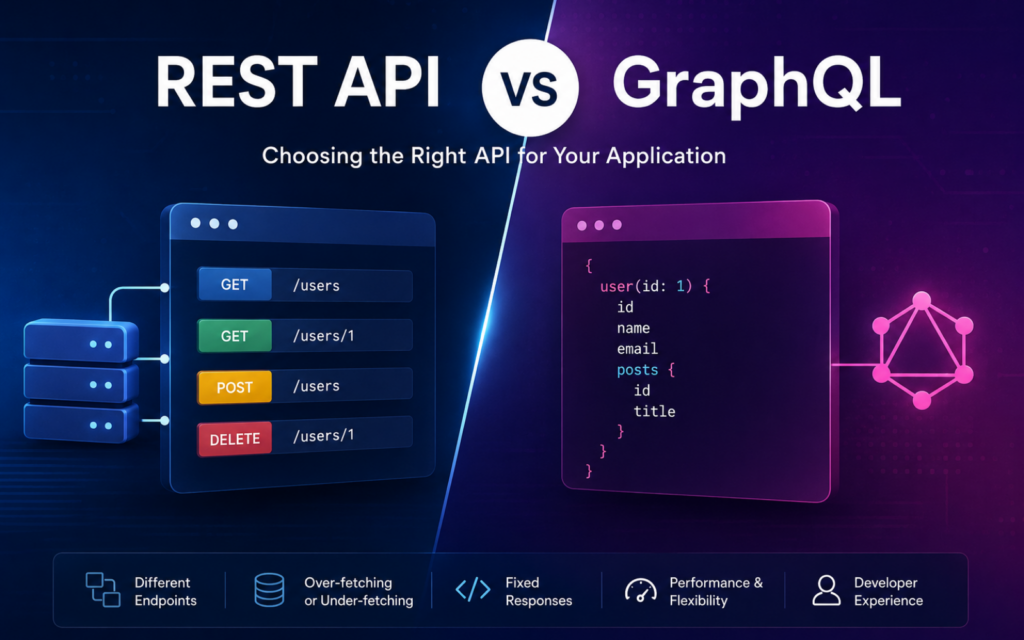
REST API vs GraphQL: Key Differences & Which One to Choose
REST API is a time-tested, simple architectural style best suited for public APIs, simple CRUD apps, and teams familiar with HTTP standards. GraphQL is a flexible query language ideal for complex, data-heavy applications, mobile apps, and teams that need precise control over data fetching. There is no universal winner the right choice depends entirely on your project’s needs, your team’s expertise, and your long-term goals.
If you’ve ever sat down to start a new project and wondered whether to go with a REST API or GraphQL, you’re not alone. It’s one of the most common questions developers ask today and honestly, there’s no one-size-fits-all answer. Both technologies are powerful. Both are widely used. And both have real trade-offs that can make or break your project depending on how you use them.
This article breaks everything down in plain language. No jargon overload, no empty comparisons. Just a real look at what each technology is, how they differ, when to use each one, and what actual companies are doing in 2025.
What Is REST API? (And Why It Became the Standard)
REST (Representational State Transfer) is not a protocol but an architectural style that defines a set of constraints for building web APIs. Proposed by Roy Fielding in his 2000 doctoral dissertation, REST quickly became the de facto standard for HTTP-based services.
The idea behind REST is pretty intuitive. In REST, each resource is represented by a URL. Clients interact with those resources using standard HTTP methods like GET, POST, PUT, and DELETE. These operations map naturally to CRUD (Create, Read, Update, Delete) functionality, making REST intuitive for developers familiar with the web.
Think of it like ordering from a restaurant with a fixed menu. When you use a REST API, you access specific endpoints (URLs) that return predefined sets of data. For example, if you’re building a social media app, one endpoint might give you user profiles, another for posts, and yet another for comments.
The fundamental concept behind RESTful API architecture involves treating every piece of data as a resource, accessible through standard HTTP methods. This approach has made REST implementations the backbone of countless web applications, from simple CRUD operations to complex enterprise systems.
Key Characteristics of REST
- Multiple endpoints — one for each resource
- Stateless — every request carries all the information needed
- HTTP caching — works natively with browser and CDN caching
- Standard status codes — 200, 404, 500, etc.
- JSON or XML response formats
REST APIs remain the most widely used approach in 2025, powering most web services and public APIs. Their simplicity and familiar structure keep them relevant for many use cases.
What Is GraphQL? (And Why It Was Created)
GraphQL is a query language for APIs and a runtime for executing those queries. Created by Facebook in 2012 and open-sourced in 2015, GraphQL was designed to address the data inefficiency problem of REST, particularly for mobile apps that fetch data over limited networks.
GraphQL emerged in 2012 as a response to the need for speed in emerging social media platforms. Developers found that existing API architectures, like REST, were too lengthy and structured to produce news feeds efficiently.
The simplest way to understand GraphQL: Unlike REST’s fixed-menu approach, GraphQL works more like a custom food order where you can specify exactly what you want. It provides a single endpoint where clients can request specific data fields they need. For instance, if you only need a user’s name and email (not their entire profile), GraphQL lets you request just those pieces of information. This flexibility makes it particularly efficient for applications with complex data requirements.
GraphQL is defined by an API schema written in the GraphQL schema definition language. Each schema specifies the types of data the user can query or modify, and the relationships between the types. A resolver backs each field in a schema. The resolver provides instructions for turning GraphQL queries, mutations, and subscriptions into data, and retrieves data from databases, cloud services, and other sources.
Key Characteristics of GraphQL
- Single endpoint — all queries go through one URL
- Client-driven queries — you ask for exactly what you need
- Strongly typed schema — acts as a contract between client and server
- Introspection — the API documents itself
- Subscriptions — built-in support for real-time data
The Numbers: Adoption in 2025
Before going deeper, let’s look at where things stand today, because the numbers tell a real story.
According to the latest State of APIs Report 2024 by Postman, GraphQL adoption has surged 340% among Fortune 500 companies, while RapidAPI’s Developer Survey shows REST APIs continue to power 83% of all web services.
GraphQL adoption amongst enterprises has been growing rapidly. A report from Gartner predicted that by 2025, more than 50% of enterprises will use GraphQL in production, up from less than 10% in 2021.
Companies using GraphQL report an 82% improvement in developer productivity and overall experience.
89% of teams that adopt GraphQL report they would choose it again for similar projects (Apollo GraphQL Developer Survey 2024). This retention rate suggests GraphQL isn’t just a trend it’s solving real problems that REST struggles with.
These numbers make one thing clear: REST isn’t dying, but GraphQL is growing fast and solving very real problems.
The Core Problem: Over-Fetching and Under-Fetching
This is the biggest real-world problem that GraphQL was specifically built to solve, so it deserves its own section.
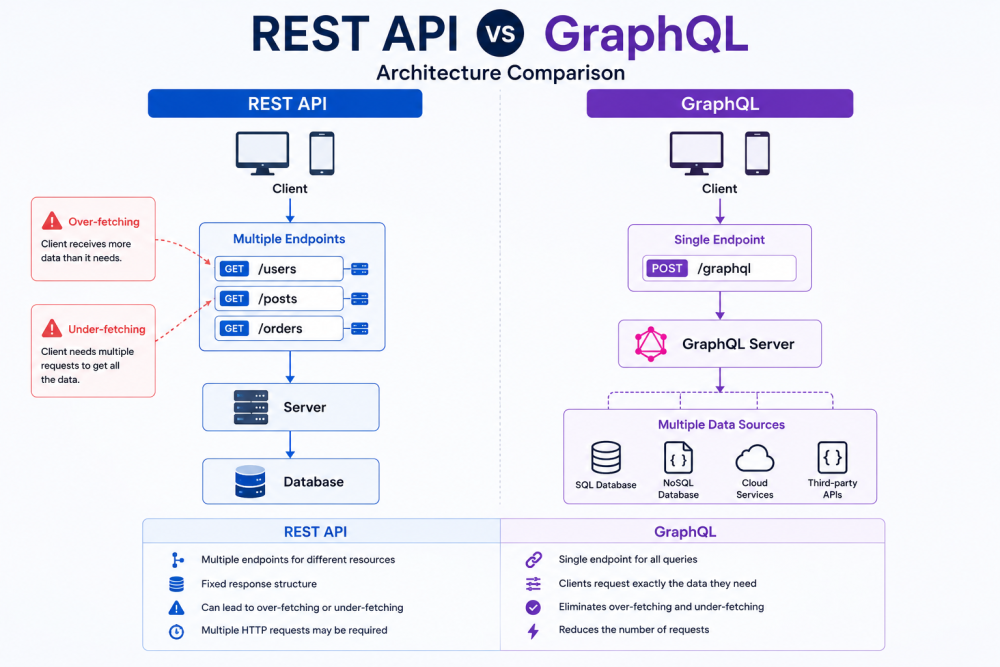
REST API is always vulnerable to overfetching, a scenario whereby the client request ends up fetching data that it doesn’t need. This happens because REST API endpoints return structured data regardless of the client-required information structure.
Some REST APIs also experience cases of under-fetching where one API returns only a limited number of details and the rest have to be fetched using other APIs from other endpoints. GraphQL eliminates the problem of both over-fetching and under-fetching through the system of requesting only necessary data in one query.
Here’s a practical example:
Imagine you’re building a mobile app that shows a user’s name and their last 3 post titles. With REST:
- You call
GET /users/123and get back the user’s entire profile (name, email, address, phone number, profile picture, bio, etc.) - You call
GET /users/123/postsand get back all posts, not just the last 3
With GraphQL, you send one query requesting only the name and last 3 post titles, and that’s exactly what comes back nothing more, nothing less.
GraphQL’s use of a single request to fetch the required data means that it has better performance than other systems in cases where data requirements are complex or network bandwidth constraints are tight.
REST API: Strengths and Weaknesses
Where REST Wins
1. Simplicity and Familiarity The HTTP-based approach aligns naturally with web development patterns, and debugging tools are mature and widely available. RESTful API documentation follows established conventions, making integration straightforward.
2. Native HTTP Caching REST leverages standard HTTP caching perfectly. A unique URL like GET /users/123 can be cached automatically by browsers and CDNs based on standard Cache-Control headers.
3. Great for Microservices REST is well-suited for microservices architectures, where each service exposes functionality through well-defined APIs. The stateless nature of RESTful services makes horizontal scaling straightforward, and load balancing strategies are well-established.
4. Clear Error Handling REST uses standard HTTP status codes (404 Not Found, 403 Forbidden). It’s clear if the entire request failed.
5. Simple to Learn For small internal APIs with a handful of endpoints, REST is still simpler and easier to maintain.
Where REST Falls Short
Despite these strengths, REST isn’t perfect. Its rigid endpoint structure can lead to over-fetching or under-fetching data, especially for complex or rapidly changing front ends. That’s where GraphQL offers a compelling alternative.
GraphQL: Strengths and Weaknesses
Where GraphQL Wins
1. Precise Data Fetching Rather than exposing multiple endpoints, GraphQL exposes a single endpoint. Clients send a query specifying exactly what data they need, and the server returns only that data. This client-driven approach eliminates over-fetching and allows the retrieval of multiple resources in a single request.
2. Strong Typing and Self-Documentation Strong typing means schemas act as contracts, improving reliability and tooling support. Introspection allows clients to query the schema itself to discover available operations, which makes APIs self-documenting.
3. Real-Time Support GraphQL supports subscriptions, enabling real-time data updates, which is crucial for applications requiring live data like chat apps, stock tracking, and live sports scores.
4. Better Developer Experience The strongly-typed schema provides excellent developer experience through auto-completion and compile-time validation, but teams must invest time in understanding GraphQL-specific concepts like resolvers, fragments, and query optimization.
5. Mobile Performance Mobile apps with constrained bandwidth benefit from fewer round trips and reduced payload sizes. This results in faster load times and better user experiences.
6. Frontend Team Independence Frontend developers love GraphQL because it gives them direct control over the data they receive. They no longer need to wait for backend teams to create new endpoints. The self-documenting schema and tooling ecosystem speed up development cycles significantly.
Where GraphQL Struggles
1. Caching is Complex Every request typically goes to the same endpoint via a POST request. Standard HTTP caching doesn’t work out-of-the-box. Caching requires more sophisticated client-side libraries or server-side techniques like persisted queries.
2. Learning Curve Teams must learn schemas, resolvers, and query planning. Backends need monitoring and query cost analysis. Adoption slows if cultural and technical shifts aren’t managed properly.
3. Error Handling Can Be Confusing GraphQL almost always returns a 200 OK status code, even if there were errors. The errors are detailed inside the JSON response body in an errors array.
4. Server Complexity GraphQL brings challenges: resolvers must handle dynamic queries, nested relationships, and performance tuning. Poor design can lead to slow queries or denial-of-service risks.
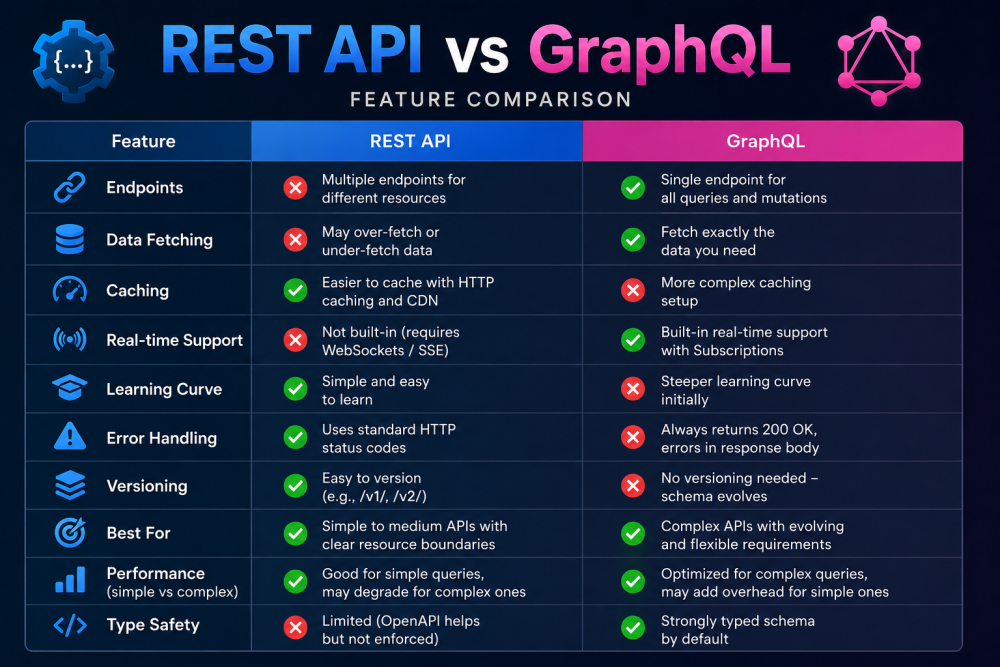
Side-by-Side Comparison: REST API vs GraphQL
| Feature | REST API | GraphQL |
|---|---|---|
| Endpoints | Multiple | Single |
| Data Fetching | Fixed, server-defined | Flexible, client-defined |
| Over/Under-Fetching | Common problem | Eliminated |
| HTTP Caching | Native & simple | Requires extra work |
| Real-Time | Needs workarounds | Built-in Subscriptions |
| Type Safety | Optional | Built-in |
| Error Handling | Standard HTTP codes | Errors in response body |
| Learning Curve | Low | Moderate–High |
| Versioning | Required (/v1, /v2) | Schema evolution (no versioning) |
| Best For | Simple/public APIs | Complex/data-heavy apps |
| Tooling Maturity | Very mature | Growing fast |
Real-World Companies: Who Uses What?
This is where the theory meets reality. Let’s look at what real companies have done.
GitHub transitioned to GraphQL to allow clients to request only the specific data they needed, thereby reducing the cost of multiple round-trips and simplifying a previously convoluted REST API that required constant client-server communication. GitHub’s GraphQL API reduced their mobile app’s data usage by 60% while improving load times.
Netflix implemented a GraphQL microservices architecture that has resulted in impressive productivity gains, with development teams deploying over 100 times daily.
PGA TOUR and Sky Italia both used GraphQL to modernize their stacks, reducing deployment time from weeks to minutes and decreasing data propagation time by a factor of 15, from minutes to milliseconds respectively.
Shopify utilizes GraphQL to power storefront APIs, enabling partners to build more sophisticated apps with far more control over the data they consume.
These aren’t just experiments. These are production-level decisions from some of the biggest names in tech, and they’re producing measurable results.
When Should You Choose REST API?
Choose REST when:
You’re building a simple, CRUD-based application — REST’s structure maps perfectly to basic create, read, update, delete operations.
You need a public API — REST is easier for third-party developers to understand and integrate with. RESTful API documentation follows established conventions, making integration straightforward.
Caching is a priority — If your app is read-heavy and performance depends on fast cache hits, REST’s native HTTP caching is a major advantage.
Your team is small and familiar with REST — There’s zero sense in switching to GraphQL if your team will spend months just learning it.
You’re building microservices — REST is well-suited for microservices architectures where each service exposes functionality through well-defined APIs. The stateless nature of RESTful services makes horizontal scaling straightforward.
You want simple, predictable error handling — Standard HTTP status codes are universally understood by every developer on your team.
When Should You Choose GraphQL?
Choose GraphQL when:
You’re building a mobile app — With mobile applications becoming even more prevalent, GraphQL’s ability to reduce data transfer and minimize the number of requests makes it an attractive choice.
Your UI needs data from multiple sources in one request — Modern applications frequently pull data from microservices, databases, and third-party APIs. GraphQL combines these sources into a single query, reducing the need for multiple REST calls and simplifying frontend logic.
Your frontend team is moving fast — Frontend developers don’t need to wait on new endpoints. If a field exists in the schema, they can query it directly without any backend changes.
You need real-time data — As real-time interactions become a necessity for many applications such as social media platforms, messaging apps, and e-commerce, GraphQL’s support for subscriptions and real-time updates becomes more relevant.
You’re managing a complex, multi-team API — Companies adopt GraphQL because they want the benefits of federation. They seek to scale their API development across multiple teams and services while enabling collaboration and change management at scale.
You want to avoid versioning headaches — GraphQL schemas can evolve without breaking existing clients by deprecating fields rather than creating new API versions.
Can You Use Both REST and GraphQL Together?
Absolutely. In fact, many companies do exactly this.
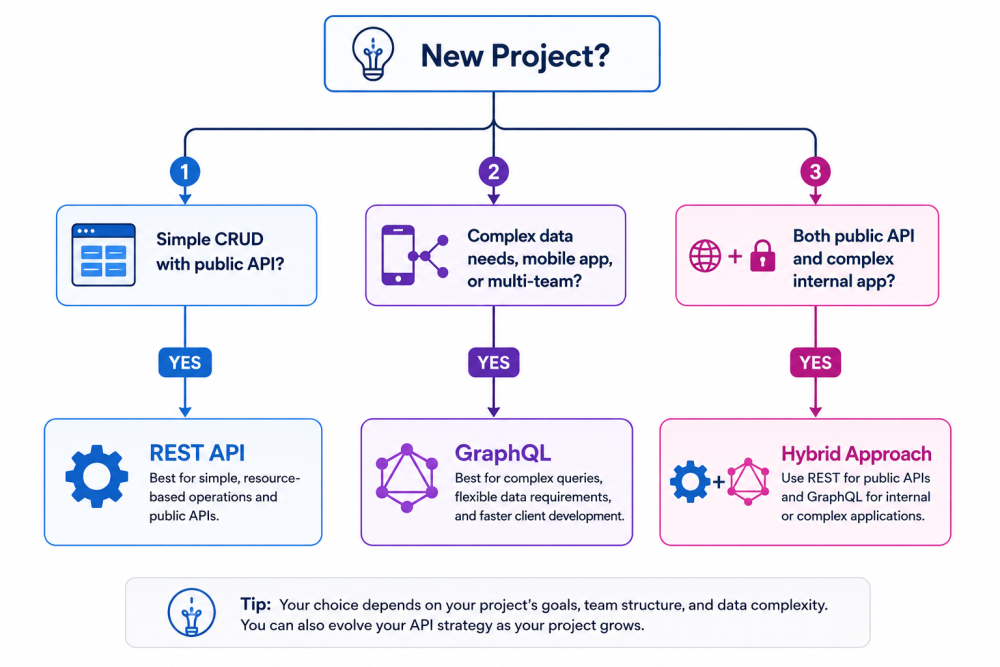
The trend shows a hybrid approach emerging. Companies are using both GraphQL and REST APIs together, choosing the best tool for specific requirements.
Choose REST for its simplicity, maturity, and predictability. Choose GraphQL for its flexibility, precision, and agility. Or use both, leveraging REST for public exposure and GraphQL for internal composition. Emerging trends include hybrid approaches where REST APIs serve as data sources for GraphQL gateways, providing the best of both worlds.
A common pattern many teams use today: expose a public REST API for third-party developers, and use GraphQL internally for front-end applications where data flexibility matters more. This gives you the best of both worlds without forcing a full migration.
Performance: REST vs GraphQL What the Data Shows
Performance is one area where you need to be careful about blanket statements. Both can be fast. Both can be slow. It entirely depends on how well they’re implemented.
GraphQL’s performance benefits aren’t automatic. They require sophisticated implementation, careful query analysis, and often specialized infrastructure. The higher CPU utilization in GraphQL reflects its computational overhead for query parsing and execution planning.
When implemented correctly with proper query optimization, batching, and caching strategies, GraphQL can dramatically outperform REST for complex data requirements.
On the REST side, its native support for HTTP caching gives it a clear edge in read-heavy scenarios. REST’s simplicity can make it faster in straightforward scenarios, especially when responses can be cached at the CDN level.
REST shines in simple applications with fixed data requirements, while GraphQL excels in complex applications where clients need different data shapes and want to avoid multiple API calls.
The bottom line on performance: Don’t pick a winner based on benchmarks alone. Your database design, server infrastructure, caching strategy, and query complexity will matter far more than whether you picked REST or GraphQL.
Security Considerations
Neither REST nor GraphQL is inherently more secure. But they have different risk areas.
With REST, security follows standard HTTP patterns rate limiting, authentication headers, and endpoint-level authorization are well-understood and widely supported.
With GraphQL, the flexibility that makes it powerful also creates new attack surfaces. Resolvers must handle dynamic queries, nested relationships, and performance tuning. Poor design can lead to slow queries or denial-of-service risks. Deeply nested GraphQL queries can overwhelm a server if query depth and complexity limits aren’t enforced.
Best practice with GraphQL: always implement query depth limits, complexity analysis, and rate limiting on your GraphQL server. Never skip this step.
The Future: Where Is This All Heading?
The API landscape continues evolving, with both REST and GraphQL finding distinct niches. REST maintains strong adoption in enterprise environments, while GraphQL usage grows in frontend-driven applications and mobile development.
Industry adoption data shows continued growth for both approaches, suggesting that the future involves coexistence rather than replacement. Organizations are increasingly adopting API-first strategies that can accommodate multiple paradigms based on specific use case requirements.
As artificial intelligence transforms how developers write and interact with code, it provides both challenges and opportunities for how APIs are designed and consumed. GraphQL’s self-documenting schema makes it particularly well-suited for AI-assisted development workflows.
GraphQL’s rise is not an isolated trend but a direct response to, and an enabler of, other major industry shifts such as the growth of complex, data-driven frontend applications and the widespread adoption of microservices architectures.
Final Verdict: REST API vs GraphQL Which Should You Choose?
There is no clear winner between REST and GraphQL. Pick the option that best suits your users, data model, and team.
Here’s the honest, no-fluff summary:
| Scenario | Best Choice |
|---|---|
| Simple app, small team, quick launch | REST |
| Public-facing API for third parties | REST |
| Mobile app with bandwidth concerns | GraphQL |
| Complex UI with many data sources | GraphQL |
| Large team with multiple frontend clients | GraphQL |
| Microservices architecture | REST or Hybrid |
| Real-time features (chat, live feeds) | GraphQL |
| Read-heavy app that needs caching | REST |
| Rapid frontend iteration needed | GraphQL |
Selecting between GraphQL and REST requires a structured evaluation of technical requirements, team capabilities, and long-term strategic goals. Rather than viewing this as a binary choice, successful organizations often adopt hybrid approaches that leverage the strengths of both paradigms.
Frequently Asked Questions (FAQ)
Q: Is GraphQL replacing REST API? No. Industry adoption data shows continued growth for both approaches, suggesting that the future involves coexistence rather than replacement. REST isn’t going anywhere.
Q: Is GraphQL harder to learn than REST? Yes, GraphQL has a steeper learning curve. It offers powerful introspection capabilities and schema-first development, but teams must invest time understanding resolvers, fragments, and query optimization before they become productive.
Q: Can GraphQL work with existing REST APIs? Yes. Many companies choose federated GraphQL to unify numerous existing services, including legacy REST and even SOAP APIs, under a single graph. This approach solves challenges related to schema management and inconsistent naming conventions across teams.
Q: Does GraphQL work well with React? Absolutely. With React, Vue, and Next.js, GraphQL lets teams colocate queries with UI components, which improves maintainability and speeds up development significantly.
Q: What is better for a startup? Teams building complex, data-rich applications tend to see significant productivity gains with GraphQL, while teams focused on simple CRUD operations often find REST more efficient and quicker to ship.
Wrapping Up
The REST vs GraphQL debate isn’t really about which one is better. It’s about which one is better for you, right now, for this specific project.
If you’re building something simple, REST will serve you well. It’s proven, everyone understands it, and the tooling is rock solid.
If you’re building something complex a mobile app, a dashboard that aggregates data from multiple services, a product where the frontend team moves faster than the backend GraphQL is worth the learning investment.
REST prioritizes simplicity and standardization, while GraphQL prioritizes flexibility and efficiency. Understanding those trade-offs is key to designing APIs that scale with your application and your team.
Start with the problem you’re trying to solve. The right technology will follow from there.