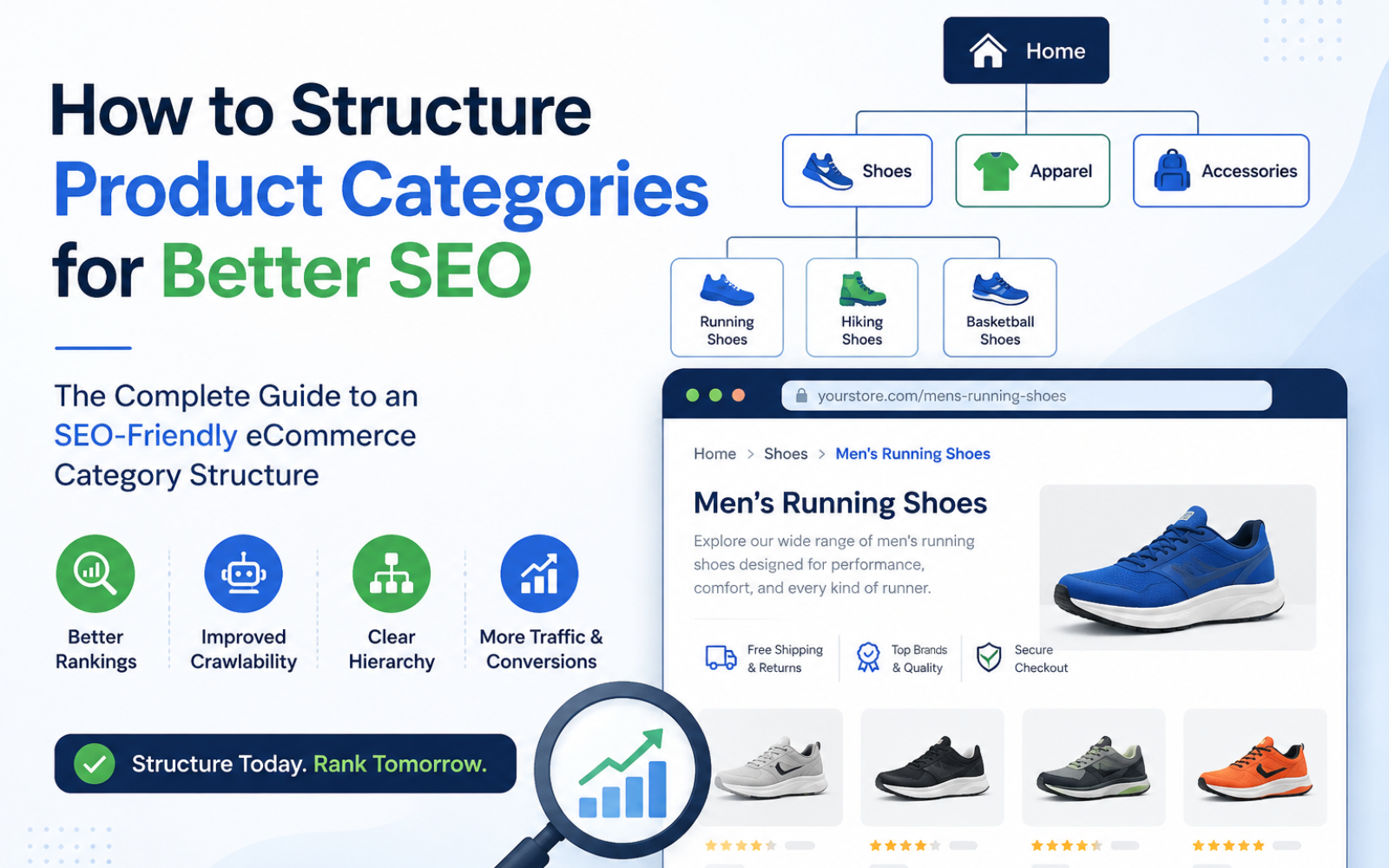
How to Structure Your Product Categories for Better SEO
TL;DR: How to Structure Product Categories for Better SEO
Product category structure is the way an eCommerce site organizes products into logical groups (categories and subcategories) that mirror how customers search and shop. A strong structure:
- Uses 2–3 category levels (Home → Category → Subcategory) for most stores
- Maps one primary keyword/intent per category, avoiding overlap
- Keeps URLs short, descriptive, and stable
- Links categories, subcategories, and products together through consistent internal linking and breadcrumbs
- Controls faceted navigation so filters don't create duplicate, thin, or crawl-wasting URLs
- Gives each category page unique, useful content instead of just a product grid
Get these right and you improve crawlability, indexability, topical relevance, and conversions simultaneously.
What Is Product Category Structure?
Product category structure is the hierarchical system that groups related products under shared labels (e.g., "Running Shoes," "Men's Running Shoes," "Trail Running Shoes"). It defines site architecture — how pages connect through navigation, URLs, and internal links — and it's the primary way both shoppers and search engines understand what a store sells and how those products relate to one another.
What Is an SEO-Friendly Product Category Structure?
An SEO-friendly category structure aligns your taxonomy with actual search demand and intent, not just internal inventory logic. It uses clean URLs, a shallow hierarchy, unique category content, and internal links that pass link equity efficiently — so Google (and AI answer engines) can crawl, index, and rank category pages as authoritative hubs for their topic.
Why Product Category Structure Matters for SEO
Category pages usually target higher-volume, higher-intent commercial keywords ("running shoes") while product pages target long-tail, specific searches ("Nike Pegasus 41 men's size 10"). If your category structure is messy, you get keyword cannibalization, thin content, wasted crawl budget, and weaker topical authority — all of which suppress rankings even if individual product pages are optimized well.
How Search Engines Understand eCommerce Site Architecture
Googlebot builds a model of your site through internal links, XML sitemaps, and URL patterns. A flat, logical hierarchy signals topical relationships (which subcategories belong to which parent) and helps distribute PageRank/link equity from the homepage down to deep product pages. Poor architecture — orphaned pages, excessive depth, duplicate categories — confuses crawlers and dilutes indexation signals.
How to Structure Your Product Categories: Step by Step
- Start with your product inventory. Audit every product and attribute (type, brand, material, use case) before creating categories.
- Identify main categories. These should reflect broad, high-volume search terms (e.g., "Shoes," "Apparel," "Accessories").
- Create logical subcategories. Split by the attribute customers actually search by — gender, use case, or type (e.g., "Trail Running Shoes").
- Build a clear hierarchy. Home → Category → Subcategory → Product. Avoid unnecessary extra layers.
- Map keywords to each category. One primary keyword cluster per page — never duplicate targeting across two categories.
- Match categories to search intent. Commercial ("buy") vs. informational intent should route to different content types.
- Keep the structure shallow. Aim for products reachable within 3 clicks from the homepage.
- Create SEO-friendly URLs. Short, descriptive, lowercase, hyphenated (
/mens-running-shoes/). - Optimize internal linking. Link categories to subcategories, related categories, and top products contextually.
- Use breadcrumb navigation. Reinforces hierarchy for users and search engines alike.
- Handle filters and faceted navigation carefully. Prevent parameter URLs from being crawled/indexed unnecessarily.
- Avoid duplicate or overlapping categories. Each category should serve a distinct purpose.
- Optimize category page content. Add unique intro copy, FAQs, and a real H1 — not just a product grid.
- Manage empty and thin categories. Merge, redirect, or noindex pages with no products or content.
- Connect category and product pages. Reciprocal links help crawlers and users move fluidly between levels.
Example: Good vs. Poor Category Structure
| Good Structure | Poor Structure |
|---|---|
| Home → Running Shoes → Men's Running Shoes → Product | Home → Shoes → Athletic → Men → Running → Road → Cushioned → Product |
| One keyword focus per level | Multiple categories targeting "running shoes" |
Clean URL: /mens-running-shoes/ |
URL: /cat123/subcat45/item.php?id=9981 |
| Unique category copy + FAQs | Empty category, product grid only |
Before vs. After Optimization: A store with 9 category levels and duplicate "Sneakers" and "Athletic Shoes" categories consolidated into 3 levels with one clear "Running Shoes" hub typically sees improved crawl efficiency and consolidated ranking signals, since link equity is no longer split across near-duplicate pages.
Core SEO Elements of a Category Page
| SEO Element | Why It Matters | Best Practice | Common Mistake |
|---|---|---|---|
| Category title/H1 | Confirms topical relevance | Include primary keyword naturally | Generic titles like "Products" |
| Meta title | Click-through from SERPs | Under 60 characters, keyword-first | Duplicated across categories |
| Meta description | Improves CTR | Under 155 characters, benefit-driven | Missing or auto-generated |
| Intro content | Adds unique, indexable text | 100–300 words above the fold | Thin or duplicate boilerplate |
| Subcategories | Aids navigation and crawling | Clearly linked, logically grouped | Buried in dropdowns only |
| Internal links | Distributes link equity | Contextual, descriptive anchors | Generic "click here" links |
| Breadcrumbs | Reinforces hierarchy | Match URL structure | Missing or inconsistent |
| Images/alt text | Supports relevance, accessibility | Descriptive, keyword-aware alt text | Empty or filename-based alt text |
| Schema markup | Enables rich results | Use Product and BreadcrumbList schema | No structured data |
| Canonical tags | Prevents duplicate content | Self-referencing canonical per page | Missing on filtered URLs |
| Pagination | Preserves crawl paths | rel=next/prev or clean paginated URLs | Infinite scroll with no crawlable URLs |
| Filters | Manages faceted navigation | Noindex/parameter handling | All filter combinations indexable |
| FAQs | Targets zero-click and AI search | 3–5 relevant Q&As | Generic, unrelated questions |
| Related categories/products | Improves discovery and dwell time | Genuinely relevant links | Random or automated suggestions |
SEO-Friendly Category Hierarchy
- Homepage: Links to all main categories; distributes authority sitewide.
- Main categories: Broad, high-search-volume topics.
- Subcategories: Narrower intent (gender, type, use case).
- Sub-subcategories: Use sparingly, only with genuine search demand (e.g., "Trail Running Shoes" under "Running Shoes").
- Product pages: The most specific level; should always be reachable from a category page.
Avoid adding a new hierarchy level unless it has distinct search demand and can support multiple products.
Categories vs. Subcategories vs. Product Pages
| Categories | Subcategories | Product Pages | |
|---|---|---|---|
| Search intent | Broad commercial | Narrower commercial | Transactional, specific |
| Keyword focus | "Running shoes" | "Men's running shoes" | "Nike Pegasus 41" |
| Content | Overview + product grid | Filtered grid + intro copy | Full product details |
| Internal links | To subcategories, top products | To products, parent category | To related products/category |
Create a new category only when there's measurable search demand and enough products to populate it meaningfully — otherwise, keep items under an existing category.
Mapping Keywords to Product Categories
Cluster keywords by shared intent, then assign one cluster per page:
- Running Shoes → broad category, "buy running shoes"
- Men's Running Shoes → gendered subcategory
- Women's Running Shoes → gendered subcategory
- Trail Running Shoes → use-case subcategory
- Road Running Shoes → use-case subcategory
Each targets a distinct query pattern, so none compete for the same ranking — this is how you avoid keyword cannibalization.
How Internal Linking Supports Category SEO
Internal links distribute link equity and help crawlers discover pages efficiently:
- Category-to-category: related or sibling categories
- Category-to-product: featured or bestselling items
- Product-to-category: "back to category" links
- Breadcrumbs: reinforce hierarchy on every page
- Contextual links: within category descriptions or blog content
Pages with more relevant internal links tend to be crawled more frequently and treated as more important within the site's architecture.
Faceted Navigation and Product Filters
Faceted navigation lets users filter by size, color, price, etc. — but each combination can generate a unique URL, multiplying pages exponentially. Left unmanaged, this creates duplicate content, wastes crawl budget, and dilutes indexation.
Practical rules:
- Canonicalize filtered URLs back to the main category page unless a filter combination has real search demand.
- Use
noindex,followon low-value parameter combinations. - Reserve indexable, crawlable URLs for high-demand filters (e.g., "blue running shoes" if that has real volume).
- Block unnecessary parameters via robots.txt or URL parameter handling only when appropriate — not as a blanket fix.
Category URLs and SEO
Good: /running-shoes/mens/ Bad: /shop/category.php?id=12&sub=45&ref=nav
- Keep URLs short and descriptive
- Use lowercase letters and hyphens, not underscores
- Avoid unnecessary parameters
- Limit depth to 2–3 folders
- Never change URLs without 301 redirects
Breadcrumbs and Category SEO
Breadcrumbs improve navigation, reinforce site hierarchy, and help search engines understand page relationships. Implementing BreadcrumbList structured data can also enable breadcrumb rich results in search listings, improving perceived relevance and CTR.
Category Pages vs. Product Pages
| Category Pages | Product Pages | |
|---|---|---|
| Purpose | Organize and discover | Convert on a specific item |
| Search intent | Broad/commercial | Narrow/transactional |
| Target keywords | "Running shoes" | Specific product name/SKU |
| Content | Overview, grid, FAQs | Specs, reviews, pricing |
| Internal links | To products, subcategories | To category, related products |
| Conversion intent | Medium | High |
| SEO role | Topical authority hub | Long-tail capture |
Common Product Category SEO Mistakes
- Too many or too few categories
- Deep, overly nested hierarchies
- Duplicate or overlapping categories
- Keyword cannibalization between similar pages
- Keyword-stuffed category names
- Non-descriptive, parameter-heavy URLs
- Thin or empty category pages
- Duplicate category descriptions across pages
- Indexing every faceted filter URL
- Missing breadcrumbs or poor internal linking
- Ignoring actual search intent/demand
- Changing URLs without redirects
- Building categories around inventory alone, not demand
Checklist: Choosing the Right Category Structure
- Does the category have measurable search demand?
- Does it represent a distinct product group?
- Does it match a clear, single search intent?
- Can it support multiple relevant products?
- Can the page offer genuinely useful content?
- Does it overlap with an existing category?
- Is it easy for users to find via navigation?
- Is the URL short, logical, and stable?
- Should this page be indexed at all?
How to Audit an Existing Category Structure
- Pull indexed URLs and crawl stats from Google Search Console.
- Crawl the site with Screaming Frog (or similar) to map hierarchy depth and duplicate/thin pages.
- Cross-reference organic traffic and conversions per category in Google Analytics.
- Run keyword research to confirm each category still matches real demand.
- Check internal link counts per page to spot orphaned categories.
- Review index coverage reports for excluded or duplicate filtered URLs.
- Inspect key URLs directly via URL Inspection in Search Console.
- Confirm your XML sitemap only includes canonical, indexable category URLs.
Platform-Specific Considerations
- Shopify: Collections act as categories; watch URL structure (
/collections/) and manage tag-based filtering to avoid duplicate collection URLs. - Magento/Adobe Commerce: Highly flexible category trees, but layered navigation can generate massive faceted URL sets — canonicalization and indexing rules are critical.
- WooCommerce: Category and tag taxonomies can overlap; consolidate to avoid duplicate content between the two.
- BigCommerce: Similar category/URL flexibility to Shopify; audit auto-generated filter URLs regularly.
Across all platforms, the same principles apply: shallow hierarchy, clean URLs, controlled faceted navigation, and strong internal linking.
How AI Search Changes Product Category SEO
AI Overviews and answer engines like ChatGPT, Gemini, Claude, and Perplexity rely on clear entity relationships and consistent terminology to summarize what a store sells. A well-defined taxonomy — where "Running Shoes" clearly relates to "Men's Running Shoes" and specific products — makes it easier for these systems to extract accurate, quotable answers. Descriptive category names, contextual FAQ content, and consistent internal linking increase the likelihood that AI systems correctly interpret and represent your catalog.
Future Trends in eCommerce Category SEO
- AI-powered product discovery and shopping assistants
- Semantic and entity-based search replacing pure keyword matching
- Generative and conversational commerce experiences
- Dynamic, personalized category pages
- Greater reliance on structured data for AI retrieval
- Continued growth of zero-click and voice search
Frequently Asked Questions
What is product category SEO?
It's the practice of organizing and optimizing category pages so they rank for relevant commercial search terms and support overall site structure.
How should I structure product categories for SEO?
Use a shallow hierarchy, map one keyword focus per category, and connect pages through clear internal linking and breadcrumbs.
How many category levels should an eCommerce website have?
Most stores should use 2–3 levels: main category, subcategory, and occasionally a sub-subcategory for high-demand niches.
Are product categories good for SEO?
Yes — they organize topical authority and let you target broader commercial keywords than individual product pages can.
Should categories be included in product URLs?
It's optional; category-inclusive URLs can aid clarity, but avoid excessive depth or duplication if products belong to multiple categories.
What is the ideal eCommerce site structure?
A shallow, logical hierarchy where any product is reachable within about three clicks from the homepage.
How do I choose keywords for category pages?
Cluster keywords by shared intent and assign each cluster to exactly one category to avoid cannibalization.
Should every product have a category?
Yes — uncategorized products risk being orphaned and harder for both users and crawlers to find.
How do I avoid category keyword cannibalization?
Ensure each category targets a distinct keyword cluster and intent; consolidate near-duplicate categories.
How should I handle product filters for SEO?
Canonicalize or noindex low-value filter combinations; only allow indexing for filters with genuine search demand.
Should filtered category pages be indexed?
Only if the specific filter combination has meaningful, distinct search volume.
How long should a category page URL be?
Short and descriptive — typically 2–4 words, avoiding unnecessary parameters.
How many products should a category page have?
Enough to justify the page's existence — there's no fixed number, but very low counts often signal a category should be merged.
What should I do with empty product categories?
Merge them into a related category, redirect, or noindex until stock is available.
How do breadcrumbs help category SEO?
They reinforce hierarchy for users and search engines and can enable breadcrumb rich results via structured data.
What is the difference between a category page and a product page?
Category pages target broad commercial intent and organize multiple products; product pages target specific, transactional searches.
How can I improve my category pages?
Add unique intro content, FAQs, clear internal links, and proper schema markup.
Does category structure affect Google's crawling?
Yes — a shallow, logical structure improves crawl efficiency and indexation of deeper pages.
How does category structure affect internal linking?
It defines the natural link paths between homepage, categories, subcategories, and products.
How can AI search understand my eCommerce categories?
Through consistent terminology, clear entity relationships, and well-structured internal linking and content.
Final Conclusion
A strong product category structure balances search intent, user experience, product organization, crawlability, indexability, internal linking, conversion intent, and semantic relevance. Get the hierarchy shallow and logical, map keywords carefully, control faceted navigation, and give every category page genuine content and links — and you build a foundation that performs well in both traditional search and AI-driven discovery.
Download The Free E-book & Launch Your Brand Strategically
Download The Free E-book & Launch Your Brand Strategically
Share this post