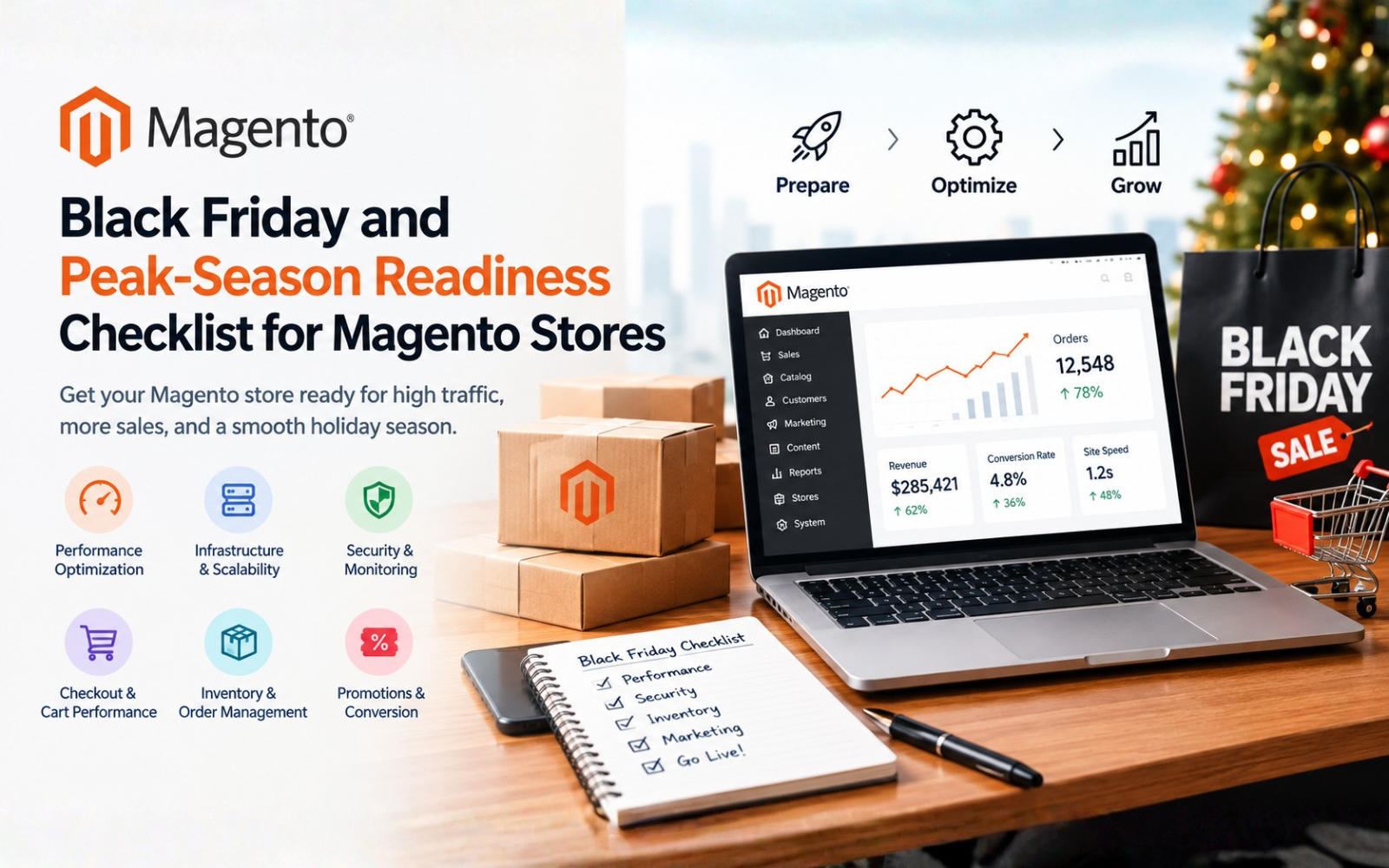
Magento Black Friday and Peak-Season Readiness Checklist
Black Friday changes how a Magento store behaves. Concurrent sessions multiply, checkout activity spikes in short bursts, payment gateways receive more requests per minute than usual, and database queries pile up faster than they clear. A store that runs smoothly in October can slow down or crash in November if it hasn't been prepared specifically for peak load.
What is a Magento Black Friday readiness checklist? It's a structured review of a store's infrastructure, application, database, cache, search, checkout, payments, security, and monitoring systems, done before peak season to confirm the store can handle high concurrent traffic and transaction volume without downtime or checkout failures.
Preparation has to happen weeks before the event, not during it. Once traffic spikes, there's little room to diagnose a slow database query or a misconfigured cache rule.
TL;DR: The Checklist at a Glance
Before Black Friday, review: backups and restore testing, Magento/security patches, extension and theme audits, full-page cache (Varnish), Redis, CDN configuration, database optimization, indexers and cron jobs, queue consumers, search (Elasticsearch/OpenSearch), checkout and payment gateways, inventory sync, load and stress testing, monitoring and alerting, mobile performance and Core Web Vitals, SEO readiness, analytics tracking, and promotion/coupon testing. Each area is covered in detail below.
What Is Magento Black Friday Readiness?
Magento Black Friday readiness means confirming that every layer of the store—server, application, database, cache, search, checkout, payments, inventory, and monitoring—can handle traffic and order volumes well above normal, without manual intervention during the event itself.
Why Normal Performance Doesn't Guarantee Peak Reliability
A store that performs well under everyday traffic is often tested only against predictable load. Black Friday introduces conditions most stores never see: sustained concurrent checkout sessions, repeated cache misses from personalized pricing or promotions, cron and indexer backlogs, and third-party API calls (shipping, tax, fraud checks) that suddenly queue up.
| Normal Day | Black Friday / Peak Season |
|---|---|
| Predictable traffic | Sudden traffic spikes |
| Normal checkout volume | High concurrent checkout |
| Stable database load | Sustained database pressure |
| Standard API usage | Increased API calls (payment, shipping, tax) |
| Routine order volume | Order surges and queue backlogs |
The Complete Readiness Checklist
1. Version and Security
Confirm the Magento/Adobe Commerce version, PHP compatibility, and installed security patches. Review admin access controls, two-factor authentication, and API credentials. Avoid major version upgrades in the weeks immediately before Black Friday—an upgrade introduces new variables at the worst possible time. Security patching, however, should not be skipped for this reason.
2. Backup and Disaster Recovery
A backup file sitting untested is not a recovery plan. Verify database, media, and configuration backups, and actually restore one to a staging environment. A tested rollback procedure matters more than the backup itself.
3. Extension Audit
Every installed extension is a potential bottleneck—extra database queries, external API calls, or unoptimized code. Audit for unused extensions, outdated modules, and overlapping functionality, especially around checkout, payment, shipping, and search. Avoid installing new, untested extensions right before the event; any new code should go through a full QA cycle first.
4. Theme and Frontend Performance
Whether the store runs Luma or Hyvä, frontend weight affects both conversion and Core Web Vitals. Review JavaScript bundle size, image optimization and lazy loading, third-party tracking scripts, and font loading. A slow product page loses mobile shoppers before they ever reach checkout.
5. Cache Configuration
Confirm full-page cache, block cache, and configuration cache are enabled and correctly scoped. Varnish should be tuned for cache hit ratio, and cache warming should run before traffic arrives so the first wave of visitors isn't generating cold-cache database hits.
6. CDN and Edge Performance
A CDN (Cloudflare, Fastly, or similar) offloads static assets and images from the origin server, reducing pressure during traffic spikes. Confirm edge caching rules, image delivery, SSL/TLS configuration, and DDoS protection are active well before the event.
7. Server and Infrastructure Capacity
Review PHP-FPM worker capacity, database connections, disk I/O, and network bandwidth. Confirm auto-scaling rules are configured for cloud environments.
| Component | What to Check | Warning Sign |
|---|---|---|
| CPU | Utilization under load | Sustained high usage |
| RAM | Available memory | Swapping |
| PHP workers | Capacity vs. concurrency | Queue buildup |
| Database | Queries/connections | Slow queries |
| Storage | Disk space | Low capacity |
| Network | Bandwidth | Saturation |
Avoid setting arbitrary server specs without load-testing data to justify them.
8. Database Optimization
Review slow query logs, indexes, and table growth (especially order and log tables). Database bottlenecks ripple into product pages, cart, checkout, and admin operations alike. Clean up log tables and stale data before peak traffic hits.
9. Indexers and Cron Jobs
Confirm indexers are running on schedule mode where appropriate, and that cron jobs and queue consumers are healthy. A delayed cron backlog during Black Friday can mean stale prices, incorrect stock levels, or a delayed sitemap—problems that compound under load.
10. Search Performance
Elasticsearch or OpenSearch should be tested for response time under concurrent queries. Search matters more during Black Friday because shoppers often arrive already knowing what they want.
11. Product Pages and Catalog Readiness
Confirm pricing, promotions, stock availability, product schema, and out-of-stock handling are correct before traffic arrives—errors here are highly visible and costly.
12. Cart and Checkout Optimization
Checkout deserves the most scrutiny of any single area: add-to-cart performance, discount and tax calculation, shipping rate calls, guest checkout, and address validation. Any third-party API dependency in checkout should be tested under load, since a slow external call can stall the entire process.
13. Payment Gateway Testing
Test successful payments, failed payments, webhook and callback handling, and duplicate-order prevention. Payment failures tend to increase during traffic spikes as gateways throttle or time out under load—plan for retry logic and clear failure messaging.
14. Inventory and Order Management
Confirm stock synchronization across sales channels, multi-source inventory reservation, and ERP/warehouse integration to prevent overselling during high-order-volume windows.
15. Load Testing and Stress Testing
Load testing simulates expected peak traffic to confirm the store performs within acceptable limits. Stress testing pushes beyond expected capacity to find the breaking point. Spike testing simulates a sudden traffic surge. Endurance testing checks performance under sustained load over hours.
| Test Type | Purpose |
|---|---|
| Load Test | Expected peak traffic |
| Stress Test | Beyond expected capacity |
| Spike Test | Sudden traffic increase |
| Endurance Test | Sustained traffic over time |
Test browsing, search, add-to-cart, checkout, payment, login, and promotions—not just the homepage.
16. Monitoring and Alerting
Real-time monitoring during Black Friday should cover uptime, server resources, database performance, error logs, checkout and payment failure rates, response times, and order volume. Alerts should reach the right people immediately, not surface only in a dashboard nobody is watching.
17. SEO and Search Readiness
Confirm crawlability, canonical tags, product and breadcrumb schema, mobile usability, and Core Web Vitals. Build and internally link seasonal landing pages (Black Friday, Cyber Monday) at least a few weeks in advance so they have time to be indexed.
18. Analytics and Conversion Tracking
Test GA4 ecommerce events—add_to_cart, begin_checkout, purchase—and UTM tracking before traffic arrives. Broken tracking during Black Friday means lost visibility into what actually worked.
19. Promotions, Coupons, and Cart Rules
Test cart price rules, catalog price rules, and coupon codes under realistic conditions, including stacking rules and customer group restrictions, to avoid pricing errors at checkout.
20. Mobile Commerce Readiness
Mobile traffic often dominates Black Friday. Test mobile page speed, checkout flow, and JavaScript performance separately from desktop—mobile networks and devices behave differently under load.
Readiness Timeline
| Timeline | Priority Tasks |
|---|---|
| 8–12 weeks before | Audit and planning |
| 6–8 weeks before | Performance and infrastructure work |
| 4–6 weeks before | Load and stress testing |
| 2–4 weeks before | Fixes and retesting |
| 1 week before | Freeze risky changes |
| Event day | Active monitoring |
| After the event | Analysis and cleanup |
Common Magento Problems During Black Friday
- Slow product pages — Cause: uncached queries or bloated frontend assets. Impact: bounce rate rises. Prevention: cache warming, image optimization.
- Checkout timeouts — Cause: slow third-party API calls (tax, shipping). Impact: abandoned carts. Prevention: load-test checkout dependencies.
- 502/503 errors — Cause: PHP-FPM worker exhaustion. Impact: site unavailability. Prevention: capacity testing and auto-scaling.
- Database overload — Cause: unindexed queries, log table bloat. Impact: site-wide slowdown. Prevention: query review and cleanup.
- Cron backlog — Cause: overloaded queue consumers. Impact: stale inventory or pricing. Prevention: monitor cron health continuously.
- Payment failures — Cause: gateway throttling under load. Impact: lost orders. Prevention: test failure handling and retries.
What NOT to Do Before Black Friday
- Don't deploy untested extensions or theme changes.
- Don't run risky migrations right before the event.
- Don't change payment providers without full testing.
- Don't skip load testing to save time.
- Don't assume last year's performance still applies.
- Don't rely on uptime monitoring alone—track checkout and payment success rates too.
- Don't make production changes without a rollback plan.
- Don't wait until Black Friday week to discover bottlenecks.
Magento vs. Shopify for Black Friday
Magento (Adobe Commerce) gives merchants deep infrastructure control—custom caching, CDN configuration, and database tuning—but that control comes with the responsibility of proper technical planning and hosting management. Shopify handles infrastructure scaling automatically but offers less flexibility for deep customization. Larger, complex catalogs with specific performance or integration needs often favor Magento's control; simpler catalogs may benefit from Shopify's managed scaling. Neither is universally "better"—the right choice depends on technical requirements and internal resources.
How AI Is Changing Peak-Season Management
Practical today: anomaly detection in monitoring tools, automated performance alerts, AI-assisted customer support, and demand forecasting for inventory planning. Still emerging: fully automated incident response and predictive traffic modeling at scale. Merchants should treat AI tools as an addition to solid monitoring and testing practices, not a replacement for them.
Choosing a Magento Partner for Black Friday Prep
Ask a prospective agency or developer:
- Do you run load and stress tests, or only functional QA?
- How do you configure Varnish, Redis, and CDN together?
- What's your process for auditing extensions for performance?
- Do you provide real-time monitoring and emergency support during the event itself?
- Can you show experience with checkout and payment gateway troubleshooting under load?
Frequently Asked Questions
What is a Magento Black Friday checklist?
A structured list of technical and operational checks—covering caching, checkout, payments, and monitoring—used to confirm a Magento store can handle peak-season traffic without downtime.
How far in advance should I prepare?
Start 8–12 weeks before Black Friday, with load testing completed at least 4–6 weeks prior to leave time for fixes.
Should I update Magento right before Black Friday?
Apply security patches, but avoid major version upgrades in the final weeks—new code introduces risk when there's no time to fully test it.
Should I install new extensions before Black Friday?
No. New, untested extensions should go through a full QA and load-testing cycle well before peak season, not during the freeze period.
How do I load test a Magento site?
Simulate expected peak concurrent users across browsing, search, add-to-cart, checkout, and payment flows using a load-testing tool, then compare results against server and database metrics.
What causes Magento downtime during high traffic?
Common causes include PHP worker exhaustion, unindexed database queries, cron/queue backlogs, and misconfigured caching.
How can I improve checkout performance?
Test third-party API dependencies (tax, shipping, payment) under load, minimize checkout extensions, and confirm guest checkout performs well.
What's the difference between load testing and stress testing?
Load testing confirms performance at expected peak traffic; stress testing pushes beyond that to find the breaking point.
What should I do after Black Friday?
Review monitoring data, analyze conversion and error rates, document issues found, and update the readiness checklist for the next event.
Download The Free E-book & Launch Your Brand Strategically
Download The Free E-book & Launch Your Brand Strategically
Share this post