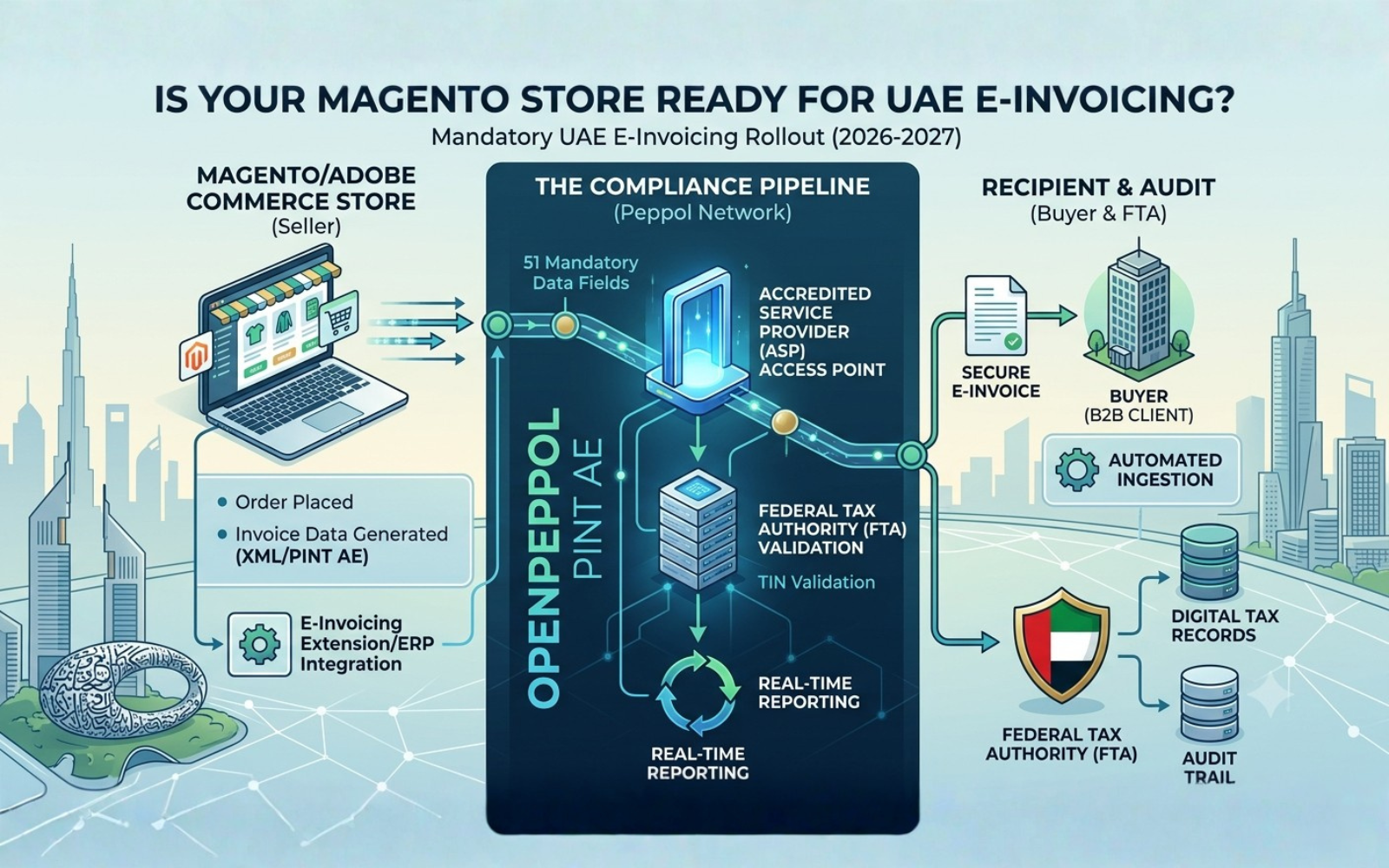
Is Your Magento/Adobe Store Ready for UAE E-Invoicing?
UAE e-invoicing is a standardized, digital process regulated by the Federal Tax Authority (FTA) that requires businesses to generate, transmit, and validate tax invoices in a structured XML format via the decentralized OpenPeppol network. Under this framework, traditional PDF or paper invoices are no longer considered legally compliant for in-scope business-to-business (B2B) and business-to-government (B2G) transactions.
As the United Arab Emirates accelerates its digital tax transformation, eCommerce operators utilizing Magento Open Source and Adobe Commerce must rapidly update their billing architectures.
TL;DR: Urgent Compliance Milestones
- What is changing? The UAE is adopting a Peppol-based, 5-corner Decentralized Continuous Transaction Control and Exchange (DCTCE) model for real-time tax reporting.
- Who is affected? All UAE VAT-registered businesses dealing in B2B and B2G commerce. Business-to-consumer (B2C) transactions are currently excluded until further notice.
- Crucial Deadlines (Updated 2026): Large taxpayers ($\ge$ AED 50 million revenue) must appoint an Accredited Service Provider (ASP) by October 30, 2026, and go live by January 1, 2027. Smaller taxpayers must go live by July 1, 2027.
- Magento Action Plan: You must integrate your storefront or ERP with an ASP via secure APIs to generate PINT AE specification XML files containing the 51 mandatory FTA fields.
What Is UAE E-Invoicing?
UAE e-invoicing is the automated electronic exchange of billing documents between suppliers, buyers, and the Federal Tax Authority (FTA). Rather than emailing standard PDFs, businesses must transmit invoice data as structured XML documents using the globally recognized OpenPeppol standard.
The country implements the Decentralized Continuous Transaction Control and Exchange (DCTCE) model, also known as the 5-corner model:
- Corner 1: The Seller (Your Magento/Adobe Commerce store)
- Corner 2: The Seller’s Accredited Service Provider (ASP / Access Point)
- Corner 3: The Buyer’s Accredited Service Provider (ASP)
- Corner 4: The Buyer
- Corner 5: The Federal Tax Authority (FTA)
When an order is invoiced, the data passes through the ASPs, validating the invoice and reporting tax elements to the FTA in near real-time, eliminating manual audits and batch reporting.
Is UAE E-Invoicing Mandatory?
Yes, electronic invoicing is legally mandatory for all applicable business transactions within the UAE under Ministerial Decisions No. 243 and 244 of 2025. Failure to adopt a compliant system on schedule results in administrative penalties of AED 5,000 per month.
The Ministry of Finance has structured the rollout in distinct phases based on annual revenue thresholds:
Official UAE E-Invoicing Compliance Timeline
| Phase / Taxpayer Category | Revenue Threshold | ASP Appointment Deadline | Mandatory Go-Live Date |
| Pilot Program | Selected Taxpayer Working Group | N/A | July 1, 2026 |
| Wave 1: Large Businesses | $\ge$ AED 50 Million | October 30, 2026 (Extended) | January 1, 2027 |
| Wave 2: SMEs & Others | < AED 50 Million | March 31, 2027 | July 1, 2027 |
| Wave 3: Government Entities | B2G Transactions | March 31, 2027 | October 1, 2027 |
| Intra-VAT Group Transactions | Corporate Groups | N/A | January 1, 2029 (24-Month Grace Period) |
Note on B2C Transactions: Out of scope for the current mandate. If your Magento storefront serves purely retail consumer traffic, your standard UAE VAT configuration remains valid for now. However, B2B wholesale extensions or mixed storefronts must comply immediately.
How UAE E-Invoicing Will Impact Magento & Adobe Commerce Stores
The shift to digital invoicing fundamentally changes how Magento manages checkout calculations, order states, and database storage.
- Data Structure Upgrades: Standard Magento databases capture essential customer metadata, but the FTA now requires 51 mandatory fields. This includes the Tax Identification Number (TIN)—defined as the first 10 digits of the Corporate Tax Registration Number (TRN)—as well as specific legal registration identifiers (TL, EID).
- Currency Conversion Realism: For storefronts processing multi-currency transactions (e.g., USD, EUR, SAR), the final e-invoice data transmitted to the ASP must display VAT amounts and totals converted to UAE Dirhams (AED) utilizing the official UAE Central Bank daily exchange rate.
- Timing of Issuance: Invoices must be transmitted within 14 days of the transaction date for non-registered entities, or strictly aligned with the standard UAE VAT time-of-supply rules for registered firms.
Is Your Magento Store Ready?
Neither Magento Open Source nor Adobe Commerce supports the UAE Peppol PINT AE XML structure out of the box. To assess your operational readiness, evaluate your platform against these three specific checklists.
1. Technical Readiness Checklist
- Can your store generate structured XML invoices complying with the PINT AE specification?
- Is there an active API integration connecting your checkout or ERP to an official Accredited Service Provider?
- Does your checkout process validate the customer's 10-digit TIN in real-time?
- Is your system architecture capable of notifying the FTA within two business days in the event of an unexpected system failure or outage?
2. Business Readiness Checklist
- Has your corporate finance team cleansed master data to ensure all B2B client files contain valid TRNs, legal addresses, and designated billing emails?
- Have you mapped specific transaction scenarios, such as Free Trade Zone exemptions, deemed supplies, or margin schemes?
- Are advance payment workflows structured to issue a compliant e-invoice immediately upon receipt of a deposit, followed by a final invoice detailing only the outstanding balance?
3. Compliance Readiness Checklist
- Are electronic invoice files and cryptographic audit logs archived locally within the UAE for the legally mandated minimum retention period?
- Can your system cleanly differentiate between a standard commercial tax invoice and an electronic tax credit note for order returns?
- Is your internal workflow ready to ingest incoming vendor B2B e-invoices via your own ASP Access Point?
Key Features Required for UAE E-Invoicing
To maintain absolute compliance, any integration module or middleware developed for your Magento store must support the following core technical capabilities:
- XML Invoice Support: Native conversion of database order variables into standardized XML matching the Peppol International (PINT) UAE specifications.
- Automated Invoice Validation: Pre-flight parsing of the document to ensure no missing parameters prior to passing to the ASP.
- Secure API Connectivity: Authenticated, encrypted REST or GraphQL pipelines syncing Magento data tables directly with middleware or service providers.
- Comprehensive Audit Logs: Permanent, unalterable system records showcasing time-stamps of creation, submission, validation receipts, and error codes.
- Automated Document Delivery: Instantaneous transmission of the verified digital invoice payload back to the customer's procurement network via the Peppol grid.
Magento Open Source vs. Adobe Commerce for UAE Compliance
Choosing how to build out your tax architecture depends significantly on whether you run a self-hosted community version or the cloud-based enterprise tier.
| Compliance Feature | Magento Open Source | Adobe Commerce |
| Native Global Tax Engine | Basic table-rate calculation; manual entry. | Advanced Vertex integration; automated calculation. |
| API Flexibility | High; standard REST/GraphQL endpoints available. | Enhanced; optimized Adobe I/O Runtime serverless layer. |
| ERP Integration Speed | Requires third-party extensions or custom code. | Accelerated via App Builder and native integration frameworks. |
| Scalability for Large Volumes | Dependent on server tuning and database indexing. | Enterprise-grade multi-node infrastructure built-in. |
| Audit Log Capability | Manual module installation required. | Native, comprehensive admin and system mutation logging. |
Common Compliance Challenges Businesses Face
- Manual Invoicing Hurdles: Relying on back-office staff to generate invoices post-purchase creates severe processing backlogs, missing the strict time-of-supply reporting windows.
- Incorrect VAT Conversions: Broadly using third-party global currency APIs rather than locking transactions to the official UAE Central Bank daily rates leads to flagrant compliance variations.
- Legacy ERP Disconnections: Magento might process an online sale flawlessly, but if an un-updated legacy ERP acts as the centralized system of record, it may strip out essential PINT AE attributes during synchronization.
- Missing Audit Trails: Failing to capture and document validation responses from ASPs creates immediate liability during formal FTA audits.
Best Practices for Preparing Your Store
Step 1: Formulate a Cross-Functional Project Team
Do not relegate e-invoicing to an isolated IT task. Bring together your e-commerce platform leads, financial controllers, legal counsel, and an expert Magento implementation agency to map your unique operational flows.
Step 2: Cleanse Customer and Vendor Databases
Invalid registration data breaks the automated Peppol chain. Audit existing B2B user registers, enforcing front-end input masks during corporate checkout signups to capture proper 10-digit TINs and specific legal titles.
Step 3: Architect an ASP Connectivity Layer
Evaluate and select a Ministry of Finance pre-approved ASP. Work alongside your developer to establish automated data pipelines, using the extended 2026 timelines wisely to build robust exception-handling protocols.
Integration Options: Connecting Magento to the Peppol Network
Depending on your enterprise architecture, choose one of three common methodologies to pipe storefront transactions directly into the national invoicing ecosystem:
[ Magento / Adobe Commerce ]
       │
       ├──► (Option A: Direct Extension) ──► [ ASP Access Point ] ──► [ Peppol Network / FTA ]
       │
       ├──► (Option B: Centralized ERP)  ──► [ SAP / Oracle ]     ──► [ ASP Access Point ]
       │
       └──► (Option C: Cloud Middleware) ──► [ Adobe I/O / Mule ] ──► [ ASP Access Point ]
A. Direct Extension Integration
For standalone Magento setups running without a heavyweight external back-office, custom modules connect the platform's native invoice generation events directly to an ASP's REST API. This ensures zero operational footprint outside of the web store framework.
B. Enterprise ERP Sync (SAP, Oracle, Microsoft Dynamics)
In modern omnichannel deployments, Magento functions purely as an order capture engine. It passes the sales data down to enterprise resource planning (ERP) suites like SAP, Oracle, or Microsoft Dynamics 365. The ERP, updated with native localized compliance packages, handles the final generation of compliant XML and coordinates directly with the designated ASP.
C. Lightweight Cloud Accounting & Middleware Integration
Mid-market B2B brands often rely on platforms like QuickBooks or Xero coupled with cloud middleware (e.g., Celigo, Make, or Adobe I/O Runtime). The middleware maps the checkout properties, runs essential validation tests, and pushes clean entries downstream into compliant regional accounting applications.
How AI Is Improving Invoice Automation
Integrating artificial intelligence tools into your Magento framework reduces compliance overhead and human error:
- Predictive Validation: AI models intercept order datasets before they reach the ASP, checking for semantic anomalies, missing registration details, or mismatched item classifications based on history.
- Intelligent Document Matching: Automated verification loops systematically tie online purchase orders, shipping manifests, and electronic tax invoices together, producing self-generating audit trails.
- Dynamic Tax Categorization: Machine-learning nodes parse complex multi-line order manifests, automatically assigning correct VAT categories (standard, zero-rated, or exempt) based on dynamic shifts in local tax legislation.
The Future of UAE E-Invoicing
The ongoing digital rollout serves as the bedrock for the UAE’s broader economic digitization initiatives. Over the next decade, expect the FTA to layer real-time predictive tax assessments and direct automated corporate tax filing reconciliation cleanly atop this Peppol foundational grid.
Furthermore, as neighboring GCC countries move swiftly toward matching models, establishing a flexible, API-driven architecture within your Magento or Adobe Commerce storefront ensures seamless cross-border regional expansion without technical friction.
Frequently Asked Questions
What happens if our invoicing integration goes down?
Per FTA guidelines, if your e-invoicing architecture experiences a system failure, you must formally notify the Federal Tax Authority within two business days. Your system must temporarily store offline records and automatically resubmit them once connectivity is restored.
Are B2C eCommerce sales affected by the current UAE e-invoicing laws?
No. Business-to-consumer (B2C) sales are currently excluded from the mandate. Standard Magento VAT configuration and traditional storefront PDF invoices remain acceptable for individual retail clients until future notice.
What is the minimum storage requirement for digital invoices?
All electronic invoices, credit notes, and transactional cryptographic metadata must be stored securely within data hosting infrastructures located inside the UAE for a minimum of 5 to 10 years, matching standard Tax Procedures Law requirements.
Conclusion
The transition to UAE e-invoicing is a major operational shift. With the Wave 1 ASP appointment deadline set for October 30, 2026, large-scale B2B eCommerce operations running Magento Open Source or Adobe Commerce cannot afford to delay integration plans.
Transitioning away from legacy PDFs requires a deep understanding of Magento’s API schema, data mapping, and tax architectures. Don't risk penalties or operational disruption. Contact our senior technical consulting team today to audit your storefront architecture and deploy a bulletproof, Peppol-compliant e-invoicing framework.
Download The Free E-book & Launch Your Brand Strategically

Download The Free E-book & Launch Your Brand Strategically
Share this post