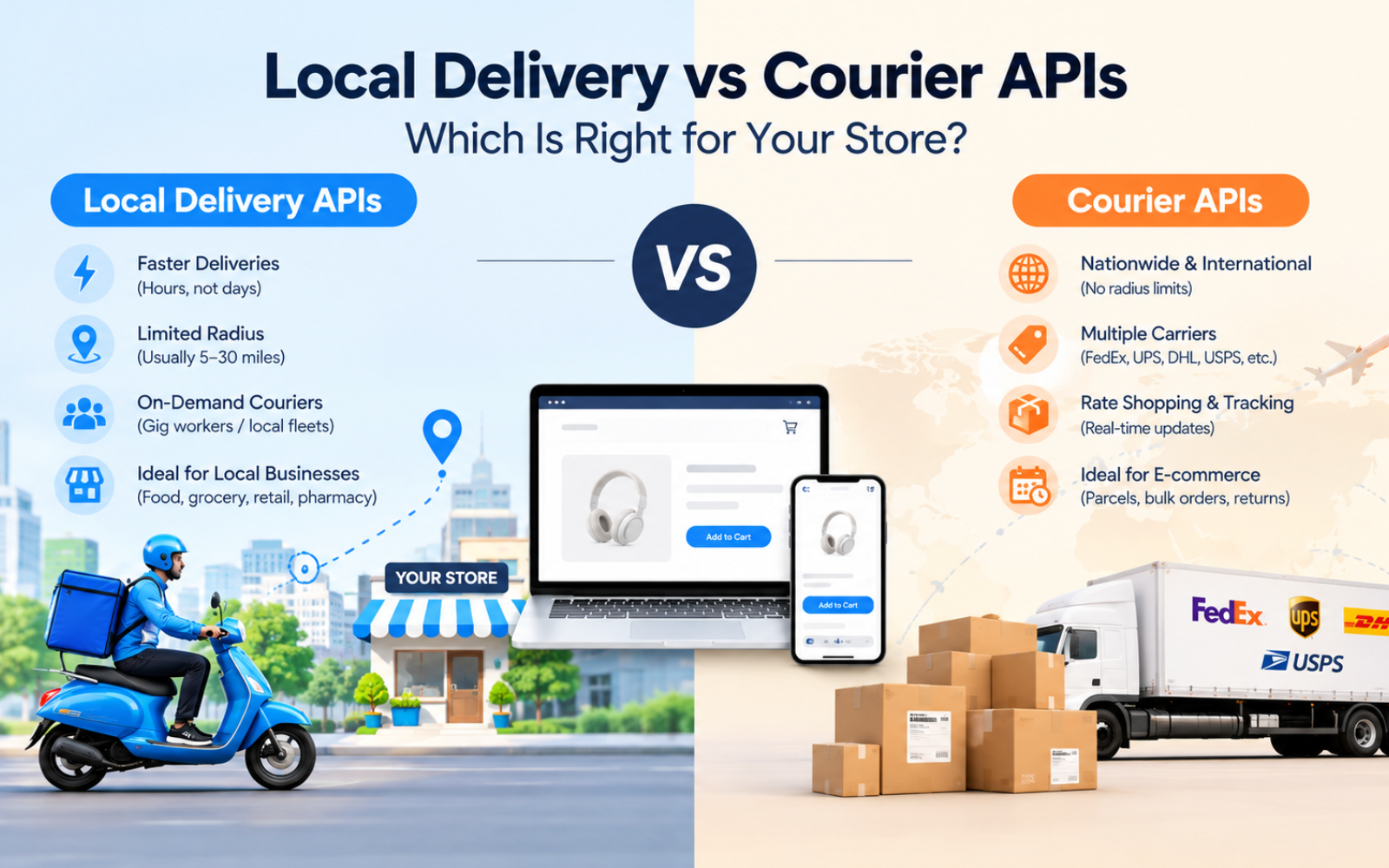
Local Delivery vs Courier APIs: Which Is Right for Your Store?
If you run an online store, your shipping infrastructure is quietly shaping your conversion rate, customer satisfaction, and operational margin — often more than your product or price. And right now, two distinct API-driven delivery models are competing for your attention: local delivery APIs and courier APIs.
Both promise to get orders into customers' hands. Both can be integrated into your store's checkout flow. But they serve fundamentally different needs, and choosing the wrong one can mean paying too much, delivering too slowly, or building on infrastructure that doesn't scale with you.
This guide gives you a clear, detailed comparison of local delivery APIs vs. courier APIs — covering how each works, what they cost, where they excel, and exactly which type of store should use which.
What Is a Local Delivery API?
A local delivery API connects your store to a network of on-demand, hyperlocal couriers — typically gig workers or small fleets — who pick up orders from your location and deliver them within a defined radius, usually within hours.
Think of platforms like DoorDash Drive, Uber Direct, Nash, Dispatch, or Onfleet. These APIs plug into your order management system or checkout flow and dispatch a nearby driver the moment an order is placed or scheduled.
How Local Delivery APIs Work
- Order is placed in your store (online or in-person).
- API triggers a dispatch request — sending pickup location, delivery address, item details, and timing window to the local delivery platform.
- A driver is matched from the nearby pool, often within minutes.
- Pickup and delivery happen — typically same-day, often within 1–4 hours.
- Tracking and proof of delivery are returned to your system via webhooks.
Local delivery APIs are radius-bound — they only work within a service area, usually 5–30 miles from the pickup point. Outside that zone, they either fail or fall back to a courier.
Common Local Delivery API Providers
| Provider | Best For | Coverage |
|---|---|---|
| DoorDash Drive | Restaurants, grocery, retail | US, Canada, Australia |
| Uber Direct | Retail, food, pharmacy | Global cities |
| Nash | Multi-provider local delivery orchestration | US |
| Onfleet | Fleets with own drivers | Global |
| Bringg | Enterprise retail and logistics | Global |
| Shipday | SMBs managing local drivers | Global |
What Is a Courier API?
A courier API connects your store to established parcel carriers — think FedEx, UPS, USPS, DHL, Royal Mail, or aggregators like EasyPost, Shippo, or ShipStation — to generate shipping labels, rate-shop across carriers, track packages, and manage returns.
These APIs are the backbone of traditional ecommerce shipping. They handle parcels that travel through carrier networks, warehouses, and sorting facilities, typically delivering in 1–7 business days depending on the service level selected.
How Courier APIs Work
- Order is placed in your store.
- API queries carrier rates based on package dimensions, weight, origin, and destination.
- Label is generated and attached to the order.
- Package is handed to the carrier at a dropoff point or via scheduled pickup.
- Tracking updates flow back to your store and customer in real time.
Courier APIs are geography-agnostic — they can ship to virtually any address in your target country (or internationally), with no radius limitations.
Common Courier API Providers
| Provider | Type | Best For |
|---|---|---|
| EasyPost | Multi-carrier aggregator | Rate shopping, label generation |
| Shippo | Multi-carrier aggregator | SMBs, startups |
| ShipStation | Order + shipping management | Multi-channel sellers |
| FedEx API | Direct carrier | Overnight, international |
| UPS Developer Kit | Direct carrier | B2B, heavy parcels |
| Stamps.com API | USPS-focused | High-volume domestic |
| Easyship | Global aggregator | International ecommerce |
Local Delivery API vs. Courier API: Core Differences
Before diving into which is right for your store, here's a side-by-side breakdown of how the two models differ across every dimension that matters.
1. Delivery Speed
Local delivery APIs win decisively on speed. Same-day and same-hour delivery are their core value proposition. If your store sells perishables, high-intent purchases, or anything where immediacy is part of the value (a birthday gift ordered at noon, a prescription, a last-minute catering order), local delivery is the only viable API-driven option.
Courier APIs are built for next-day to 5-day windows. Even premium options like FedEx Priority Overnight or UPS Next Day Air require orders to clear a cutoff window and still take 24 hours minimum — and cost significantly more per shipment at expedited rates.
Winner for speed: Local delivery APIs.
2. Geographic Coverage
Courier APIs win on coverage — by a wide margin. EasyPost, Shippo, or a direct FedEx integration will ship to any residential or commercial address in your target market. For national or international ecommerce operations, courier APIs are non-negotiable.
Local delivery APIs are tightly bound by service zones. DoorDash Drive might cover 80% of a major metro area, but a customer 35 miles outside the city boundary simply won't be serviceable. If 30–50% of your customer base lives outside local delivery zones, building exclusively on a local delivery API creates a massive operational gap.
Winner for coverage: Courier APIs.
3. Cost Structure
This is where it gets nuanced.
Local delivery APIs typically charge per-delivery flat fees or mileage-based rates, ranging from $5–$15 for short-distance orders to $20+ for longer runs. There are no dimensional weight calculations, no fuel surcharges buried in fine print (usually), and no packaging minimums. However, the cost per delivery doesn't decrease at volume the way it does with carrier APIs.
Courier APIs price based on weight, dimensions, origin, destination, and service level. For small, lightweight items, USPS First Class through an aggregator can be $3–$6. For larger items or faster service, costs rise sharply. Aggregator APIs like Shippo and EasyPost negotiate discounted rates, making them cost-competitive for high-volume shippers.
For low-volume, urban, same-day delivery: Local delivery APIs are often cost-effective. For high-volume, nationwide shipping of sub-1lb packages: Courier APIs almost always win on unit economics.
Winner for cost: Depends on volume, order weight, and geography. Courier APIs win at scale for standard shipping; local delivery APIs win for same-day urban fulfillment.
4. Integration Complexity
Local delivery APIs are generally simpler to integrate at the surface level. A basic Uber Direct or DoorDash Drive integration can be operational in a weekend. You're typically dealing with: create delivery, track delivery, cancel delivery, webhook for status updates. Most platforms have well-documented REST APIs and SDKs for Node.js, Python, and PHP.
Courier APIs — especially through aggregators like EasyPost or Shippo — can be similarly straightforward for basic label generation. However, full-featured integrations (rate shopping, multi-carrier fallback logic, address validation, return label generation, international customs documentation) add meaningful complexity. Enterprise courier integrations with direct carrier systems (FedEx Web Services, UPS API) require more setup, certification, and ongoing maintenance.
Winner for simplicity: Local delivery APIs for basic use cases; courier APIs through aggregators for mid-complexity needs.
5. Reliability and SLA
This is a real pain point for local delivery APIs. Gig-worker-dependent platforms suffer from driver availability issues — surge periods, bad weather, low-demand zones, and driver cancellations can all delay or fail a delivery. Local delivery platforms are improving at guaranteeing SLAs, but they still can't match the consistency of established carrier networks.
Courier APIs, backed by FedEx, UPS, and USPS infrastructure, offer more predictable — if not always faster — delivery windows. Service failures happen, but they're typically weather-related or exception-based, not a function of driver supply.
Winner for reliability: Courier APIs.
6. Customer Experience and Tracking
Local delivery APIs offer a richer real-time tracking experience. Customers can often see a driver on a map, get minute-accurate ETAs, and receive live SMS or in-app updates. This mirrors the food delivery experience customers are now accustomed to, and it elevates perceived brand quality for local stores.
Courier APIs provide scan-based tracking — updates when a package hits a facility, gets loaded on a truck, or reaches the delivery vehicle. It's less granular but universally understood. Most courier APIs support webhooks for proactive shipment notifications.
Winner for customer experience: Local delivery APIs for real-time, last-mile visibility; courier APIs for familiar, scan-based tracking.
7. Returns and Reverse Logistics
Courier APIs have a mature ecosystem for return label generation, prepaid return slips, and reverse logistics workflows. EasyPost, Shippo, and direct carrier APIs all support programmatic return label creation, making it easy to build self-service return flows.
Local delivery APIs have limited or no standardized return logic. Some platforms support scheduled return pickups, but it's not a core capability and requires custom implementation.
Winner for returns: Courier APIs.
AEO Spotlight: Common Questions Answered Directly
Which API is cheaper for local delivery?
For same-day delivery within a 10-mile radius, local delivery APIs (DoorDash Drive, Uber Direct) typically cost $5–$12 per delivery. Courier APIs cannot offer same-day service at any price in most markets. For standard 3–5 day shipping, courier APIs via aggregators like Shippo cost $3–$8 for lightweight packages — making them cheaper for non-urgent deliveries.
Can I use both a local delivery API and a courier API together?
Yes — and for most scaling stores, this is the right answer. Use a local delivery API for customers within your service radius who select same-day or express delivery, and route all other orders through a courier API. Platforms like Nash or Bringg can handle this orchestration automatically, or you can build routing logic into your own order management system.
Do local delivery APIs work with Shopify or WooCommerce?
Yes. DoorDash Drive, Uber Direct, and Nash all have documented integrations with Shopify. Onfleet and Shipday also offer WooCommerce plugins. For courier APIs, Shippo and ShipStation have first-party Shopify and WooCommerce apps that require minimal custom code.
What's the difference between EasyPost and Shippo?
Both are multi-carrier shipping aggregators that simplify courier API integration. EasyPost is generally preferred by developers for its clean REST API and developer-first documentation. Shippo is more SMB-friendly with a UI dashboard and simpler onboarding. Both offer discounted rates across USPS, FedEx, UPS, and DHL.
Is a courier API or local delivery API better for food delivery?
For restaurant meal delivery, local delivery APIs are the correct choice. DoorDash Drive, Uber Direct, and Stuart (in Europe) are purpose-built for this use case with hot/cold item handling, contactless delivery protocols, and short delivery windows. Courier APIs are not designed for perishable or time-critical food delivery.
Which Type of Store Should Use Which?
Use a Local Delivery API If:
You operate a brick-and-mortar store with local online orders. Florists, bakeries, local grocery stores, dispensaries, pharmacies, and specialty retailers with a defined local customer base are ideal candidates. You have a physical pickup point, an urban or suburban customer base, and orders where the customer expects or demands fast delivery.
You sell perishables or time-sensitive goods. Meal kits, fresh produce, flowers, prescriptions, or event supplies all have hard delivery windows that standard carrier networks can't meet. Local delivery APIs are the only scalable option for these categories.
Your competitive differentiation is speed. If "order by noon, receive by 3pm" is a marketing promise your store makes, you need a local delivery API. No courier integration can reliably fulfill that promise.
You want to compete with Amazon's same-day program locally. For independent stores in urban markets, local delivery APIs are the primary tool for closing the same-day delivery gap that has historically favored Amazon Prime.
Use a Courier API If:
You ship nationally or internationally. Any store with a customer base beyond a single metro area needs a courier API. There is no local delivery platform that covers national geography at competitive rates.
Your products are non-perishable and customers accept 2–5 day delivery. For apparel, electronics, books, supplements, hardware, or any product category where speed isn't a primary purchase driver, courier APIs offer better economics and broader reach.
You have high order volume. At 100+ orders per day, the volume discounts available through courier aggregators like EasyPost or direct carrier contracts with FedEx and UPS become significant. Local delivery APIs don't offer comparable volume-based pricing.
You need robust returns infrastructure. If product returns are a significant part of your operation (as they are in apparel, electronics, or subscription boxes), courier APIs with programmatic return label generation will save you substantial manual effort.
You're dropshipping or fulfilling from a warehouse. Dropshipping operations and third-party logistics (3PL) arrangements don't have a local pickup point, making local delivery APIs structurally incompatible. Courier APIs are the only option.
Use Both If:
You're a multi-location retailer with both urban stores and a national customer base. A hybrid architecture — local delivery API for proximity-based, same-day orders and courier API for everything else — is the most sophisticated and customer-optimal approach. It lets you offer same-day delivery as a premium option at checkout while maintaining national coverage.
You want to offer tiered shipping options at checkout. "Get it in 2 hours — $12" (local delivery API) alongside "Standard shipping — Free, 4-5 days" (courier API) is a checkout experience that serves multiple customer segments and often increases average order value.
Technical Considerations for Integration
Webhook Architecture
Both API types rely on webhooks for status updates, but the event frequency differs significantly. Local delivery APIs fire numerous micro-events — driver assigned, en route to pickup, arrived at pickup, en route to dropoff, delivered — that require your system to handle high-frequency webhook traffic without creating database contention. Courier APIs typically fire fewer events — label created, shipment picked up, in transit, out for delivery, delivered — with hours between updates.
Design your webhook handlers accordingly. For local delivery APIs, use a queue-based architecture (SQS, RabbitMQ, or similar) to buffer and process events asynchronously rather than writing directly to your database on each webhook receipt.
Address Validation
For courier APIs, address validation before label generation is critical. An undeliverable address generates a returned shipment and a refund headache. EasyPost and Shippo both expose address verification endpoints — call these at checkout, not at label generation.
Local delivery APIs perform their own serviceability checks. Your integration should call the platform's coverage or quote endpoint with the customer's address before presenting local delivery as an available checkout option. Presenting local delivery to a customer outside the service zone and then failing silently at fulfillment is a significant UX and trust failure.
Rate Shopping Logic
If you're integrating a courier API with multiple carrier options, implement rate shopping logic that considers both cost and delivery speed. A naive "always choose cheapest" rule can result in slow deliveries; "always choose fastest" erodes margins. Build a scoring function that weights both factors based on your store's priorities, and consider surfacing 2–3 options to the customer at checkout rather than pre-selecting one.
Fallback and Redundancy
Especially for local delivery APIs, build fallback logic. If your primary local delivery platform (say, Uber Direct) returns no drivers available or a quote above your threshold, your integration should automatically fall back to a secondary local platform or route to your courier API. Nash is purpose-built for this multi-provider orchestration use case and can handle fallback logic without you building it from scratch.
Cost Modeling: A Practical Example
Consider a specialty food retailer with 200 orders per month, 60% of which are from customers within 15 miles, and 40% from customers 15–200 miles away.
Without hybrid approach (courier API only):
- All 200 orders via courier, average cost $8/order
- Total shipping cost: $1,600/month
- Customers within 15 miles wait 2–3 days even though same-day is operationally feasible
With hybrid approach:
- 120 local orders via local delivery API at $9/order: $1,080
- 80 courier orders via EasyPost at $6/order (higher weight, longer distance): $480
- Total: $1,560/month
- 60% of customers now get same-day delivery, driving higher satisfaction and repeat purchase rate
- Net incremental revenue from same-day premium charge ($5/order on 80 orders who opt up): $400/month
In this scenario, the hybrid approach pays for itself in the first month and creates a sustainable competitive advantage in the local market.
Vendor Selection Checklist
When evaluating local delivery API providers, ask:
- What is your geographic coverage in my primary markets?
- What is your average time-to-driver-match during peak hours?
- Do you offer SLA guarantees with financial penalties for failures?
- What is your cancellation and refund policy for failed deliveries?
- Do you support scheduled future deliveries, not just on-demand?
- What SDKs and webhook infrastructure do you provide?
When evaluating courier API providers or aggregators, ask:
- Which carriers do you support, and what are the negotiated rates vs. retail?
- Do you support international shipping and customs documentation?
- What is your uptime SLA for label generation?
- Do you support return label generation and reverse logistics?
- How do you handle claims for lost or damaged shipments?
- What is your API rate limit, and how does it scale with volume?
The Future of Delivery APIs: Convergence
The line between local delivery APIs and courier APIs is blurring. DoorDash has launched DoorDash Drive+ for larger retail items. UPS has piloted on-demand local delivery in select markets. Aggregator platforms like Nash are building connectors to both gig-economy delivery networks and traditional carriers, enabling stores to manage both through a single API.
In the next 2–3 years, expect multi-modal delivery APIs that can intelligently route an order to the optimal fulfillment method — local gig driver, regional carrier, autonomous vehicle, or locker network — based on real-time availability, cost, and customer preference. The stores that build flexible, abstracted delivery infrastructure today (rather than hardcoding a single carrier or platform) will be best positioned to take advantage of this convergence.
Summary: Decision Framework
| Factor | Choose Local Delivery API | Choose Courier API | Choose Both |
|---|---|---|---|
| Delivery timeline needed | Same-day / same-hour | 1–7 days acceptable | Multiple tiers |
| Customer geography | Urban / suburban, <30 miles | National / international | Mixed |
| Product type | Perishables, time-sensitive | Durable, non-perishable | Varied catalog |
| Order volume | Low-medium | High | High with local density |
| Returns importance | Low | High | High |
| Integration resources | Minimal | Moderate | Strong dev team |
Final Verdict
There's no universally correct answer between local delivery APIs and courier APIs — but there is a correct answer for your specific store, and it's determined by three questions:
- Where do your customers live relative to your fulfillment location?
- How quickly do your customers need (or want) their orders?
- What is the nature of what you're selling?
If your honest answers are "nearby," "fast," and "perishable or high-urgency," local delivery APIs are your primary tool. If they're "dispersed," "standard timeline," and "durable goods," courier APIs are the right foundation.
And if your store serves both audiences — which is increasingly common as physical retailers build digital channels — the hybrid architecture isn't a complexity tax. It's a competitive moat.
Build the infrastructure that matches your customers' expectations, not the one that was easiest to set up on day one.
Download The Free E-book & Launch Your Brand Strategically

Download The Free E-book & Launch Your Brand Strategically
Share this post