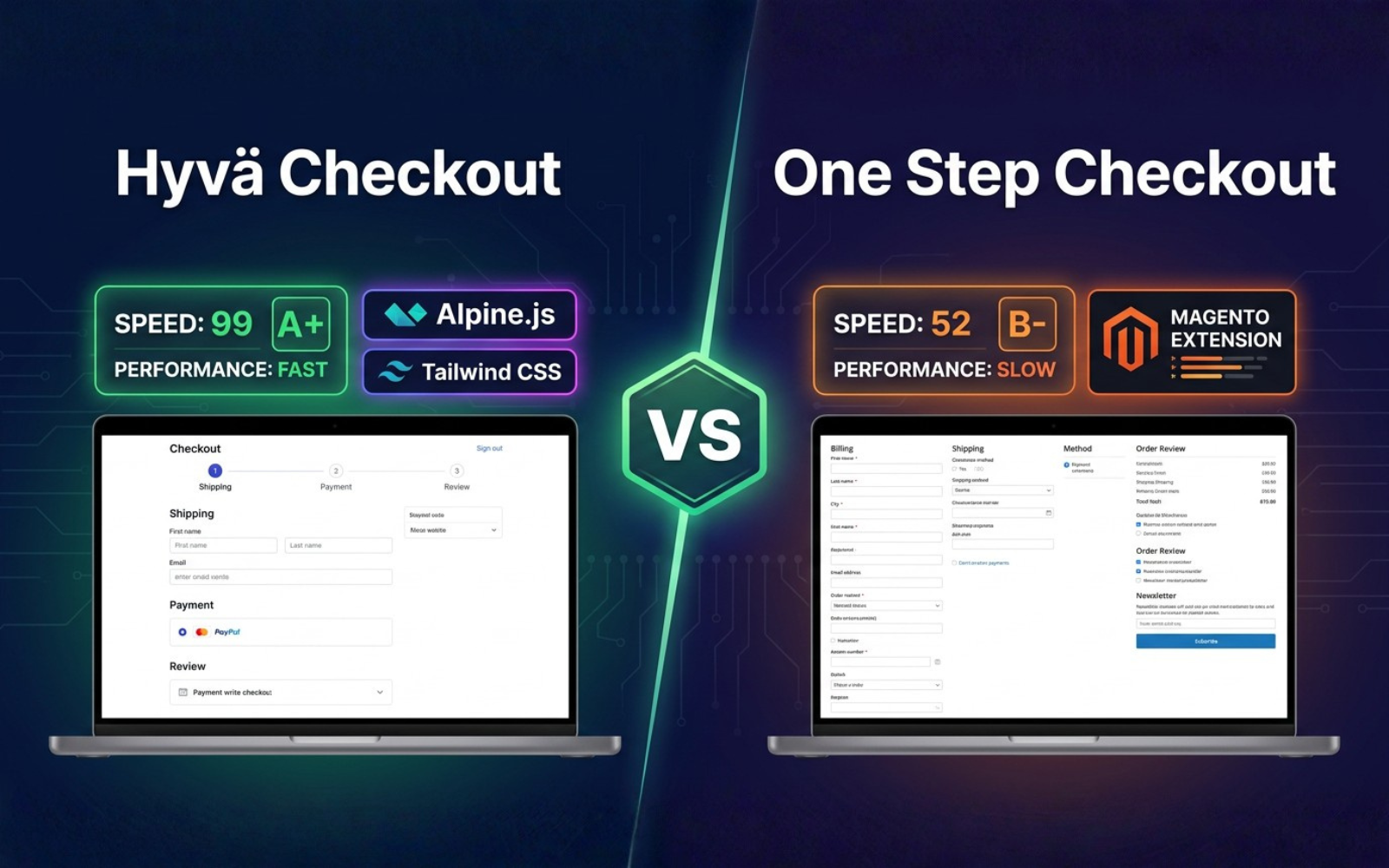
Hyvä Checkout vs One Step Checkout: Which Is Better for Magento Stores?
Choosing the right checkout solution for your Magento store can directly impact your revenue, your customers' experience, and your long-term technical health. Two options consistently come up in this conversation: Hyvä Checkout and One Step Checkout.
Both are designed to solve the same fundamental problem. The default Magento checkout is slow, rigid, and conversion-unfriendly. But Hyvä Checkout and One Step Checkout take very different approaches to solving it. One is a modern frontend rebuild. The other is a feature-rich extension that layers on top of the existing checkout.
This guide breaks down everything you need to know, including performance, UX, customization, pricing, developer experience, and which solution fits different types of Magento businesses.
TL;DR Summary
For merchants who want the short answer before diving deep:
Hyvä Checkout is a complete checkout frontend replacement built on Alpine.js and Tailwind CSS. It prioritizes raw performance, Core Web Vitals, and a clean developer experience. It is ideal for stores already running the Hyvä theme or willing to commit to the Hyvä ecosystem.
One Step Checkout (from providers like Mageplaza or Amasty) is a Magento extension that compresses the standard multi-step checkout into a single page. It is faster to implement, more compatible with existing setups, and requires less technical overhead.
If performance and scalability are your top priorities, Hyvä Checkout is the better long-term investment.
If you need quick wins, broad compatibility, and a lower upfront cost, One Step Checkout is the more pragmatic choice.
What Is Hyvä Checkout?
Hyvä Checkout is a modern, high-performance checkout frontend for Magento 2, built from the ground up using Alpine.js and Tailwind CSS, replacing the legacy Knockout.js and RequireJS stack entirely.
Developed by the team behind Hyvä Themes, Hyvä Checkout was created specifically to address the performance and developer experience problems baked into Magento's default checkout. It removes the heavy JavaScript dependencies that make the standard checkout slow and difficult to customize.
Hyvä Checkout is not a plugin layered on top of Magento's existing checkout architecture. It is a complete replacement of the frontend rendering layer.
Key characteristics of Hyvä Checkout include:
- Built on Alpine.js for reactive UI components
- Uses Tailwind CSS for styling
- Eliminates Knockout.js and RequireJS from the checkout flow
- Dramatically reduces JavaScript payload
- Delivers significantly faster Time to Interactive (TTI)
- Designed to work natively within the Hyvä theme ecosystem
Hyvä Checkout requires a Magento 2 backend but completely reinvents how the checkout frontend operates. This makes it one of the most technically ambitious checkout solutions available in the Magento ecosystem today.
What Is One Step Checkout?
One Step Checkout is a Magento 2 extension that consolidates the default multi-step checkout process into a single page, allowing customers to enter shipping, payment, and order details without navigating between multiple steps.
Unlike Hyvä Checkout, One Step Checkout does not replace the underlying checkout architecture. It works within the existing Magento checkout framework and enhances it by displaying all required fields on one screen.
Several vendors offer One Step Checkout extensions for Magento 2, with the most widely adopted options being:
- Mageplaza One Step Checkout — Feature-rich, widely compatible, and competitively priced
- Amasty One Step Checkout — Known for deep customization and enterprise-grade support
- Aitoc One Step Checkout — A cost-effective alternative for smaller stores
One Step Checkout extensions typically include features like:
- Single-page checkout layout
- Auto-fill for addresses
- Guest checkout optimization
- Inline form validation
- Custom field additions
- Ajax-based order placement
- Compatibility with popular payment gateways
One Step Checkout is a pragmatic, widely adopted solution that fits into most existing Magento setups without requiring significant architectural changes.
Hyvä Checkout vs One Step Checkout: Quick Comparison Table
| Feature | Hyvä Checkout | One Step Checkout |
|---|---|---|
| Architecture | Full frontend replacement | Extension on existing checkout |
| JavaScript framework | Alpine.js | Knockout.js (existing Magento) |
| CSS framework | Tailwind CSS | Depends on theme |
| Performance | Excellent | Moderate improvement |
| Core Web Vitals impact | High positive impact | Moderate improvement |
| Customization flexibility | Very high | High |
| Developer experience | Modern, clean | Familiar but complex |
| Theme compatibility | Requires Hyvä theme | Works with most themes |
| Third-party compatibility | Growing ecosystem | Broad compatibility |
| Implementation complexity | High | Low to medium |
| Time to deploy | Weeks to months | Days to weeks |
| Pricing | Premium (license-based) | Moderate ($150–$500+) |
| Best for | Performance-focused stores | Broad compatibility needs |
| Mobile experience | Superior | Good |
| Long-term scalability | Excellent | Moderate |
Key Differences Explained
Performance and Speed
Performance is arguably the most important differentiator between these two solutions.
Hyvä Checkout eliminates the root cause of Magento checkout slowness. The default Magento checkout loads a large JavaScript bundle built on Knockout.js and RequireJS. These technologies were state-of-the-art in 2015 but are now considered legacy. They add significant weight to the page and delay interactivity.
Hyvä Checkout replaces this entire stack with Alpine.js, which is dramatically lighter. Studies and real-world implementations consistently show Hyvä Checkout delivering JavaScript payloads that are 50 to 90 percent smaller than the default checkout.
One Step Checkout improves on the default checkout experience by reducing the number of steps. However, it still operates within the same Knockout.js framework. The performance gains are real and measurable, but they come from UX simplification rather than architectural improvement.
In terms of raw performance, Hyvä Checkout wins decisively.
User Experience (UX)
Both solutions aim to reduce friction in the checkout process, but they approach UX differently.
One Step Checkout focuses on consolidation. By putting everything on one screen, it removes the cognitive load of navigating between steps. Customers can see the full scope of what is required, fill everything out, and place their order. This approach is proven to reduce checkout abandonment.
Hyvä Checkout focuses on both structure and interaction quality. Because it is built with Alpine.js and a clean UI layer, it can offer smoother transitions, faster inline validation, and a more responsive feel. Every interaction feels faster because the JavaScript overhead is lower.
For the average customer, a well-implemented One Step Checkout will feel like a significant improvement over the default Magento experience. A well-implemented Hyvä Checkout will feel noticeably faster and more modern.
Hyvä Checkout delivers a superior UX ceiling. One Step Checkout delivers reliable UX improvements with less effort.
Mobile Experience
Mobile commerce now accounts for the majority of eCommerce traffic in most markets. A checkout that performs poorly on mobile devices will cost you conversions.
One Step Checkout extensions are generally responsive and mobile-friendly. However, because they operate within Magento's existing JavaScript stack, they can still feel sluggish on slower mobile networks or lower-end devices.
Hyvä Checkout's lightweight JavaScript architecture gives it a genuine advantage on mobile. Pages load faster, interactions feel snappier, and the overall experience aligns much better with what modern mobile users expect.
When tested on mid-range Android devices or 3G/4G connections, the performance gap between Hyvä Checkout and One Step Checkout becomes even more pronounced.
For mobile-first stores or markets where mobile dominates, Hyvä Checkout is the stronger choice.
Developer Experience
This is one of the clearest areas of differentiation.
Magento's default checkout, which underpins all One Step Checkout extensions, is notoriously difficult to work with. Knockout.js components, RequireJS module loading, and deeply nested XML layout files create a development environment that is hard to navigate, difficult to debug, and slow to iterate on.
One Step Checkout extensions add their own layer of customization on top of this already complex system. While experienced Magento developers can work with it effectively, junior developers and frontend specialists unfamiliar with Magento internals often struggle.
Hyvä Checkout is a breath of fresh air for modern developers. Alpine.js is simple and approachable. Tailwind CSS is fast and readable. The codebase is structured more like a modern web application than a legacy enterprise platform.
Developers working with Hyvä Checkout report faster iteration cycles, fewer debugging headaches, and a more enjoyable development experience overall.
For development teams that value productivity and modern tooling, Hyvä Checkout is significantly better.
Customization Flexibility
Both solutions offer strong customization options, but the nature of that customization differs.
One Step Checkout extensions typically come with built-in admin configuration panels. You can add custom fields, reorder sections, change labels, apply custom CSS, and configure behavior without writing code. This makes it accessible to non-technical store owners and junior developers.
For deeper customization, however, One Step Checkout still requires navigating Magento's existing checkout architecture. Adding a custom step, deeply modifying the form structure, or integrating unusual payment flows can become complex quickly.
Hyvä Checkout offers deep structural customization at the code level. Because the entire frontend is rebuilt, developers have complete control over every component. Want a two-column layout? Done. Want a completely custom progress indicator? Straightforward. Want to add a custom upsell step mid-checkout? Achievable without fighting the framework.
The trade-off is that Hyvä Checkout's customization is primarily code-driven. There is no admin panel with drag-and-drop checkout building. This makes it less accessible for non-technical users but far more powerful for development teams.
Hyvä Checkout wins on depth of customization. One Step Checkout wins on accessibility of customization.
Third-Party Compatibility
Compatibility is one area where One Step Checkout has a genuine advantage.
Magento's ecosystem has thousands of extensions, payment gateways, shipping providers, and integrations. Most of these are built to work with the standard Magento checkout architecture. One Step Checkout extensions are designed to maintain this compatibility. They sit on top of the existing system, so the vast majority of third-party modules continue to work without modification.
Hyvä Checkout, by replacing the checkout frontend entirely, creates compatibility challenges. Any third-party extension that injects JavaScript, Knockout.js components, or frontend modifications into the checkout will need to be updated or patched to work with Hyvä Checkout's architecture.
The Hyvä ecosystem is growing rapidly and compatibility is improving. A number of popular extensions now offer dedicated Hyvä compatibility modules. However, if your store relies on many third-party extensions, you will need to audit each one carefully before committing to Hyvä Checkout.
One Step Checkout wins on third-party compatibility. Hyvä Checkout requires more diligence during integration planning.
Payment and Shipping Integrations
Payment gateway and shipping method compatibility is closely tied to the broader third-party compatibility discussion.
One Step Checkout extensions are designed to work with Magento's native payment and shipping infrastructure. Most major payment providers — including Stripe, PayPal, Braintree, Klarna, and Authorize.Net — work with One Step Checkout out of the box or with minimal configuration.
Hyvä Checkout also supports major payment gateways, but compatibility varies by provider. Some payment providers offer native Hyvä-compatible modules. Others require custom integration work. The Hyvä team and community actively maintain compatibility documentation, and the situation continues to improve as adoption grows.
For shipping, both solutions typically work well with standard Magento shipping methods. Third-party shipping rate calculators and carrier integrations may require additional testing.
If payment gateway compatibility is a critical concern, verify Hyvä Checkout compatibility with your specific providers before committing.
SEO Impact
Checkout pages themselves are generally not indexed by search engines, so the direct SEO impact of your checkout solution is limited. However, there are indirect SEO implications worth understanding.
Hyvä Checkout contributes to better Core Web Vitals scores. While Google measures Core Web Vitals primarily on landing pages and product pages, the overall perception of your site's performance can influence crawl behavior and user engagement signals.
More importantly, Hyvä Checkout is often implemented as part of a broader move to the Hyvä theme ecosystem. The Hyvä theme itself delivers substantial performance improvements across your entire storefront, which directly benefits SEO.
One Step Checkout has a neutral to mildly positive SEO impact. It improves the checkout experience, which can reduce abandonment and improve conversion rates — both of which have indirect positive effects on revenue and potentially on engagement metrics.
Neither solution is an SEO silver bullet for checkout pages specifically. However, Hyvä's broader ecosystem benefits deliver stronger indirect SEO gains.
Core Web Vitals Performance
Core Web Vitals are Google's primary performance metrics for measuring page experience. The three key metrics are Largest Contentful Paint (LCP), Interaction to Next Paint (INP), and Cumulative Layout Shift (CLS).
Hyvä Checkout directly improves Core Web Vitals on the checkout page by removing heavy JavaScript dependencies. Stores using Hyvä Checkout consistently report significantly better LCP and INP scores compared to the default Magento checkout.
One Step Checkout can improve these metrics somewhat, primarily by reducing the number of page loads during the checkout process. However, because it still uses the legacy JavaScript stack, its improvements are more modest.
For stores where checkout page performance is actively monitored or where a significant percentage of traffic enters the funnel from performance-sensitive channels, Hyvä Checkout's Core Web Vitals advantage is meaningful.
Hyvä Checkout delivers superior Core Web Vitals performance on the checkout page.
Security and Maintenance
Security is a critical consideration for any component that handles payment and customer data.
Both Hyvä Checkout and reputable One Step Checkout extensions maintain active development and security patch cycles. The key difference is in the maintenance model.
One Step Checkout extensions from established vendors like Mageplaza and Amasty have dedicated security teams and regular update cycles. They are deeply tested against Magento security patches and typically respond quickly to vulnerabilities.
Hyvä Checkout, as a newer solution, has a smaller but highly active development team. The codebase is cleaner and has fewer moving parts, which theoretically reduces the attack surface. However, it requires careful management of Hyvä Checkout updates alongside Magento core updates.
Both solutions are secure when maintained properly. One Step Checkout extensions from major vendors have a longer track record. Hyvä Checkout's cleaner architecture reduces inherent complexity risks.
Scalability
As your Magento store grows, your checkout solution needs to scale with it.
Hyvä Checkout is architecturally better positioned for scaling. Its lightweight frontend reduces server-side rendering load, decreases JavaScript execution time on the client, and integrates cleanly with headless and composable commerce patterns. For stores moving toward API-first architectures or considering progressive decoupling, Hyvä Checkout aligns well with those roadmaps.
One Step Checkout scales reasonably well for most mid-market stores. However, as catalog complexity, traffic volume, and customization requirements grow, the underlying Knockout.js architecture can become a limiting factor. Performance degradation under high load is more common in legacy JavaScript architectures.
Hyvä Checkout is the stronger choice for stores with aggressive growth plans or evolving architecture requirements.
Pricing Comparison
Pricing is often a deciding factor, especially for smaller stores.
Hyvä Checkout Pricing:
Hyvä Checkout is a commercial product available through the Hyvä Themes marketplace. It requires an active Hyvä license. Pricing is typically structured around a one-time license fee plus optional support and update subscriptions. As of recent market data, Hyvä Checkout licensing typically falls in the range of several hundred to a few thousand euros depending on the license tier. Implementation costs add significantly to the total, as skilled Hyvä developers command premium rates.
One Step Checkout Pricing:
- Mageplaza One Step Checkout: Approximately $150–$350 (one-time or subscription depending on edition)
- Amasty One Step Checkout: Approximately $300–$700 depending on features and support tier
- Implementation costs are generally lower, as the extension works within familiar Magento patterns
Total Cost of Ownership Considerations:
- Hyvä Checkout has a higher upfront cost but may deliver lower long-term development costs due to its cleaner codebase
- One Step Checkout has a lower entry cost but customization and maintenance complexity can increase costs over time
For budget-constrained stores, One Step Checkout offers better immediate value. For stores with longer-term performance and growth goals, Hyvä Checkout offers better ROI over time.
Hyvä Checkout Pros and Cons
Pros
- Dramatically improved performance and Core Web Vitals
- Modern developer experience with Alpine.js and Tailwind CSS
- Highly flexible structural customization
- Eliminates legacy JavaScript debt
- Strong alignment with modern frontend practices
- Better mobile performance
- Growing ecosystem and community support
- Future-proof architecture
Cons
- Higher upfront cost
- Requires Hyvä theme or significant setup work
- Smaller pool of experienced developers
- Third-party compatibility requires careful auditing
- Longer implementation timeline
- Less accessible for non-technical customization
- Newer solution with shorter track record
One Step Checkout Pros and Cons
Pros
- Fast implementation
- Lower entry cost
- Broad third-party compatibility
- Works with most existing Magento themes
- Admin panel-based configuration
- Proven track record with thousands of stores
- Large pool of experienced developers
- Familiar Magento architecture
Cons
- Still built on legacy Knockout.js stack
- Performance improvements are limited by underlying architecture
- Customization at depth can be complex
- Not aligned with modern frontend practices
- Mobile performance limited by JavaScript overhead
- Long-term technical debt accumulates
Which Solution Is Better for Different Business Types?
Small Businesses
For small Magento stores with limited technical resources and tight budgets, One Step Checkout is generally the better fit.
It delivers a meaningful improvement over the default checkout without requiring significant investment or specialized development expertise. A standard Mageplaza or Amasty One Step Checkout implementation can typically be completed within a few days and will noticeably improve the customer experience.
Hyvä Checkout's full benefit is realized only when the store also runs the Hyvä theme. For a small business that has not already committed to the Hyvä ecosystem, the cost and complexity of adopting Hyvä Checkout is likely disproportionate to the benefit.
Growing eCommerce Brands
For mid-market stores that are growing rapidly and starting to invest seriously in performance, both solutions deserve consideration.
If the store is already running Hyvä Themes or is planning to migrate to Hyvä, then adopting Hyvä Checkout is the natural and strategically sound next step. The investment pays off through better conversion rates, improved mobile performance, and a more maintainable codebase.
If the store is not yet on Hyvä Themes and has significant third-party dependencies, One Step Checkout may be the more pragmatic intermediate step. It delivers improvement now while longer-term architecture decisions are made.
Enterprise Magento Stores
For enterprise-level Adobe Commerce stores with large catalogs, high traffic volumes, and complex customization requirements, Hyvä Checkout is the more compelling long-term investment.
Enterprise stores typically have development teams capable of implementing Hyvä Checkout properly. They also have more to gain from the performance improvements, as even small percentage improvements in conversion rate translate into significant revenue at scale.
However, enterprise stores also tend to have the most complex third-party integration landscapes. A thorough compatibility audit is essential before committing to Hyvä Checkout at the enterprise level.
International Stores
For stores operating across multiple markets with diverse payment gateway requirements and complex shipping configurations, compatibility is the primary concern.
One Step Checkout extensions from major vendors typically have better out-of-the-box compatibility with regional payment providers and shipping carriers. Hyvä Checkout's compatibility ecosystem, while growing, may not yet cover all regional integrations required by international stores.
International stores considering Hyvä Checkout should conduct a detailed integration audit covering every payment and shipping provider they rely on before making a decision.
Real-World Use Cases
Use Case 1: Fashion eCommerce Brand, Mid-Market
A fashion retailer running Magento Open Source with approximately 50,000 monthly visitors migrated from the default checkout to Mageplaza One Step Checkout. The result was a 15 percent reduction in checkout abandonment and a measurable increase in mobile conversion rates. Implementation took four days. No third-party integrations were broken.
Use Case 2: Industrial B2B Store, Enterprise
A B2B distributor running Adobe Commerce with a complex product catalog and custom pricing rules implemented Hyvä Checkout as part of a full Hyvä theme migration. After a three-month implementation, Lighthouse performance scores on the checkout page improved from the low 40s to above 85. Developer maintenance costs decreased over the following year due to the cleaner codebase.
Use Case 3: Consumer Electronics Retailer, Growing Brand
A growing electronics retailer was using Amasty One Step Checkout and encountered performance bottlenecks as traffic scaled. After evaluating Hyvä Checkout, they found that several critical third-party extensions lacked Hyvä compatibility. They chose to continue with One Step Checkout in the short term while planning a phased Hyvä migration over 12 months.
Common Challenges Solved
Problem: High checkout abandonment rates
Both solutions address this by reducing friction. One Step Checkout solves it through step consolidation. Hyvä Checkout solves it through step consolidation plus significantly better performance.
Problem: Slow checkout on mobile devices
Hyvä Checkout is the stronger solution here. Its lightweight JavaScript architecture performs substantially better on mobile networks and devices.
Problem: Difficulty customizing the checkout layout
Hyvä Checkout offers greater structural flexibility for developers. One Step Checkout offers more accessible admin-based configuration for non-technical users.
Problem: Third-party extension conflicts
One Step Checkout is better positioned here due to its compatibility with the existing Magento architecture.
Problem: High long-term development costs
Hyvä Checkout's modern codebase tends to reduce ongoing development costs for stores with active development teams. One Step Checkout can accumulate technical debt over time.
How AI Is Changing Magento Checkout Experiences
Artificial intelligence is beginning to influence checkout optimization in meaningful ways.
AI-powered personalization tools can now predict checkout friction points, suggest optimal form field ordering, and dynamically adjust the checkout flow based on customer behavior patterns. These capabilities are relevant to both Hyvä Checkout and One Step Checkout, though Hyvä's more modern architecture is generally better positioned to integrate with emerging AI-driven commerce platforms.
AI tools are also being used to analyze Core Web Vitals data at scale, identify performance bottlenecks in the checkout funnel, and recommend optimizations. For stores investing in AI-driven analytics and personalization, a high-performance checkout foundation matters more than ever.
Additionally, conversational commerce and AI-assisted checkout experiences — where chatbots or AI agents guide customers through the purchase process — are emerging as future checkout modalities. These innovations favor checkout architectures that are modular and API-accessible. Hyvä Checkout's alignment with modern frontend patterns makes it a better foundation for these future capabilities.
How to Choose the Best Magento Checkout Solution
Use this decision framework to choose the right solution for your store.
Choose Hyvä Checkout if:
- Your store is already running or planning to migrate to Hyvä Themes
- Performance and Core Web Vitals are top priorities
- You have an experienced development team or budget to hire Hyvä specialists
- You are building for long-term scalability
- You are considering headless or composable commerce patterns
- Mobile performance is a critical business metric
- You are running a high-traffic store where conversion improvements have significant revenue impact
Choose One Step Checkout if:
- You need a fast, cost-effective improvement with minimal implementation risk
- Your store has significant third-party dependencies that need compatibility assurance
- You do not have access to Hyvä-experienced developers
- You are not yet running the Hyvä theme
- You need admin-based configuration options
- Budget constraints make the Hyvä investment impractical right now
- You are managing a store with many regional payment and shipping integrations
Best Practices for Implementation
Regardless of which solution you choose, follow these best practices for checkout implementation.
For both solutions:
- Conduct thorough testing across devices and browsers before go-live
- Test every payment gateway integration end to end
- Implement checkout analytics to track funnel performance from day one
- Set up A/B testing to validate conversion improvements post-launch
- Monitor Core Web Vitals before and after implementation
- Train your team on how to manage and configure the new checkout
For Hyvä Checkout:
- Audit all third-party extensions for Hyvä compatibility before starting
- Engage a developer with verified Hyvä experience
- Plan a longer implementation timeline to accommodate architectural complexity
- Budget for custom compatibility work on any extensions without native Hyvä support
For One Step Checkout:
- Choose an extension from a reputable vendor with active support and update cycles
- Test thoroughly with your existing theme to avoid CSS conflicts
- Verify compatibility with all payment gateways before deployment
- Configure guest checkout and address auto-fill to maximize conversion improvements
Future Trends in Magento Checkout Optimization
The Magento checkout landscape is evolving in several important directions.
Headless and composable checkout — The trend toward decoupled frontends is accelerating. As more stores move toward headless Magento architectures, checkout solutions that are API-first and frontend-agnostic will gain advantage. Hyvä Checkout is better aligned with this trend than traditional One Step Checkout extensions.
Progressive Web App (PWA) checkout — PWA-based checkout experiences deliver app-like speed and offline capabilities. While this is distinct from both Hyvä Checkout and One Step Checkout, Hyvä's modern architecture is more compatible with PWA patterns.
AI-driven checkout personalization — As discussed earlier, AI will increasingly be used to personalize and optimize checkout flows dynamically. Modern checkout architectures will have an advantage in integrating these capabilities.
Biometric and one-click payment — The growth of biometric payment authentication and saved payment methods will continue to shorten checkout flows. Both solutions will need to integrate with these payment innovations over time.
Performance budgets as standard practice — As Core Web Vitals become more central to both user experience standards and search ranking signals, stores that have not yet addressed checkout performance will face increasing competitive pressure to do so.
Frequently Asked Questions
Q: Can I use Hyvä Checkout without the Hyvä theme?
Technically, Hyvä Checkout can be used independently of the Hyvä storefront theme, but it is designed to work within the Hyvä ecosystem. Using it with a non-Hyvä theme requires significant additional development work and is generally not recommended without experienced Hyvä developer support.
Q: Does One Step Checkout work with Adobe Commerce (Magento Enterprise)?
Yes. Major One Step Checkout extensions like those from Mageplaza and Amasty are compatible with both Magento Open Source and Adobe Commerce. Always verify version compatibility with your specific Adobe Commerce release before purchasing.
Q: How much does Hyvä Checkout cost compared to One Step Checkout?
Hyvä Checkout requires a commercial license, typically costing several hundred to a few thousand euros depending on the tier. One Step Checkout extensions from major vendors typically range from $150 to $700 for the extension itself. Implementation and customization costs vary significantly for both.
Q: Which solution reduces checkout abandonment more effectively?
Both solutions reduce checkout abandonment compared to the default Magento experience. Hyvä Checkout tends to deliver greater improvement due to its combined performance and UX advantages. One Step Checkout delivers reliable and measurable abandonment reduction with lower implementation risk.
Q: Is Hyvä Checkout compatible with PayPal, Stripe, and Klarna?
Hyvä Checkout maintains a growing list of compatible payment providers. PayPal, Stripe, and Klarna all have compatibility support, though it is important to verify specific module versions and check the official Hyvä compatibility documentation before implementation.
Q: Which checkout solution is better for SEO?
Neither solution directly impacts SEO on checkout pages, as these pages are typically excluded from indexing. However, Hyvä Checkout contributes to better Core Web Vitals and is part of an ecosystem that delivers sitewide performance improvements, which indirectly supports SEO.
Q: How long does it take to implement Hyvä Checkout?
A full Hyvä Checkout implementation, including theme setup and compatibility work, typically takes four to twelve weeks depending on store complexity, number of third-party integrations, and developer experience level.
Q: How long does One Step Checkout take to implement?
A standard One Step Checkout extension can typically be installed, configured, and tested within two to five business days for straightforward stores. More complex stores with custom themes or many extensions may require additional time.
Q: Can I switch from One Step Checkout to Hyvä Checkout later?
Yes. Many stores use One Step Checkout as an intermediate solution and migrate to Hyvä Checkout when they are ready to invest in the broader Hyvä ecosystem migration. Planning this transition from the start helps minimize rework.
Q: Which solution is better for B2B Magento stores?
B2B stores often have complex checkout requirements including custom pricing, quote-based ordering, and multiple approval workflows. Hyvä Checkout offers greater structural flexibility for building these custom flows, but requires more development investment. One Step Checkout is a faster starting point for B2B stores with simpler checkout requirements.
Final Conclusion
Hyvä Checkout and One Step Checkout both solve a real problem — the default Magento checkout is not good enough for modern eCommerce. But they solve it in fundamentally different ways, and the right choice depends entirely on your store's specific situation.
Hyvä Checkout is the better solution for stores that prioritize performance, developer experience, and long-term scalability. It delivers genuine architectural improvement, not just UX polish. For stores committed to the Hyvä ecosystem, the investment is well justified and increasingly supported by a growing developer community and extension compatibility landscape.
One Step Checkout is the better solution for stores that need reliable improvement now, without significant architectural risk or investment. It is proven, compatible, and delivers meaningful conversion gains across a wide range of Magento stores.
There is also a third path that many successful stores follow: implement One Step Checkout now while planning a longer-term migration to Hyvä. This approach captures immediate conversion improvements while setting the stage for the stronger performance foundation that Hyvä Checkout delivers.
The Magento ecosystem is moving toward lighter, faster, and more modern frontend architectures. Hyvä is leading that transition. If your store is planning for the next three to five years, Hyvä Checkout represents the direction the platform is heading.
If your store needs improvement in the next three to five weeks, One Step Checkout is ready to deliver.
Choose based on where your store is today and where you want it to be tomorrow.
Download The Free E-book & Launch Your Brand Strategically

Download The Free E-book & Launch Your Brand Strategically
Share this post