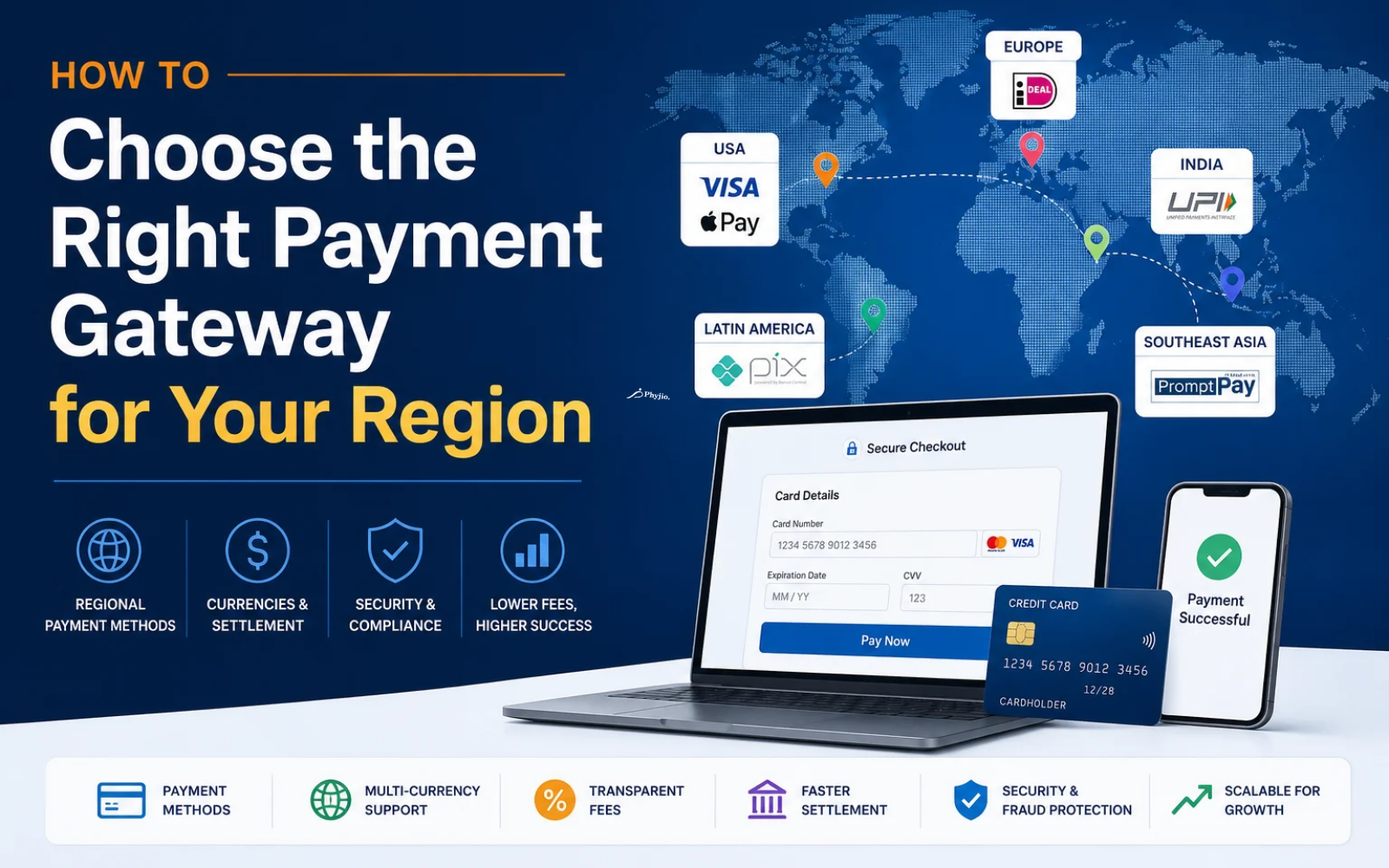
How to Choose the Right Payment Gateway for Your Region
Choosing a payment gateway is not simply about finding the provider with the lowest transaction fee. The right gateway depends on where your business operates, where your customers are located, which payment methods they prefer, which currencies you need to accept, how funds are settled, and what compliance requirements apply to your market.
Payment behavior is deeply regional. A shopper in India may expect UPI. A shopper in the Netherlands may expect iDEAL. A shopper in the US may expect a saved card or Apple Pay. A gateway that performs well in one region may be a poor fit in another — even if the pricing looks identical on paper.
Short answer: The right payment gateway depends on your business location, customer location, required payment methods, currencies, fees, settlement needs, security requirements, and platform integration — not on which provider markets itself as "the best."
How Do You Choose the Right Payment Gateway for Your Region?
To choose the right payment gateway for your region, identify where your business and customers are based, list the local payment methods your customers expect (cards, wallets, bank transfers, BNPL), confirm currency and settlement support, compare fee structures, and verify the gateway meets regional security and compliance standards before integrating it with your platform.
TL;DR: Key Decision Factors
- Business location — where you're legally registered
- Customer location — where your buyers actually are
- Payment methods — cards, wallets, bank transfers, BNPL, real-time payments
- Currency support — presentment and settlement currencies
- Fees — domestic vs. international, FX, refund, chargeback costs
- Settlement — frequency, currency, and payout timing
- Security — PCI DSS, 3D Secure, tokenization, fraud tools
- Compliance — regional regulatory requirements
- Integration — API, SDKs, platform compatibility
- Scalability — ability to support new markets as you grow
What Is a Payment Gateway?
Short answer: A payment gateway is the technology that securely captures and transmits payment data from a customer's checkout to the payment processor and card network for authorization, before settling funds to the merchant's account.
Several related terms are often confused:
- Payment gateway — captures and encrypts payment data at checkout
- Payment processor — moves transaction data between the gateway, card networks, and banks
- Merchant account — the account that holds funds before they're transferred to your business bank account
- Acquirer — the bank that accepts card payments on the merchant's behalf
- Issuer — the customer's bank that issued the card or account
- Card network — networks such as Visa or Mastercard that route authorization requests
Basic payment flow: Customer submits payment details → gateway encrypts and forwards the data → processor routes the request → issuer approves or declines → acquirer receives funds → gateway/processor settles funds to the merchant, typically within a few business days, depending on the provider and region.
Why Your Region Matters When Choosing a Payment Gateway
Location affects nearly every part of the payment experience:
- Available payment methods — UPI is dominant in India; iDEAL is widely used in the Netherlands; ACH and BNPL are common in the US
- Supported currencies — not every gateway settles in every currency
- Transaction fees — domestic fees are typically lower than cross-border fees
- Settlement currency and timing — payout schedules vary by provider and country
- Local banking infrastructure — real-time payment rails like UPI, Faster Payments, Pix, and FedNow differ by country
- Regulatory requirements — rules such as PSD2/SCA in Europe affect authentication flows
- Fraud patterns — risk profiles vary by market and payment method
- Customer trust and success rates — customers convert better when they see familiar payment options
Example: An eCommerce store based in the UK selling into the EU may need to support SEPA transfers and comply with PSD2 Strong Customer Authentication, while a US-based SaaS company selling domestically may prioritize card acceptance and ACH support instead.
How to Choose the Right Payment Gateway: A Step-by-Step Framework
1. Identify Where Your Business Is Based
Your business's registered country often determines which gateways you're eligible to use, which currencies you can settle in, and which local regulations apply.
2. Identify Where Your Customers Are Located
If you sell only domestically, a local gateway with strong regional payment method support may suffice. If you sell internationally, you'll need multi-currency and cross-border capabilities.
3. List the Payment Methods Your Customers Expect
Common categories include:
- Credit and debit cards
- Digital wallets (Apple Pay, Google Pay)
- Bank transfers (SEPA, ACH, local bank transfers)
- Real-time payments (UPI, Pix, Faster Payments, FedNow)
- Buy Now, Pay Later (BNPL)
- Mobile and QR-based payments
4. Check Supported Currencies
- Multi-currency payments — accepting multiple currencies at checkout
- Presentment currency — the currency shown to the customer
- Settlement currency — the currency you're paid in
- FX fees — costs applied when converting between currencies
5. Compare Payment Gateway Fees
| Fee Type | Description |
|---|---|
| Transaction fee (fixed) | Flat amount per transaction |
| Transaction fee (percentage) | Percentage of transaction value |
| International fee | Additional charge for cross-border cards |
| Currency conversion fee | Charged when settling in a different currency |
| Refund fee | May apply even when refunding a customer |
| Chargeback fee | Charged when a dispute is filed |
| Payout fee | Cost of transferring funds to your bank |
| Monthly/platform fee | Recurring account or subscription cost |
Actual fees vary by provider, business type, transaction volume, and country, and should always be confirmed on the provider's official pricing page.
6. Check Settlement Options
Review settlement frequency, whether payouts arrive in local currency, minimum bank account requirements, and any minimum payout thresholds — these vary significantly between providers.
7. Evaluate Fraud Prevention and Security
Look for PCI DSS compliance, 3D Secure authentication, tokenization, encryption, risk-based scoring, and chargeback management tools.
8. Check Regional Compliance
Compliance requirements differ by jurisdiction and change over time. This article does not provide legal advice — verify current requirements with your payment provider and the relevant regulatory authority in your market.
9. Check eCommerce Platform Compatibility
Confirm native or plugin support for Shopify, WooCommerce, Magento/Adobe Commerce, BigCommerce, custom-built sites, or SaaS platforms before committing.
10. Evaluate API and Developer Experience
Assess REST APIs, SDKs, webhooks, hosted checkout options, payment links, documentation quality, and sandbox testing environments.
11. Check Subscription and Recurring Payment Support
SaaS, membership sites, and subscription businesses need reliable recurring billing APIs, retry logic for failed payments, and dunning management.
12. Evaluate Customer Support
Confirm support availability in your time zone, technical onboarding assistance, and dispute-resolution support.
Best Payment Gateway by Region
No single provider is best for every region. Availability, supported methods, and pricing change frequently and should be verified directly with each provider.
| Region | Common Payment Priorities | What to Evaluate |
|---|---|---|
| India | UPI, cards, wallets, bank payments | UPI support, settlement, domestic transaction handling |
| United States | Cards, wallets, ACH, BNPL | Card acceptance, ACH support, fraud tools |
| United Kingdom | Cards, wallets, bank payments | GBP settlement, Faster Payments support |
| Europe | Cards, SEPA, local methods (iDEAL, BLIK) | EUR support, PSD2/SCA considerations |
| UAE | Cards, wallets, local preferences | AED settlement, regional support |
| Australia | Cards, wallets, bank payments | AUD settlement, fraud prevention |
| Singapore | Cards, wallets, bank payments | SGD support, regional methods |
Domestic vs. International Payment Gateways
| Factor | Domestic Gateway | International Gateway |
|---|---|---|
| Payment methods | Local methods (e.g., UPI, iDEAL) | Broader mix of cards and wallets |
| Currencies | Usually single-currency | Multi-currency support |
| Fees | Generally lower for domestic cards | Often higher due to cross-border/FX costs |
| Settlement | Local bank, faster in some cases | May involve currency conversion |
| Compliance | Local regulations only | Multiple jurisdictions |
| Fraud risk | Lower cross-border exposure | Higher exposure, needs stronger tools |
| Customer experience | Familiar local options | Requires localization per market |
Payment Gateway vs. Payment Processor vs. Merchant Account
| Term | What It Does |
|---|---|
| Payment gateway | Captures and encrypts checkout payment data |
| Payment processor | Routes transaction data between banks and networks |
| Merchant account | Holds funds temporarily before transfer to your bank |
Many modern providers, such as Stripe or Razorpay, bundle these functions into a single platform, which is why the terms are often used interchangeably in everyday conversation.
Payment Gateway vs. Payment Service Provider (PSP)
A payment gateway technically refers to the checkout technology layer. A payment service provider (PSP) typically bundles the gateway, processing, and merchant account functions together, simplifying onboarding for smaller businesses. You'll encounter both terms because providers market themselves differently depending on their target audience.
Hosted Checkout vs. Direct API Integration
| Factor | Hosted Checkout | Direct API Integration |
|---|---|---|
| Implementation effort | Low | Higher |
| Customization | Limited | Extensive |
| Security responsibility | Largely handled by provider | Shared with merchant |
| Checkout experience | Standardized | Fully brandable |
| Maintenance | Minimal | Ongoing developer involvement |
Cloud-Based Payment Processing
Most modern payment gateways run on cloud infrastructure, allowing merchants to scale transaction volume, add markets, and integrate via APIs without managing physical processing hardware. This is a major reason cloud-based providers dominate eCommerce and SaaS payment stacks today.
How Payment Gateway Choice Affects Conversion Rates
Payment friction directly impacts checkout completion. Missing local payment methods, unexpected currency conversion, or failed authentication can increase cart abandonment. [STATISTIC PLACEHOLDER] International customers, in particular, are more likely to abandon checkout if their preferred payment method or currency isn't available.
Common Payment Gateway Mistakes
- Choosing only based on advertised price
- Ignoring local payment method preferences
- Overlooking settlement currency and timing
- Not checking international transaction fees
- Failing to confirm supported currencies upfront
- Ignoring chargeback exposure
- Underestimating fraud protection needs
- Selecting a gateway without proper platform integration
- Not testing failed and declined payment scenarios
- Not reviewing refund workflows before launch
- Skipping the fine print in contract terms
- Not planning for future market expansion
Payment Gateway Use Cases
Indian eCommerce store selling domestically: Should prioritize UPI support, fast domestic settlement, and card acceptance for a strong local checkout experience.
US store selling internationally: Needs multi-currency pricing, cross-border fraud tools, and clear FX fee visibility.
SaaS company: Requires robust recurring billing APIs, failed-payment retry logic, and automated invoicing.
Shopify store: Should confirm native platform integration and support for regionally relevant payment methods.
Magento/Adobe Commerce store: Needs strong API/module support, reliable checkout compatibility, and clear refund and order-management workflows.
Marketplace: Requires split payment functionality, seller payout management, and KYC support for onboarding multiple sellers.
How to Compare Payment Gateways: A Scoring Framework
| Factor | Weight |
|---|---|
| Payment methods | 20% |
| Regional availability | 15% |
| Fees | 15% |
| Currency support | 10% |
| Settlement | 10% |
| Security & fraud prevention | 10% |
| Integration | 10% |
| Customer support | 5% |
| Scalability | 5% |
Adjust these weights based on your business model — a subscription business may weight recurring billing more heavily, while a marketplace may prioritize payout flexibility.
How Much Does a Payment Gateway Cost?
Pricing structures vary by provider, market, and business type, and typically include a mix of per-transaction percentage fees, fixed fees, international transaction fees, currency conversion fees, refund fees, chargeback fees, payout fees, monthly platform fees, and setup or premium feature costs. Always confirm current pricing directly on the provider's official pricing page rather than relying on third-party estimates.
How AI Is Changing Payment Processing
Established capabilities already in wide use include AI-driven fraud detection, transaction risk scoring, and behavioral analysis to flag suspicious activity. Emerging applications — including smart payment routing, payment failure prediction, and automated reconciliation — are developing rapidly but vary in maturity across providers.
Future of Payment Gateways
Trends shaping the industry include real-time and account-to-account payments, embedded payments within apps and platforms, open banking, biometric authentication, tokenized payments, and continued growth of digital wallets. Discussion of stablecoin and digital-asset payment infrastructure remains an emerging, evolving area rather than a settled standard.
People Also Ask
What is the best payment gateway for my country?
It depends on which payment methods, currencies, and settlement options your customers and business require — no single gateway is best for every country.
Which payment gateway is best for international payments?
Look for strong multi-currency support, competitive cross-border fees, and robust fraud tools rather than a single "best" provider.
How do I choose a payment gateway?
Match your business and customer locations, required payment methods, currencies, fees, and platform compatibility against each provider's capabilities.
Which payment gateway has the lowest fees?
Fees vary by provider, region, and transaction type — compare official pricing pages directly rather than relying on general claims.
Can one payment gateway support multiple countries?
Many providers support multiple countries, but coverage and payment methods vary and should be confirmed for your specific markets.
Can I accept payments in multiple currencies?
Many gateways support multi-currency acceptance, though settlement currency and FX fees differ by provider.
What is the difference between a payment gateway and a payment processor?
A gateway captures and encrypts checkout data; a processor routes that data between banks and card networks.
Do I need a merchant account?
Some providers require a separate merchant account; others bundle this function into an all-in-one platform.
Is PayPal a payment gateway?
PayPal functions as both a payment gateway and a payment service provider, offering checkout processing and account-based payments.
Is Stripe available in every country?
No — availability varies by country and should be confirmed on Stripe's official coverage page.
What payment gateway is best for Shopify?
This depends on your target markets and required payment methods; check Shopify's list of supported providers for your region.
What payment gateway is best for Magento?
Choice depends on required payment methods, currencies, and available Magento extensions or modules.
What payment gateway is best for SaaS?
SaaS businesses should prioritize recurring billing support, failed-payment recovery, and subscription management tools.
How can I reduce payment processing fees?
Compare fee structures across providers, negotiate volume-based pricing where possible, and minimize unnecessary cross-border or currency conversion costs.
Download The Free E-book & Launch Your Brand Strategically

Download The Free E-book & Launch Your Brand Strategically
Share this post