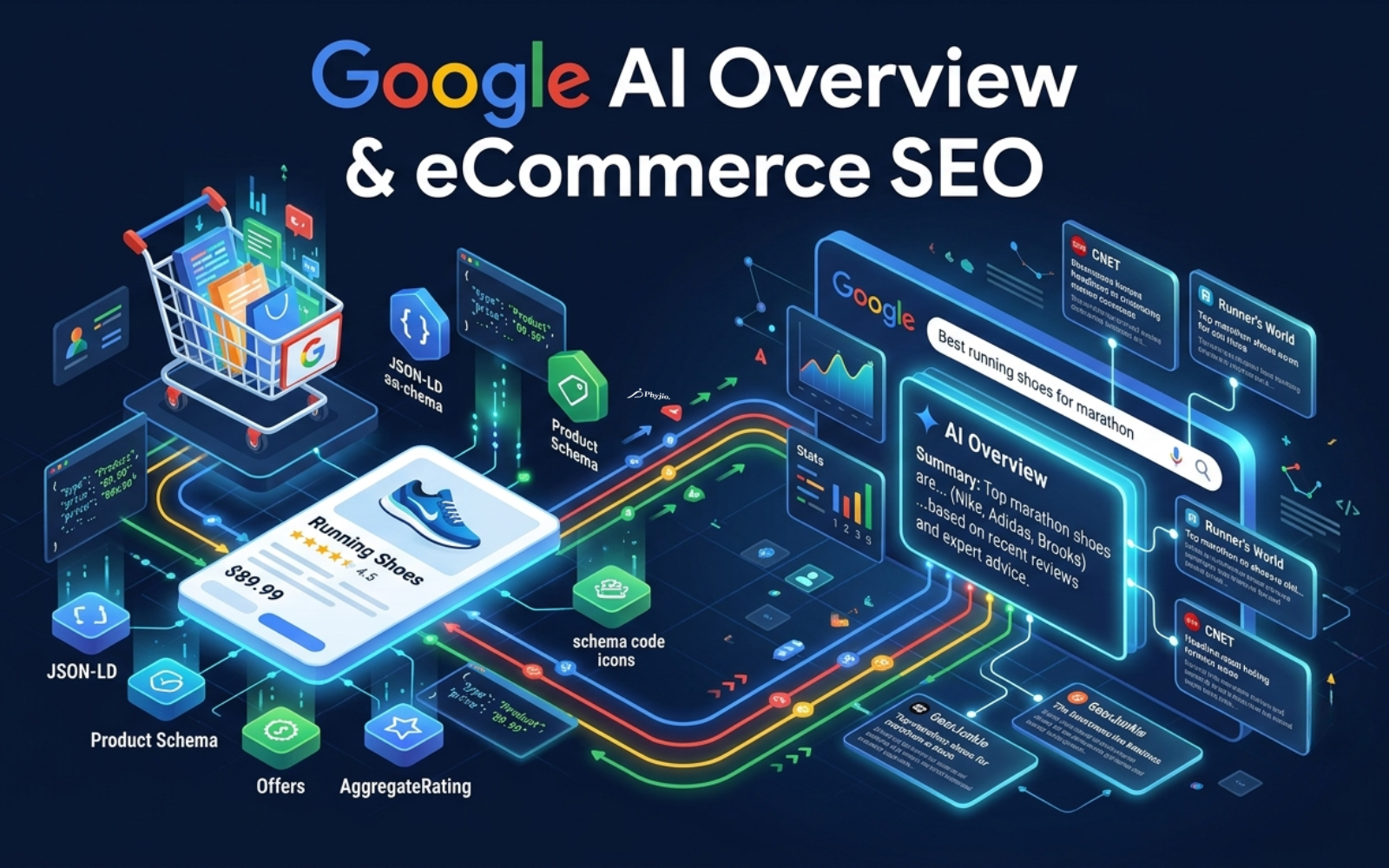
What Google's Latest AI Overview Update Means for Your eCommerce SEO
TL;DR Summary
Google AI Overviews now appear across a large share of shopping-related searches, but their footprint is uneven. Transactional queries like "buy running shoes" still trigger an AI Overview only about 5–8% of the time — your product and category pages remain governed by classic ranking signals: schema, page speed, Core Web Vitals, and shopping feed quality. Informational and comparison queries ("best running shoes for flat feet") trigger AI Overviews well over 90% of the time, and this is where citation, not clicks, becomes the goal. The practical takeaway: run a dual-track SEO strategy, matched to query intent, rather than abandoning either approach.
What Is Google's Latest AI Overview Update?
AI Overviews are AI-generated summaries that appear above traditional blue-link results, synthesizing answers from multiple sources using a process called query fan-out — Google runs several related sub-searches, retrieves relevant pages, and generates a summary with clickable source links. The system sits on top of Google's existing ranking infrastructure rather than replacing it.
As of mid-2026, AI Overviews are live in more than 200 countries and 40 languages, reaching roughly 2.5 billion users, with the related AI Mode surpassing one billion users. France was the last major holdout due to regulatory concerns under the EU's DMA and GDPR, and Google extended both features there on July 22, 2026.
On May 15, 2026, Google published official guidance stating its core message plainly: optimizing for generative AI search is still SEO. The guidance rests on three pillars — creating valuable, non-commodity content; maintaining clean technical structure; and optimizing local and eCommerce details properly.
How AI Overviews Change eCommerce Search
The shift isn't uniform across query types, and that distinction matters more than any single statistic:
| Query Type | Example | AI Overview Frequency | SEO Priority |
|---|---|---|---|
| Transactional | "buy running shoes online" | ~5–14% | Product schema, feed quality, page speed |
| Informational/Comparison | "best running shoes for flat feet" | 83–95%+ | Citation-worthy, well-sourced content |
| Local/service | "plumber near me" | Lower impact | Local SEO fundamentals still dominate |
Coverage is also volatile — one report observed swings from 9% to 26% in a single day before reverting, and year-over-year keyword overlap for AI Overview triggers was only about 18%. This volatility means weekly, not quarterly, monitoring is the new baseline.
Winners and Losers of AI-Powered Search
Gaining visibility:
- Sites with clear, well-sourced buying guides and comparison content
- Brands with strong structured data (Product, Review, FAQ schema)
- Retailers whose listings appear directly in Merchant Center feeds
- Content that answers a buyer's full decision journey in one place
Losing traffic:
- Editorial/content hubs built mainly to drive clicks to affiliate or marketplace links
- Thin "top 10" listicles with no original testing or data
- Pages answering simple how-to or definitional questions AI can summarize entirely in-SERP
Reporting from June 2026 confirms measurable drops in click-through for eCommerce sites as AI Overviews increasingly answer product and how-to questions directly on the results page, with content hubs most exposed while native marketplace listings remain comparatively insulated.
What AI Overview Looks for in eCommerce Websites
Google's own guidance rejects the idea that a special new "AI markup" trick exists. Danny Sullivan, Google's Search Liaison, said in January 2026 that engineers specifically advised against chopping content into small chunks designed purely for AI consumption — Google's systems parse full pages and extract relevant passages, not pre-fragmented snippets.
What actually earns citation:
- Depth over breadth — one authoritative page beats five shallow ones
- Original data or testing — first-hand product experience signals
- Clear structure — descriptive headings, direct answers near the top
- Demonstrated E-E-A-T — visible authorship, sourcing, and expertise
- Clean technical foundation — crawlable, fast, mobile-friendly pages
Essential SEO Strategies for AI Overview
Product Pages
Keep these focused on transactional intent: accurate specs, real customer reviews, clear pricing, fast load times. These pages are largely insulated from AI Overview disruption, so classic optimization still pays off directly.
Category Pages
Add genuinely useful filtering context and a short, unique intro — avoid boilerplate that adds no value for users or crawlers.
Buying Guides
This is prime AI-citation territory. Structure guides around real decision criteria, include a direct-answer summary near the top, and back claims with specifics rather than generic advice.
FAQ Content
Write concise, direct answers formatted for extraction. Mark up with FAQPage schema where genuinely appropriate.
Comparison Content
Use structured tables. Comparison and "best of" queries trigger AI Overviews the vast majority of the time, so this content carries outsized citation potential.
Internal Linking
Connect buying guides to relevant product and category pages to reinforce topical relationships and help both users and crawlers follow intent pathways.
Product Schema & Merchant Listings
Keep Product, Offer, and Review schema accurate and current. Feed quality in Google Merchant Center increasingly influences both shopping results and AI-generated summaries.
Brand Authority & Trust Signals
Visible authorship, transparent sourcing, and consistent brand mentions support E-E-A-T — but Google's guidance explicitly warns against seeding artificial brand mentions across forums and social platforms, which spam systems are built to catch.
Technical SEO Requirements
- Fast Core Web Vitals scores
- Clean crawl paths and efficient crawl budget use
- Mobile-first rendering
- Accurate structured data (Product, FAQ, Review, Breadcrumb)
- No unnecessary duplicate content across product variants
AI Overview vs. Traditional Search Results
| Factor | Traditional Organic | AI Overview |
|---|---|---|
| Click behavior | User clicks through | Often answered in-page (zero-click) |
| Ranking basis | Backlinks, on-page SEO, relevance | Same core signals, plus citation-worthiness |
| Best content type | Product/category pages | Buying guides, comparisons, FAQs |
| Volatility | Relatively stable | High week-to-week variation |
Common SEO Mistakes That Hurt AI Visibility
- Fragmenting content into artificial "AI-friendly" chunks (Google advises against this)
- Chasing fake brand mentions instead of building genuine authority
- Treating AI Overview optimization as a replacement for, rather than an addition to, core SEO
- Relying on quarterly-only tracking when AI Overview presence can shift within days
- Publishing thin comparison pages with no original insight
Future of eCommerce SEO in Google's AI Search Era
Analysts project a meaningful share of organic search traffic — some estimates near a quarter by the end of 2026 — will shift toward AI chatbots and voice assistants. Agentic shopping features, including virtual try-on and agent-assisted checkout, are already rolling out in the US, signaling that AI agents may increasingly browse, compare, and pre-filter products before a human visits a site. Preparing product data and structured markup for agent readability is becoming a forward-looking priority, not just a defensive one.
Action Plan for Online Stores
- Audit top 20 organic pages — flag which were answered inside AI Overviews in the last 30 days
- Separate keyword tracking into transactional vs. informational buckets
- Rebuild top-of-funnel content for citation quality, not just click volume
- Verify Product, Review, and FAQ schema accuracy sitewide
- Set up weekly, not quarterly, AI Overview visibility monitoring
- Keep product pages focused on conversion fundamentals — they're less exposed
- Avoid content fragmentation gimmicks; write for full-page comprehension
Frequently Asked Questions
Does AI Overview reduce clicks to eCommerce sites? Yes, particularly for informational and how-to queries. Transactional product searches are affected far less.
Should stores abandon traditional SEO? No. Product pages still rely on classic ranking signals; only top-of-funnel content needs a citation-focused approach.
Does structured data matter more now? It remains a core requirement for rich results and shopping visibility, though Google states no special "AI-only" markup is required.
How does this affect Shopify, Magento, and WooCommerce stores? The platform matters less than execution — clean technical SEO, accurate schema, and strong buying-guide content apply across all three.
Final Conclusion
Google's AI Overview update doesn't replace SEO — it splits it into two coordinated tracks. Product and category pages still live or die by classic technical and on-page fundamentals. Informational and comparison content now competes for AI citation as much as for rankings. Stores that monitor both, and invest in genuinely useful, well-sourced content, are positioned to gain visibility rather than lose it.
Download The Free E-book & Launch Your Brand Strategically
Download The Free E-book & Launch Your Brand Strategically
Share this post