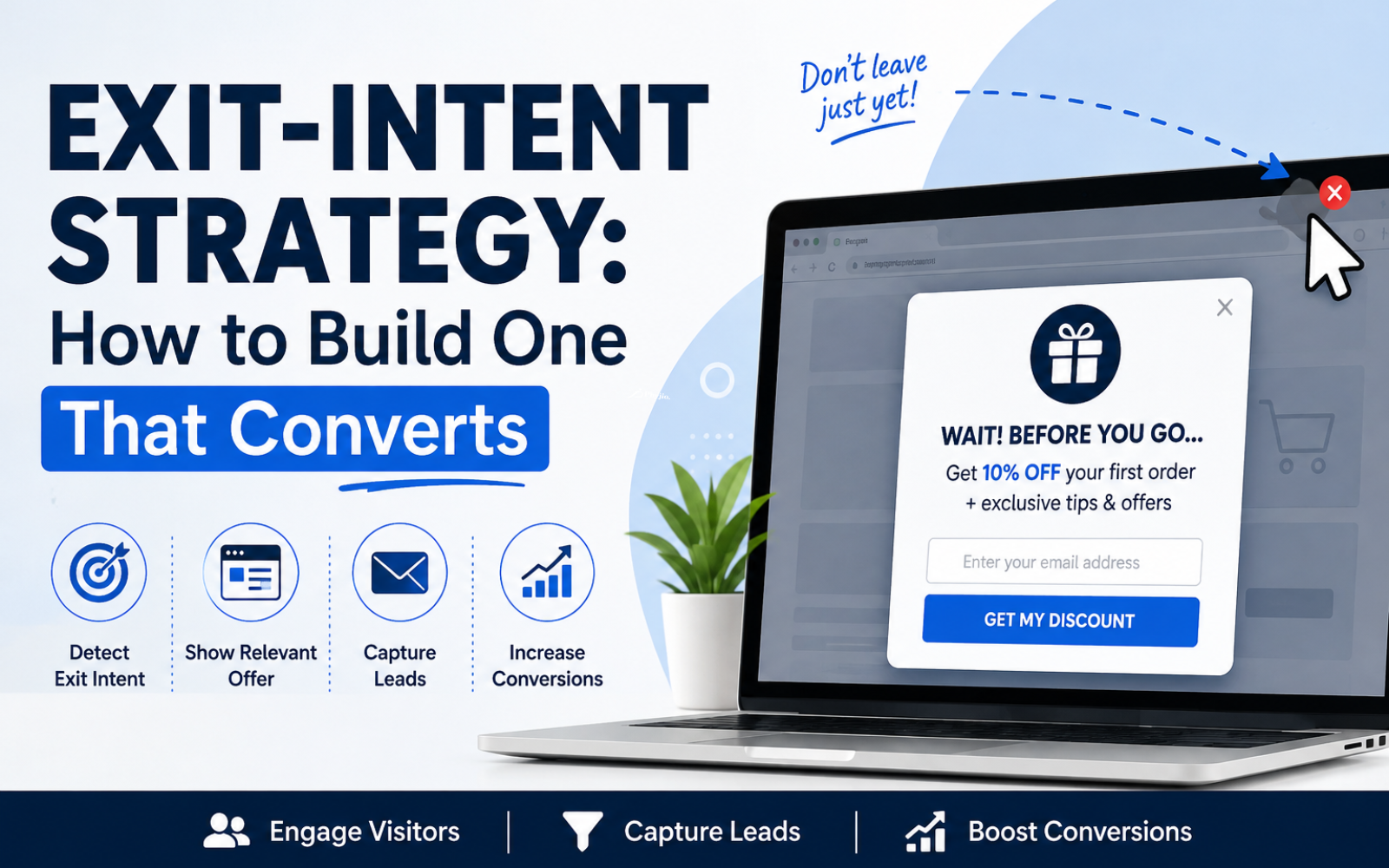
How to Build an Exit-Intent Strategy That Keeps Visitors Engaged
Most website visitors leave without converting. They browse, hesitate, and click away — often for reasons that have nothing to do with your product and everything to do with timing, trust, or unanswered questions. An exit-intent strategy gives you one more chance to reach that visitor before they go.
An exit-intent strategy is a conversion optimization approach that detects behavioral signals suggesting a visitor is about to leave a website, then presents a relevant message, offer, or call to action to keep them engaged or capture their contact information before they exit.
TL;DR
- Exit intent = software detects signals (like cursor movement toward the browser's close/tab bar) that suggest a visitor is leaving.
- How it works: behavioral tracking + trigger rules + a targeted popup, slide-in, or overlay.
- Why businesses use it: to recover otherwise-lost visitors, capture leads, reduce cart abandonment, and grow email lists.
- What makes it effective: relevance, timing, a real value exchange, and restraint.
- Key metrics: popup view rate, conversion rate, downstream revenue, and bounce rate — not just impressions.
What Is an Exit-Intent Strategy?
Exit intent refers to the behavioral signal — typically rapid mouse movement toward the top of the browser window on desktop — that indicates a visitor may be about to leave the page. Exit-intent technology listens for this and similar signals (inactivity, back-button presses, scroll reversal) and triggers a response in real time.
This differs from a standard popup, which usually fires on a timer or scroll depth regardless of whether the visitor is leaving. Exit intent is contextual: it responds to a specific behavioral signal rather than an arbitrary rule, which is why well-built campaigns tend to feel less intrusive than generic popups.
How Does Exit-Intent Technology Work?
- The visitor lands on the page.
- They interact with content — scrolling, clicking, reading.
- Tracking scripts monitor mouse movement, scroll position, and time on page.
- The system detects an exit signal (e.g., cursor moving toward the browser chrome).
- A targeted message displays — a popup, slide-in, or full-screen overlay.
- The visitor converts, dismisses it, or leaves anyway.
- Analytics capture the outcome so the campaign can be refined.
Desktop vs. mobile: Desktop exit intent relies on cursor movement, which doesn't exist on touchscreens. Mobile detection instead uses signals like fast upward scrolling, back-button taps, prolonged inactivity, or app-switching gestures.
Why Do Visitors Leave Without Converting?
- Lack of trust or social proof
- Unclear pricing
- No compelling offer
- Slow page load
- Confusing navigation or weak CTA
- Product uncertainty or comparison shopping
- Unexpected costs at checkout
- Poor mobile experience
- Simply not ready to buy yet
A generic "Wait! Don't leave!" popup ignores why someone is leaving. The strongest exit-intent strategies match the offer to the likely reason for abandonment — a pricing-page exit gets a comparison guide, a cart exit gets a recovery incentive.
How to Build an Exit-Intent Strategy: Step by Step
Step 1 — Define the conversion goal. Lead capture, email signup, demo booking, cart recovery, or trial start. One primary goal per campaign.
Step 2 — Identify high-value exit pages. Pricing, checkout, product, and comparison pages typically deserve dedicated campaigns; blog posts usually warrant a lighter-touch offer.
Step 3 — Understand visitor intent. Segment by new vs. returning, traffic source, device, page viewed, and funnel stage. A first-time visitor and a returning cart abandoner need different messages.
Step 4 — Create a relevant offer. Discount, free consultation, demo, lead magnet, checklist, or helpful content — matched to the page and segment.
Step 5 — Write the popup copy. A strong headline states the value plainly; a weak one is vague ("Don't miss out!"). Keep the form to one or two fields and include a visible trust signal.
Step 6 — Design the experience. Clear visual hierarchy, an obvious and easy-to-find close button, brand-consistent styling, and mobile-responsive layout.
Step 7 — Set trigger rules. Combine exit intent with time delay, scroll depth, page count, and frequency caps so the same visitor isn't shown the popup repeatedly.
Step 8 — A/B test. Headlines, CTA copy, offers, form length, and timing all move conversion rate — test one variable at a time.
Best Exit-Intent Strategies by Business Type
| Business Type | Recommended Strategy | Example Offer | Primary Goal |
|---|---|---|---|
| Ecommerce | Cart/product recovery | Discount or recommendation | Increase sales |
| SaaS | Demo/trial capture | Free trial or demo | Lead generation |
| B2B | Resource capture | Guide or consultation | Qualified leads |
| Agencies | Consultation offer | Free strategy call | Lead generation |
| Blogs | Content upgrade | Ebook/checklist | Email subscribers |
| Online Courses | Enrollment incentive | Discount or webinar | Course sales |
| Local Services | Contact capture | Consultation/quote | Leads |
Exit-Intent vs. Other Conversion Strategies
| Approach | Best For | Trigger |
|---|---|---|
| Exit-intent popup | Recovering an about-to-leave visitor | Exit signal |
| Welcome popup | First impression, broad offer | Page load/time |
| Sticky bar | Persistent, low-friction CTA | Always visible |
| Embedded form | Engaged readers already committed | Scroll position |
| Chatbot | Answering specific questions in real time | Interaction |
| Remarketing/email recovery | Visitors who already left | Post-session |
Exit-intent works best on pages with meaningful traffic and a clear next step; sticky bars and embedded forms often outperform it on low-intent pages like general blog content.
Does Exit Intent Hurt User Experience?
Not inherently — but poor execution does. Intrusive, frequent, or irrelevant popups frustrate visitors and can increase bounce rate. Well-built campaigns are relevant to the page, appear only once per session, offer genuine value, and always include a visible close button. Google does not penalize exit-intent popups the way it penalizes intrusive interstitials on mobile that block content immediately on load — the distinction is intrusiveness and timing, not the mechanism itself.
Exit-Intent Strategy for Mobile
Since there's no cursor to track, mobile campaigns rely on scroll behavior, back-button taps, inactivity, and session duration. Keep mobile popups smaller, faster to dismiss, and less frequent than desktop versions — mobile users are more sensitive to anything that interrupts the page.
How to Measure Exit-Intent Campaign Performance
Key metrics: popup view rate, conversion/submission rate, click-through rate, revenue per visitor, assisted conversions, close rate, and unsubscribe rate.
Exit-Intent Conversion Rate = Conversions ÷ Exit-Intent Impressions × 100
Track downstream outcomes too — email signups that never convert to customers aren't a win on their own. [STATISTIC PLACEHOLDER: verify current average exit-intent popup conversion rate before publishing.]
How to A/B Test Exit-Intent Campaigns
Test one element at a time (headline, offer, CTA, or timing), establish a baseline conversion rate first, and run tests long enough to reach a reasonable sample size before drawing conclusions. Track a primary KPI (conversion rate) alongside secondary KPIs (downstream revenue, unsubscribe rate) to avoid optimizing for the wrong outcome.
Common Exit-Intent Strategy Mistakes
- Showing the same popup to every visitor
- Offering an irrelevant discount
- Triggering too quickly or too often
- Ignoring mobile behavior entirely
- Weak, vague CTAs
- Asking for too much information upfront
- Hiding or removing the close button
- Never testing or iterating
- Measuring popup conversions without checking downstream revenue
Privacy, Consent, and Compliance
Exit-intent tracking relies on behavioral data, so it intersects with privacy regulation. Depending on your audience, this may mean cookie consent banners, GDPR compliance in the EU, and CCPA/CPRA compliance in California. Favor first-party data, keep tracking transparent, and use a consent management platform where required. This is general guidance, not legal advice — confirm requirements with a qualified professional for your jurisdiction.
How AI Is Changing Exit-Intent Marketing
Traditional exit intent is rule-based: a fixed signal triggers a fixed popup. AI-driven approaches instead predict the likelihood of exit using broader behavioral patterns, generate personalized copy and offers in real time, and continuously self-optimize through automated testing. This allows more precise targeting but requires more first-party data and clear consent practices.
Common Problems an Exit-Intent Strategy Can Solve
| Website Problem | Exit-Intent Solution |
|---|---|
| Visitors leave pricing pages | Offer consultation or comparison guide |
| Low email signups | Offer a lead magnet |
| Cart abandonment | Provide a relevant recovery offer |
| Low demo bookings | Present a demo CTA |
| High bounce rate | Provide a relevant next step |
| Visitors hesitate to purchase | Add social proof or product guidance |
Exit intent is not a substitute for fixing slow load times, confusing navigation, or unclear pricing — it's a recovery layer on top of a sound site.
How to Choose Exit-Intent Software
Look for targeting and segmentation options, flexible triggers, built-in A/B testing, CRM and email integrations, mobile support, accessibility, privacy controls, minimal performance impact, and pricing that scales with traffic.
Future Trends in Exit-Intent Marketing
Expect more predictive, privacy-first personalization built on first-party data, conversational popups that ask a question rather than push an offer, and automated experimentation that continuously refines campaigns without manual test setup.
Frequently Asked Questions
What is an exit-intent strategy?
A conversion approach that detects signs a visitor is about to leave and presents a relevant offer or message before they go.
How does exit-intent technology work?
It tracks behavioral signals — like cursor movement toward the browser bar — and triggers a targeted message when those signals suggest departure.
Do exit-intent popups increase conversions?
They can recover some visitors who would otherwise leave, though results vary widely by relevance, offer, and audience.
Are exit-intent popups bad for SEO?
Not inherently. Google penalizes intrusive interstitials that block content on load, not well-timed exit popups.
Does exit intent work on mobile?
Yes, using alternative signals like scroll behavior and back-button taps instead of cursor tracking.
What should an exit-intent popup offer?
Something matched to the page and visitor intent — a discount, guide, demo, or consultation.
When should a popup appear?
Only once the exit signal fires, ideally after a minimum time or scroll threshold so it doesn't show to brand-new visitors.
Can exit-intent popups reduce bounce rate?
They can, by giving visitors a reason to stay or convert instead of leaving immediately.
How does AI improve exit-intent marketing?
By predicting exit likelihood from broader behavior and personalizing offers and copy in real time.
Is exit-intent tracking privacy compliant?
It can be, when built on consented, first-party data and disclosed transparently in a privacy policy.
Conclusion
Exit-intent popups aren't a growth hack — they're one tool in a broader conversion optimization strategy. The strategies that actually work start by understanding why visitors are leaving in the first place, then use relevant, well-timed experiences to offer a genuinely useful next step. Get that sequence right, and exit intent stops feeling like an interruption and starts feeling like help.
Download The Free E-book & Launch Your Brand Strategically
Download The Free E-book & Launch Your Brand Strategically
Share this post