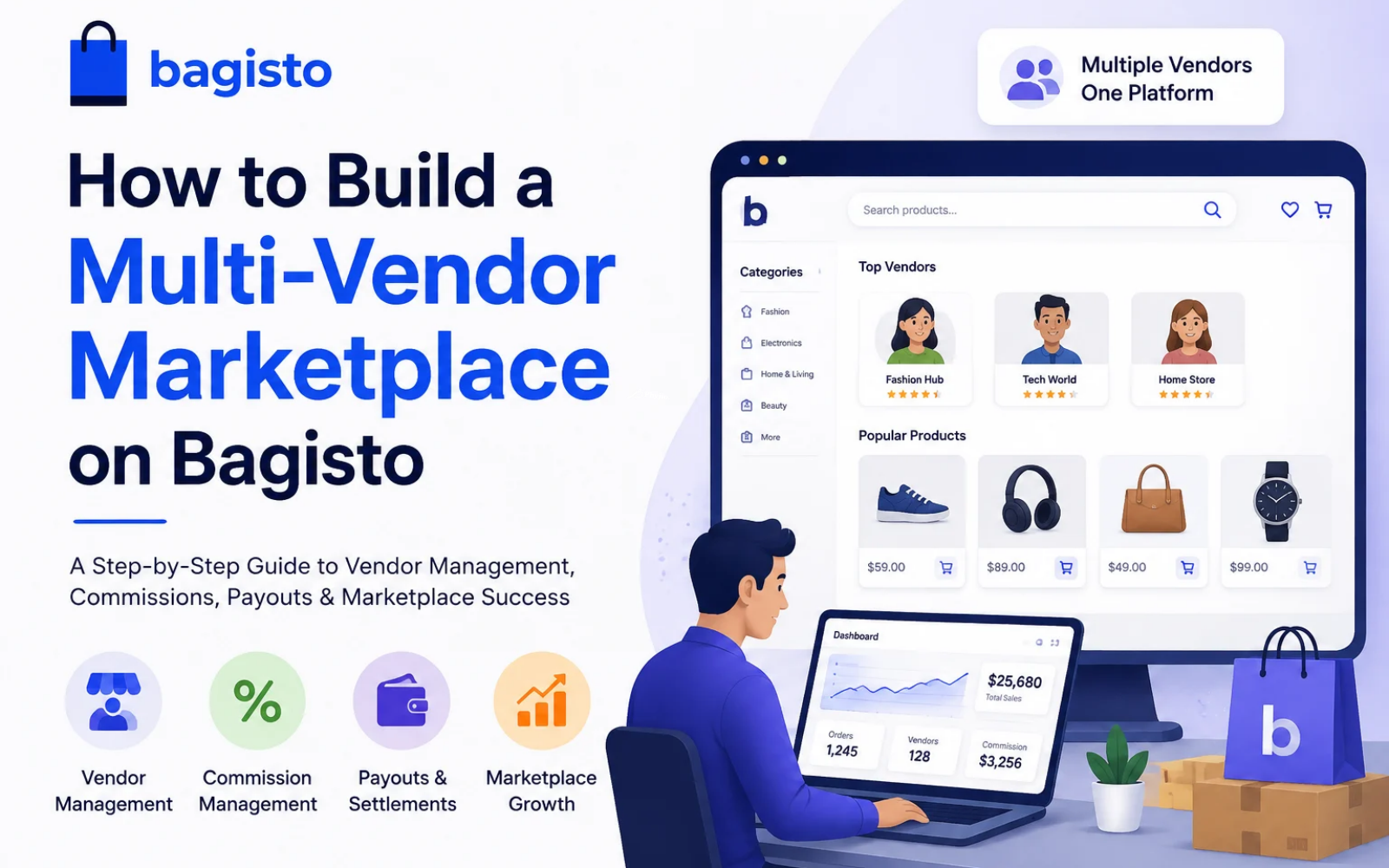
How to Build a Multi-Vendor Marketplace on Bagisto
Businesses build multi-vendor marketplaces because a single-vendor storefront caps growth at one catalog, one supply chain, and one brand. A marketplace instead lets many independent sellers list products under one roof, which multiplies catalog depth and revenue potential without the platform owner having to hold inventory. Bagisto, an open-source Laravel eCommerce platform, has become a common foundation for this kind of build because it gives development teams a working eCommerce core — catalog, cart, checkout, orders — that they can extend into marketplace territory rather than starting from zero.
Bagisto itself is not a marketplace by default. It is a single-vendor eCommerce platform whose modular, Laravel-based architecture makes it a practical starting point for marketplace customization. Whether that customization comes from an existing marketplace extension or a custom-built module depends on how complex the business's vendor, commission, and payout requirements are. This article walks through what a Bagisto multi-vendor marketplace actually involves, how to plan and build one, and where the real technical decisions lie.
What Is a Multi-Vendor Marketplace?
A multi-vendor marketplace is an eCommerce platform where multiple independent sellers (vendors) list and sell products or services to customers through a single website, while a marketplace administrator manages the overall platform, takes a commission on sales, and enforces rules for onboarding, product approval, and payouts.
This differs from a traditional online store, where one business owns the entire catalog and inventory. In a marketplace model, the platform owner instead operates infrastructure: vendor onboarding, order splitting, commission calculation, and vendor payouts. Amazon Marketplace and Etsy are widely recognized examples of this structure — mentioned here only to illustrate the concept, not to suggest Bagisto powers either platform.
Key roles in a marketplace:
- Vendor/seller — lists and manages their own products, fulfills orders, and receives payouts minus commission.
- Customer/buyer — browses vendors' combined catalog and checks out, sometimes across multiple vendors in one order.
- Marketplace administrator — approves vendors and products, configures commission rules, oversees orders, and manages the platform.
What Is Bagisto?
Bagisto is a free, open-source eCommerce platform built on Laravel (PHP) with a MySQL database, designed to give businesses a customizable, self-hosted foundation for online stores. Because it's open-source, businesses own the underlying code and aren't locked into a vendor's proprietary platform or pricing tiers.
Out of the box, Bagisto provides:
- Product catalog and category management, including configurable products
- Customer accounts and order management
- An admin panel for store operations
- Shopping cart and checkout
- Payment and shipping method integrations
- REST APIs, with GraphQL support available through the ecosystem
- A modular, package-based architecture that supports custom extensions
Developers choose Bagisto for custom eCommerce projects because its Laravel foundation gives them a familiar, well-documented framework, and its modular structure means new functionality — like marketplace features — can be added as separate packages rather than by rewriting the core.
It's important to separate two things clearly: Bagisto's core eCommerce functionality (catalog, checkout, orders — built for a single seller) and marketplace functionality (multi-vendor management, commissions, payouts, order splitting), which is not part of the base install and requires either a marketplace extension or custom development.
Can You Build a Multi-Vendor Marketplace on Bagisto?
Yes — Bagisto can be used as the foundation for a multi-vendor marketplace, but the marketplace layer itself is not native to the base platform. Turning Bagisto into a marketplace means adding vendor management, commission logic, order splitting, and payout handling, either through an existing marketplace extension or custom modules built on Bagisto's architecture.
The right approach depends on how standard or how unique the business's marketplace rules are.
| Approach | Best For | Flexibility | Development Effort | Cost |
|---|---|---|---|---|
| Existing marketplace extension | Basic marketplace | Medium | Lower | Lower |
| Customized extension | Growing marketplace | High | Medium | Medium |
| Fully custom marketplace | Complex marketplace | Very High | High | Higher |
A marketplace extension gets a business to launch faster with standard vendor, commission, and payout features. A fully custom build makes sense when the business model involves non-standard commission structures, complex approval workflows, or deep integrations that an off-the-shelf extension can't accommodate.
How Does a Bagisto Multi-Vendor Marketplace Work?
At a high level, a Bagisto marketplace follows this workflow:
Vendor Registration → Vendor Approval → Vendor Store Setup → Product Submission → Product Approval → Customer Purchase → Order Processing → Commission Calculation → Vendor Payout
- A seller registers as a vendor, submitting business details and any required verification documents.
- The marketplace administrator reviews and approves (or rejects) the vendor application.
- The approved vendor configures their store profile — name, branding, policies.
- The vendor submits products for listing.
- The administrator reviews and approves products before they go live (this step is configurable — some marketplaces auto-publish).
- A customer purchases products, potentially from multiple vendors in a single checkout.
- The system processes the order, splitting it by vendor where needed.
- Commission is calculated on each sale according to the configured rules.
- The vendor's earnings accumulate and are paid out on the marketplace's payout schedule.
Suggested visual: a horizontal workflow diagram showing each of these nine stages as connected steps.
Core Features of a Bagisto Multi-Vendor Marketplace
Vendor Management
Vendor registration and login, identity verification, profile and storefront management, dashboard access, approval/rejection workflows, permission controls, document uploads, and vendor-level sales analytics.
Product Management
Product creation and editing by vendors, an admin approval workflow, category and attribute assignment, support for configurable products, inventory and pricing controls, image management, and bulk product import/export.
Commission Management
Commission models can be percentage-based, fixed-fee, vendor-specific, or category-specific. The engine calculates commission per order, generates commission reports for the admin, and adjusts figures when refunds occur.
Order Management
Marketplace orders often involve more than one vendor, so the system needs order splitting so each vendor sees only their portion, along with independent order status, shipping status, returns, refunds, and cancellation handling per vendor.
Payment & Payout Management
Customers pay through the marketplace's payment gateway; the platform deducts commission and tracks each vendor's running balance. Payouts can be manual or automated, depending on the payment provider used. The exact payout architecture — batch transfers, direct-to-bank, or a payments platform with built-in split payments — depends heavily on which payment provider and business model the marketplace adopts.
Shipping Management
Shipping can be vendor-managed (each seller handles their own fulfillment) or centrally managed by the marketplace. Either way, the system needs shipping zones, rate rules, carrier support, and order tracking.
Customer Features
Registration, search and filtering across vendors, a unified cart and checkout, product reviews, wishlists, order tracking, and vendor/store discovery pages.
Admin Features
Vendor and product approval queues, commission configuration, order and payment oversight, payout management, tax and shipping rules, promotions, and marketplace-wide analytics and reporting.
Step-by-Step: How to Build a Multi-Vendor Marketplace on Bagisto
Step 1: Define the Business Model. Decide whether the marketplace is B2C, B2B, C2C, wholesale, service-based, or niche-focused — this shapes every downstream technical decision, from checkout flow to commission structure.
Step 2: Define Vendor Roles and Permissions. Map out admin, vendor, customer, and any staff/sub-admin roles, and plan role-based access control accordingly.
Step 3: Design the Marketplace Architecture. Plan the major components: storefront, admin panel, vendor dashboard, customer accounts, catalog system, order system, commission engine, payment and payout systems, shipping system, notifications, and reporting.
Step 4: Install and Configure Bagisto. Set up the server environment — PHP, Composer, a MySQL database, a web server, environment configuration, file storage, queue workers for background jobs, and caching (commonly Redis) for performance.
Step 5: Add Marketplace Functionality. Choose between an existing marketplace extension, a custom module, or a hybrid approach that extends a base extension with custom logic.
Step 6: Build Vendor Management. Implement the full vendor lifecycle — registration, verification, approval, store setup, product listing, selling, and payout.
Step 7: Build the Product Approval Workflow. Give administrators control over seller-submitted catalog content before it becomes publicly visible.
Step 8: Implement Commission Logic. Choose and build the commission model(s) the business needs. A simple example:
Product Sale: $100 Marketplace Commission: 10% Vendor Earnings: $90
In practice, payment processing fees, taxes, shipping charges, and refunds can all adjust the final payout figure, so the commission engine needs to account for these variables rather than a flat percentage alone.
Step 9: Implement Marketplace Payments. Decide how customer payments are collected, how commission is deducted, and how vendor balances are tracked and settled.
Step 10: Implement Shipping and Order Management. Build logic for orders that span multiple vendors, including splitting shipments and tracking each independently.
Step 11: Build Vendor Dashboards. Give vendors visibility into sales, orders, products, customers, earnings, commissions, payouts, inventory, and performance analytics.
Step 12: Test Thoroughly. A marketplace testing checklist should cover vendor registration, product creation and approval, customer checkout, payment processing, commission accuracy, order splitting, refunds, vendor payouts, shipping, notifications, security, mobile responsiveness, and performance under load.
Step 13: Launch and Monitor. After launch, track analytics, error monitoring, server and database performance, security patching, backups, and ongoing SEO and Core Web Vitals monitoring.
Bagisto Marketplace Architecture
| Layer | Responsibility |
|---|---|
| Storefront | Customer shopping experience |
| Vendor Dashboard | Seller operations |
| Admin Panel | Marketplace administration |
| Catalog | Products and categories |
| Order Engine | Order processing |
| Commission Engine | Seller commission calculation |
| Payment Layer | Customer payments |
| Payout Layer | Vendor settlements |
| Shipping Layer | Delivery management |
| Database | Marketplace data |
| API Layer | Integrations, mobile, headless commerce |
Laravel's modular package system and Bagisto's own modular structure make it feasible to build these layers as discrete, maintainable packages rather than tangled additions to the core codebase — which matters for long-term upgrade compatibility.
Existing Extension vs. Custom Marketplace Development
| Factor | Existing Extension | Custom Development |
|---|---|---|
| Initial cost | Lower | Higher |
| Launch speed | Faster | Slower |
| Customization | Limited/Moderate | Very High |
| Maintenance | Depends on vendor | Controlled internally |
| Complex workflows | May require customization | Fully supported |
| Unique business rules | Limited | Strong fit |
| Scalability | Depends on architecture | Can be designed for requirements |
An extension is often the right call for a standard marketplace launching quickly with common commission and payout rules. Custom development earns its higher cost when the business has non-standard workflows — tiered vendor programs, complex approval chains, or bespoke payout logic — that off-the-shelf extensions weren't designed to handle.
Benefits of Building a Marketplace on Bagisto
Bagisto's open-source foundation means businesses own their source code outright, avoiding platform lock-in and recurring licensing fees tied to proprietary marketplace software. Its Laravel base gives development teams access to a large, well-documented ecosystem, and the modular architecture supports custom marketplace workflows without core rewrites. The available REST and GraphQL APIs also open the door to headless commerce implementations and mobile app integrations, and businesses retain full control over hosting and infrastructure decisions.
Challenges of Building a Bagisto Multi-Vendor Marketplace
Vendor onboarding complexity can grow quickly as verification requirements increase — mitigate this with a structured, staged approval workflow. Commission calculations get harder with mixed models (percentage plus fixed fees, category overrides); a well-designed commission engine with clear rule precedence helps. Multi-vendor order handling and splitting require careful data modeling from the start, not as an afterthought. Payment and payout architecture is often the hardest technical piece — choosing a payment provider that supports split payments or marketplace payouts early avoids costly rework. Shipping complexity, product moderation queues, and vendor permission boundaries all need dedicated planning. At scale, performance tuning (caching, queue workers, database indexing) becomes essential, as does attention to third-party integration reliability, marketplace security, upgrade compatibility for custom modules, and any data migration from a prior platform.
Bagisto vs. Other Multi-Vendor Platforms
| Factor | Bagisto | Magento/Adobe Commerce | WooCommerce | Shopify | Laravel Custom Build |
|---|---|---|---|---|---|
| Open-source access | Yes | Partial (Magento Open Source) | Yes | No | Yes |
| Customization | High | High | Medium | Limited | Very High |
| Development complexity | Medium | High | Low–Medium | Low | High |
| Marketplace capabilities | Via extension/custom | Via extension | Via plugin | Via app | Fully custom |
| Hosting control | Full | Full | Full | Hosted by Shopify | Full |
| Ecosystem maturity | Growing | Mature | Very mature | Mature | Depends on team |
| Total ownership | Full code ownership | Full (Open Source edition) | Full | Platform-dependent | Full |
No platform is universally "best" — the right choice depends on budget, technical team capability, hosting preferences, and how much custom marketplace logic the business needs. Bagisto tends to appeal to teams that want Laravel-based flexibility and full code ownership without Magento's higher complexity overhead or Shopify's platform constraints.
How Much Does It Cost to Build a Multi-Vendor Marketplace on Bagisto?
Cost depends on marketplace complexity, vendor volume, the number of custom features, whether the build uses an extension or custom development, payment and shipping integrations, mobile app requirements, UI/UX scope, third-party API integrations, any data migration, hosting, testing, and ongoing maintenance.
Rather than a single universal price, cost should be scoped against the factors above, since a basic extension-based marketplace and a fully custom, multi-region marketplace sit at very different points on the cost spectrum.
How Long Does It Take to Build?
| Phase | Typical Scope |
|---|---|
| Discovery | Requirements and architecture |
| UI/UX | Marketplace experience design |
| Bagisto setup | Core platform installation |
| Marketplace development | Vendors, commissions, orders |
| Integrations | Payment, shipping, APIs |
| Testing | QA and security |
| Launch | Deployment and monitoring |
How to Choose the Best Bagisto Development Company
Look for demonstrated Bagisto and Laravel expertise, prior marketplace project experience, custom module development capability, payment gateway integration experience, API integration skills, sound security practices, a defined QA process, performance optimization know-how, SEO awareness, and clear post-launch support and maintenance offerings.
SEO Considerations for a Bagisto Marketplace
Marketplace sites can generate thousands of vendor and product URLs, so SEO-friendly URL structures, canonical tags, and clear indexation rules matter early. Implement product, breadcrumb, and organization schema, along with review schema where genuinely eligible. Maintain an accurate XML sitemap and robots.txt, and watch for duplicate product content across vendors selling similar items. Faceted navigation and pagination need careful handling to avoid crawl waste, alongside strong internal linking, image optimization, and attention to Core Web Vitals and mobile performance. Left unmanaged, thin or duplicate vendor/product pages can dilute crawl budget and hurt overall rankings — indexation strategy should be planned, not left to default settings.
Security Considerations
A marketplace multiplies the attack surface because vendors, not just admins, have write access to parts of the system. Strong authentication and role-based authorization are essential, along with input validation, CSRF protection, and secure payment processing. API endpoints need their own security review, and file uploads (vendor documents, product images) require strict validation. Vendor access should be isolated so one seller can never see or modify another's data. Database security, regular backups, security logging, timely dependency updates, and a routine security update cycle round out a reasonable baseline. Formal compliance certifications (like PCI DSS) should only be claimed if actually verified and obtained.
How AI Is Changing Multi-Vendor Marketplaces
Several AI applications are already in practical use on marketplaces today: AI-assisted product descriptions, semantic product search, automated product categorization, chatbot-based customer support, and recommendation engines. Fraud and anomaly detection, demand forecasting, and automated catalog moderation are increasingly common as well. Emerging capabilities — more advanced conversational commerce, deeper personalized merchandising, and predictive vendor performance insights — are developing quickly but vary in maturity across implementations, so businesses should treat them as evolving rather than fully standardized.
Future Trends in Bagisto Marketplace Development
Headless and API-first commerce architectures are gaining traction because they let marketplaces serve web, mobile, and other channels from one backend. Omnichannel and social commerce integration, automated vendor onboarding, and real-time analytics dashboards are becoming more common expectations from marketplace operators. As marketplaces expand geographically, multi-region and multi-currency support with reliable international payment handling becomes a practical necessity rather than a nice-to-have.
Common Problems Solved by Multi-Vendor Marketplace Software
How does marketplace software manage multiple sellers?
It gives each vendor an isolated dashboard and permission set while the admin retains oversight of approvals, commissions, and platform-wide policy.
How are vendor commissions calculated?
Through configurable rules — percentage, fixed, vendor-specific, or category-specific — applied automatically at the order level.
Can multiple vendors sell similar products?
Yes; the catalog structure typically allows overlapping listings, with customers choosing based on price, ratings, or vendor reputation.
How are marketplace orders split between vendors?
The order engine divides a single customer order into vendor-specific sub-orders so each seller only manages their own fulfillment.
How are vendors paid?
Earnings accumulate per sale after commission deduction, then get disbursed through manual or automated payout processes depending on the payment provider.
Can vendors have their own storefronts?
Yes, most marketplace implementations give each vendor a branded store page within the marketplace.
Can administrators approve vendor products?
Yes, a configurable approval queue lets admins review listings before they go live.
Can Bagisto support custom marketplace workflows?
Yes, its modular Laravel architecture is built to support custom business logic beyond what any single extension provides.
Conclusion
Bagisto is a capable, Laravel-based foundation for a multi-vendor marketplace, but it isn't a marketplace out of the box — vendor management, commissions, order splitting, and payouts have to be added through an extension or custom development. An existing marketplace extension is often enough for a straightforward launch with standard rules, while custom development pays off when the business has unique commission structures, complex vendor workflows, or specific scalability requirements. Getting the architecture right early — how vendors, commissions, orders, and payments connect — matters more for long-term stability and growth than any single feature choice made in isolation.
Businesses evaluating Bagisto for a multi-vendor marketplace are generally better served by scoping their exact requirements first, then choosing between an extension, a customized extension, or a fully custom build based on that scope — rather than picking an approach before the requirements are clear.
FAQ's
- What is a multi-vendor marketplace?
A multi-vendor marketplace is an eCommerce platform where multiple independent sellers list and sell products through one website, while an administrator manages onboarding, approvals, commissions, and payouts. - What is Bagisto?
Bagisto is a free, open-source eCommerce platform built on Laravel and PHP, offering catalog, checkout, and order management that developers can extend for custom projects, including marketplaces. - Can Bagisto build a multi-vendor marketplace?
Yes, Bagisto can serve as the foundation for a multi-vendor marketplace, though marketplace-specific features like vendor management and commissions require an extension or custom development. - Is Bagisto suitable for large marketplaces?
It can be, provided the architecture — caching, queues, database design — is planned for scale from the start; performance depends heavily on implementation quality. - How does Bagisto handle vendors?
Vendor handling isn't native to Bagisto's core; it's added through a marketplace extension or custom module that manages registration, approval, and vendor dashboards. - Can vendors have separate dashboards?
Yes, marketplace implementations on Bagisto typically give each vendor a dedicated dashboard for products, orders, and earnings. - Can Bagisto manage vendor commissions?
Yes, once marketplace functionality is added, a commission engine can apply percentage, fixed, or category-specific rules automatically. - How do vendor payouts work?
Vendors accumulate earnings after commission deduction, then receive payouts manually or automatically depending on the payment provider integrated. - Can multiple vendors sell on one Bagisto website?
Yes, that's the core premise of a Bagisto multi-vendor marketplace build. - Can Bagisto support marketplace payment gateways?
Yes, though the specific gateway needs to support the marketplace's payout model, such as split payments or delayed settlement. - Can Bagisto handle multi-vendor orders?
Yes, with order-splitting logic added so a single customer order divides into vendor-specific sub-orders. - Should I use a marketplace extension or custom development?
Use an extension for standard needs and faster launch; choose custom development for unique commission models or complex workflows. - Is Bagisto better than Shopify for a multi-vendor marketplace?
Neither is universally better — Bagisto offers more customization and code ownership, while Shopify offers faster setup with less flexibility. - Is Bagisto better than Magento for marketplace development?
Bagisto is generally lighter and less complex than Magento/Adobe Commerce, but Magento has a more mature marketplace extension ecosystem. - Can Bagisto support B2B marketplaces?
Yes, its modular architecture can accommodate B2B-specific features like tiered pricing and bulk ordering through customization. - Can Bagisto support mobile apps?
Yes, via its REST and GraphQL APIs, which support headless or mobile-first implementations. - Is Bagisto SEO-friendly?
Bagisto supports SEO-friendly URLs and standard technical SEO practices, though marketplace-specific indexation strategy still needs deliberate planning. - Can AI be integrated into a Bagisto marketplace?
Yes, AI can be added for search, recommendations, fraud detection, and catalog moderation through custom integrations.
Download The Free E-book & Launch Your Brand Strategically

Download The Free E-book & Launch Your Brand Strategically
Share this post