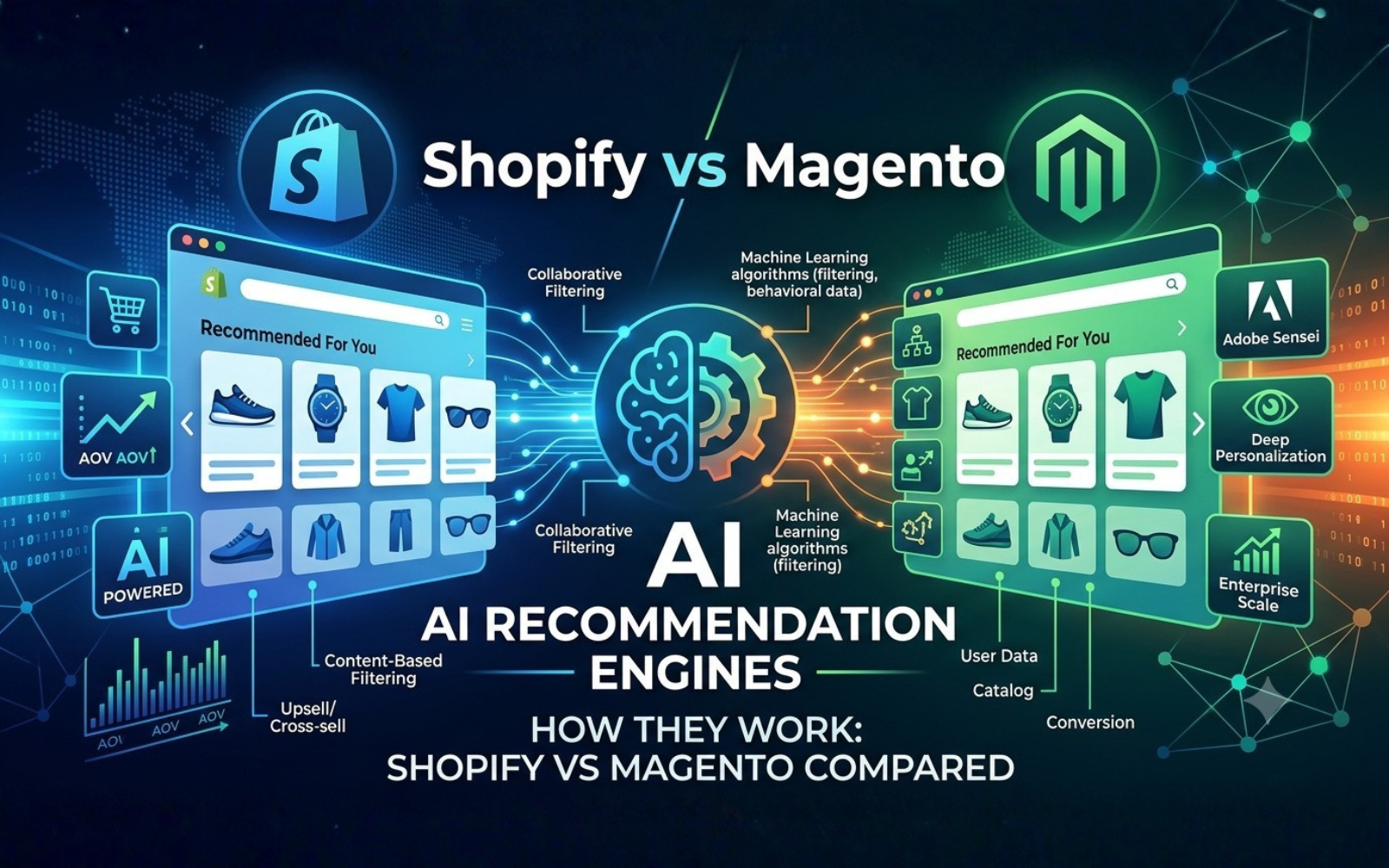
How AI Product Recommendation Engines Work: Shopify vs Magento Compared
Personalized product discovery has evolved from static, rule-based merchandising to dynamic, agentic AI frameworks. According to Shopify's commerce data, AI-referred shoppers convert at up to 50% higher rates and carry 14% higher average order values (AOV) than organic search visitors.
Understanding the underlying algorithms and platform capabilities of Shopify and Magento (Adobe Commerce) is essential for modern merchants, developers, and digital strategists aiming to maximize Conversion Rate Optimization (CRO) and Customer Lifetime Value (CLV).
What is an AI Product Recommendation Engine?
An eCommerce AI product recommendation engine is an automated software architecture that processes first-party data to predict a customer’s intent and recommend relevant items.
Unlike legacy systems that rely on manual rule creation (e.g., "if item X, show item Y"), AI-driven engines use machine learning (ML) models that autonomously re-rank product displays based on real-time session activity, historical purchase patterns, and visual similarity.
[Raw Data Streams] ──► [Feature Extraction] ──► [ML Recommendation Engine] ──► [Personalized Output]
 (Clicks, Orders,       (NLP Text, Vision,      (Collaborative / Content /      (Cart Upsell, PDP Grid,
  Cart Additions)        User Embeddings)        Hybrid Deep Learning)           Email, Search Re-Rank)
How AI Recommendation Engines Work
Modern AI recommendation pipelines rely on a multi-stage machine learning architecture designed to deliver sub-100 millisecond response times.
+-----------------------------------------------------------------------------------+
|                            DATA COLLECTION LAYER                                  |
|   First-party events, SKU catalog metadata, real-time clicks, session tokens      |
+-----------------------------------------------------------------------------------+
                                          │
                                          ▼
+-----------------------------------------------------------------------------------+
|                        CANDIDATE GENERATION (RETRIEVAL)                           |
|   Filters millions of SKUs down to ~100 candidates using fast KNN / vector search |
+-----------------------------------------------------------------------------------+
                                          │
                                          ▼
+-----------------------------------------------------------------------------------+
|                            SCORING & RANKING LAYER                                |
|   Evaluates margin, inventory level, user affinity, and conversion probability    |
+-----------------------------------------------------------------------------------+
                                          │
                                          ▼
+-----------------------------------------------------------------------------------+
|                        BUSINESS LOGIC & MERCHANDISING                             |
|   Applies pin/boost rules, out-of-stock filtering, and category constraints       |
+-----------------------------------------------------------------------------------+
1. Data Collection & Event Ingestion
The engine continuously ingests both implicit and explicit customer signals:
- Implicit Data: Pageviews, hover time, category dwell, cart additions, search queries, and scroll depth.
- Explicit Data: Purchase history, direct reviews, product ratings, and account preferences.
- Product Metadata: Taxonomy, color, size, price range, brand, and natural language descriptions.
2. Behavioral Analysis & Feature Extraction
Raw behavioral events are transformed into dense mathematical vectors (embeddings). Neural networks evaluate similarities between visitor vectors and product vectors to calculate purchase propensity scores in real time.
3. Model Inference & Candidate Generation
When a page loads, the system selects candidate SKUs using multi-arm bandit algorithms and vector search, narrowing thousands of products down to top potential matches within milliseconds.
4. Dynamic Business Filtering & Re-Ranking
Before rendering widgets on the storefront, business constraints are enforced:
- Exclusion of out-of-stock inventory.
- Profit-margin boosting and stock-clearing rules.
- Personalization re-ranking based on current session context.
Core Types of Recommendation Algorithms
                       ┌─────────────────────────────────────────┐
                       │    eCommerce Recommendation Engine      │
                       └────────────────────┬────────────────────┘
                                            │
         ┌──────────────────────────────────┼──────────────────────────────────┐
         ▼                                  ▼                                  ▼
┌─────────────────┐                ┌─────────────────┐                ┌─────────────────┐
│  Collaborative  │                │  Content-Based  │                │  Hybrid Models  │
│    Filtering    │                │    Filtering    │                │  & Deep Learning│
└────────┬────────┘                └────────┬────────┘                └────────┬────────┘
         │                                  │                                  │
 ┌───────┴───────┐                  ┌───────┴───────┐                  ┌───────┴───────┐
 │ User-based vs │                  │ NLP / Visual  │                │ Multi-modal   │
 │ Item-based    │                  │ Metadata      │                │ Session-aware │
 └───────────────┘                  └───────────────┘                  └───────────────┘
| Algorithm Type | Mechanism | Primary Use Case | Key Advantage |
| Collaborative Filtering | Matches users with similar interaction histories ("People who bought X also bought Y"). | Cart upsells, homepage discovery. | High accuracy with rich transaction history. |
| Content-Based Filtering | Compares product attributes (tags, NLP descriptions, categories) to a user's past clicks. | Cold-start items, niche catalog pages. | Functions without prior sales data. |
| Association Rule Mining | Identifies statistical item co-occurrences using algorithms like Apriori or FP-Growth. | "Frequently Bought Together" bundles. | Simple, predictable cross-selling. |
| Hybrid Deep Learning | Combines user behavior, metadata, visual AI embeddings, and real-time context. | Enterprise 1:1 personalization. | Overcomes cold-start issues; highly adaptive. |
Shopify AI Recommendation Engine
Shopify's recommendation approach relies on a lightweight native core supplemented by a rich app ecosystem.
                       ┌─────────────────────────────────────────┐
                       │         SHOPIFY ARCHITECTURE            │
                       └────────────────────┬────────────────────┘
                                            │
                   ┌────────────────────────┴────────────────────────┐
                   ▼                                                 ▼
┌───────────────────────────────────────┐         ┌───────────────────────────────────────┐
│     NATIVE LAYER (Core Platform)      │         │   APP ECOSYSTEM (Third-Party SaaS)    │
├───────────────────────────────────────┤         ├───────────────────────────────────────┤
│ • Product Recommendations API         │         │ • Rebuy / Nosto / LimeSpot            │
│ • Search & Discovery App              │         │ • Real-time session personalization   │
│ • Order history & collection logic    │         │ • Advanced cart & post-purchase logic │
└───────────────────────────────────────┘         └───────────────────────────────────────┘
Native Capabilities
- Product Recommendations API: Generates auto-related products using store sales history, product descriptions, and collection structures.
- Shopify Search & Discovery: Allows merchants to manually set complementary products, rule-based cross-sells, and search boosts.
- Shopify Magic & Sidekick: AI utilities for generating product copy, metadata tagging, and back-office analytics querying.
Advantages
- Instant Deployment: Works out of the box with standard Shopify themes via Liquid or app blocks.
- Low Technical Overhead: No machine learning maintenance required by the merchant.
- Extensive Ecosystem: Hundreds of turn-key apps (Rebuy, LimeSpot, Nosto) extend native capabilities with advanced deep-learning models.
Limitations
- No Native Real-Time Session Personalization: Native APIs rely heavily on historical order co-occurrence rather than live in-session clickstreams.
- Data Sovereignty: Transaction and behavioral data reside within third-party app infrastructures when using external recommendation tools.
- App Stack Cost Scaling: Advanced personalization requires recurring monthly subscriptions that scale with order volume.
Magento (Adobe Commerce) AI Recommendation Engine
Magento—specifically in its Adobe Commerce cloud environment—integrates enterprise-grade machine learning directly into its core infrastructure.
                       ┌─────────────────────────────────────────┐
                       │     MAGENTO / ADOBE COMMERCE ENGINE     │
                       └────────────────────┬────────────────────┘
                                            │
                   ┌────────────────────────┴────────────────────────┐
                   ▼                                                 ▼
┌───────────────────────────────────────┐         ┌───────────────────────────────────────┐
│     NATIVE ADOBE SENSEI & LIVE SEARCH │         │    OPEN-SOURCE / CUSTOM PIPELINES     │
├───────────────────────────────────────┤         ├───────────────────────────────────────┤
│ • Behavioral clustering & re-ranking  │         │ • Custom Python / PyTorch pipelines   │
│ • Live Search with Semantic Search    │         │ • On-premise vector databases         │
│ • B2B contract & matrix pricing AI    │         │ • Full data ownership & privacy control│
└───────────────────────────────────────┘         └───────────────────────────────────────┘
Native Capabilities
- Adobe Sensei Integration: Native AI services that construct behavioral clusters and calculate real-time item affinities across complex multi-storefront catalogs.
- Live Search with Semantic Search: Uses natural language processing (NLP) to interpret shopper intent rather than simple string matching, dynamically re-ranking results.
- B2B Personalization: Supports complex catalog hierarchies, custom customer-group pricing, account-specific order history, and matrix recommendations.
Advantages
- Native Enterprise Personalization: Built directly into Adobe Commerce without relying on third-party middleware.
- Full Data Ownership: Merchants maintain strict sovereignty over raw behavioral data and ML models—a critical requirement for regulated industries.
- Extensive Customizability: Open-source architecture allows developers to train and deploy custom PyTorch/TensorFlow models directly into the pipeline.
Limitations
- Higher Technical Complexity: Requires developer expertise to configure, test, and optimize recommendation widgets.
- Resource Intensive: Adobe Sensei features require an active Adobe Commerce Cloud license or dedicated cloud infrastructure.
Shopify vs Magento: Detailed Architectural Comparison
| Capability | Shopify (Native + Ecosystem) | Magento (Adobe Commerce) |
| Primary AI Engine | Product Recommendations API / 3rd-Party Apps | Native Adobe Sensei & Live Search |
| Real-Time Personalization | Requires 3rd-party SaaS (e.g., Rebuy, Nosto) | Native in-session behavioral re-ranking |
| Semantic Search Capability | Available via app store (e.g., Algolia) | Native via Live Search Semantic Engine |
| B2B & Complex Catalog Support | Basic (Extended via Shopify Plus) | Native support for tiered pricing & custom catalogs |
| Data Control & Ownership | Platform/App vendor restricted | Full merchant ownership & custom model hosting |
| Implementation Effort | Low (Turn-key / No-code options) | Medium-High (Requires developer configuration) |
| Predictive Merchandising | App-driven | Native Sensei automated re-ranking |
Business Impact & ROI Metrics
+-----------------------------------------------------------------------------------+
|                           BUSINESS IMPACT MATRIX                                  |
|                                                                                   |
|  [Average Order Value]   ──────►   Boosted via dynamic cart & PDP cross-sells     |
|  [Conversion Rate]       ──────►   Increased via semantic intent matching         |
|  [Bounce Rate]           ──────►   Reduced via personalized homepage discovery    |
|  [Customer Lifetime Val] ──────►   Enhanced via targeted re-engagement offers    |
+-----------------------------------------------------------------------------------+
Implementing an AI-driven recommendation engine provides measurable improvements across key eCommerce performance indicators:
- Increased Average Order Value (AOV): Dynamic "Frequently Bought Together" bundles and cart-checkout upsells drive multi-item purchases.
- Improved Conversion Rate (CRO): Showing relevant items reduces click-depth requirements, turning single-page visits into completed transactions.
- Reduced Bounce Rates: Personalized product feeds keep cold traffic engaged from their initial landing page.
- Higher Customer Lifetime Value (CLV): Continuous adaptation to customer tastes drives long-term repeat purchases.
Common Implementation Challenges & Solutions
1. The Cold Start Problem
- Challenge: New products or new site visitors lack historical interaction data, leading to inaccurate recommendations.
- Solution: Fall back on content-based filtering (matching product tags and NLP descriptions) or display globally trending items until behavioral data is established.
2. Data Quality & Silos
- Challenge: Fragmented product tags, missing attributes, and duplicate SKUs degrade machine learning output quality.
- Solution: Standardize product taxonomy, mandate clear product attribute fields, and audit catalog feeds regularly.
3. Data Privacy & Compliance (GDPR / CCPA)
- Challenge: Strict privacy laws limit cookie tracking and second-party data sharing.
- Solution: Rely on first-party behavioral events and zero-party data gathered directly through interactive quizzes.
Strategic Decision Framework
                                  [Select Engine Framework]
                                              │
                    ┌─────────────────────────┴─────────────────────────┐
                    ▼                                                   ▼
            [Shopify Route]                                     [Magento Route]
  • Catalog < 50,000 SKUs                             • Catalog > 50,000 SKUs / B2B Matrix
  • Small internal dev team                           • In-house technical developers
  • Preference for SaaS convenience                   • Requirement for complete data control
  • Desired turn-key app integration                  • Enterprise Adobe Experience Cloud integration
Best Practices for Optimization
- Focus on First-Party Data: Track on-site event triggers (clicks, add-to-carts, search queries) directly using robust web pixels.
- Implement Continuous A/B Testing: Compare machine learning models against static baseline rules to prove incremental revenue uplift.
- Audit Merchandising Rules Regularly: Ensure automated AI outputs align with real-world inventory levels, margins, and seasonal promotional goals.
- Leverage Zero-Party Data: Use interactive onboarding quizzes to gather explicit consumer preferences immediately.
Future Trends in AI Personalization
- Generative & Agentic AI Commerce: AI agents autonomously negotiate bundles, configure products, and guide complex buyer journeys end-to-end.
- Multi-Modal Personalization: Engines that process visual image uploads, text queries, and voice commands simultaneously to surface hyper-relevant products.
- Autonomous Merchandising: Self-optimizing storefronts that dynamically change layouts, banners, and product order based on predicted conversion velocity.
Frequently Asked Questions (FAQ)
What is the difference between rule-based and AI-powered recommendations?
Rule-based systems rely on static "if-then" logic set manually by merchants (e.g., "If buying shoes, show socks"). AI-powered engines analyze dynamic user behavior, purchase patterns, and catalog attributes to generate personalized recommendations automatically.
Does Shopify have native AI product recommendations?
Yes. Shopify provides a native Product Recommendations API that uses sales history and item collections to suggest related products. However, real-time in-session behavioral personalization typically requires third-party apps like Rebuy, Nosto, or LimeSpot.
How does Magento (Adobe Commerce) handle AI recommendations?
Adobe Commerce uses native Adobe Sensei machine learning and Live Search SaaS. It builds real-time behavioral clusters, executes semantic search queries, and delivers personalized re-ranking natively across B2C and complex B2B storefronts.
How do recommendation engines solve the cold start problem?
They switch to content-based filtering, relying on product attributes (brand, category, metadata) or showing top-selling and trending products until sufficient user behavioral data is collected.
Download The Free E-book & Launch Your Brand Strategically
Download The Free E-book & Launch Your Brand Strategically
Share this post