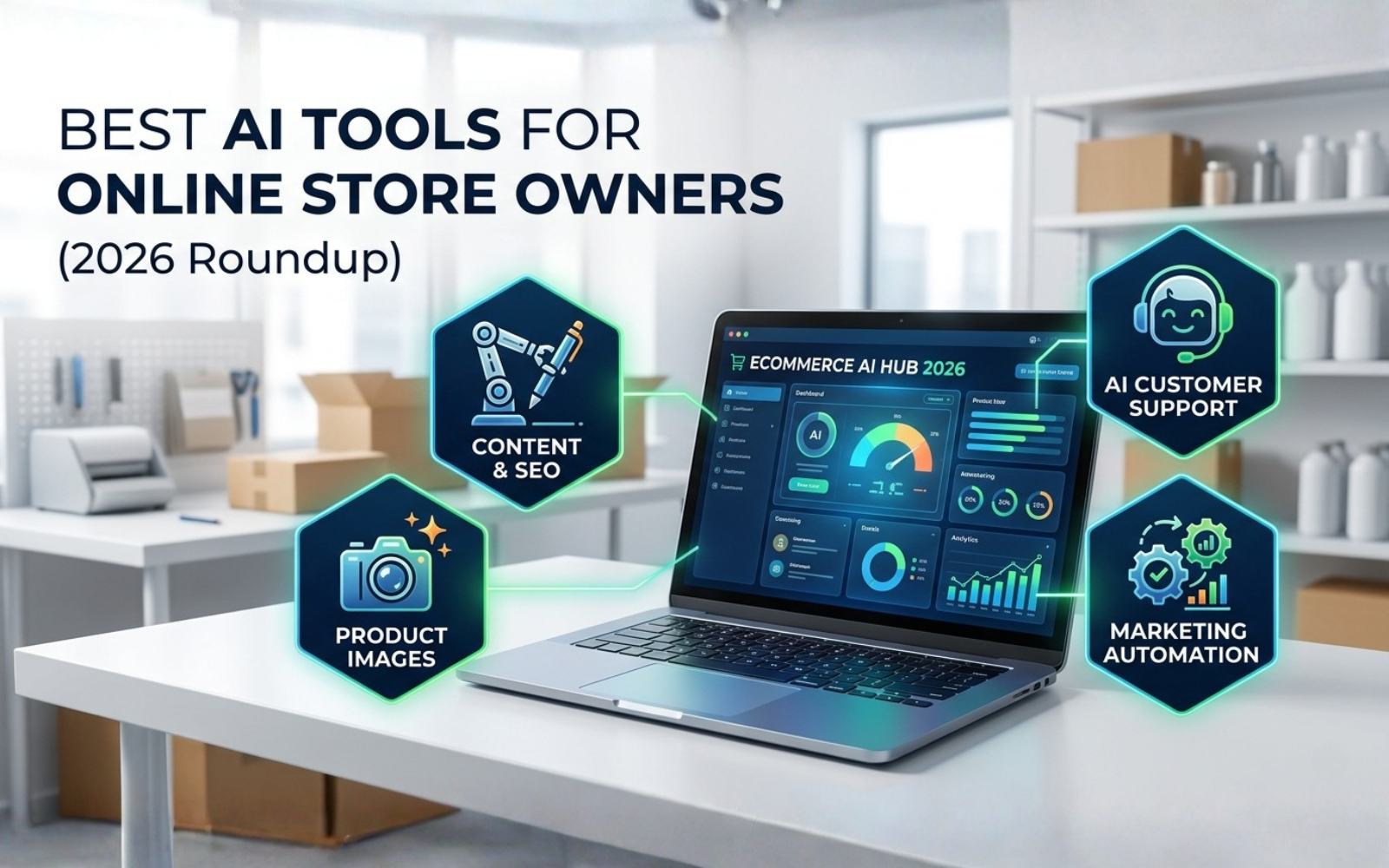
TL;DR: Best AI Tools for Online Store Owners
| Tool | Best For | Key Use Case | Pricing |
|---|---|---|---|
| Shopify Magic | Shopify merchants, quick wins | Product descriptions, email copy, Sidekick assistant | Free on all Shopify plans |
| Klaviyo | Email/SMS marketing at scale | Predictive segmentation, AI campaign copy (K:AI) | Free tier; paid from ~$20–45/mo, scales with contacts |
| Gorgias | Customer support automation | AI Agent resolves WISMO, returns, order questions | Helpdesk from $10/mo + ~$0.90–$1/resolved AI conversation |
| Photoroom | Product photography | Background removal, AI scenes, batch editing | Free tier; Pro from ~$7.50–7.99/mo |
| WebbyTroops AI Smart Content | Bulk meta title/description generation | ChatGPT-powered SEO metadata for products | Free (Shopify App Store) |
Quick picks: best overall for most stores is Shopify Magic (free, native); best for email marketing is Klaviyo; best for customer support is Gorgias; best for product images is Photoroom; best budget-friendly option is WebbyTroops AI Smart Content, since it's free and targets SEO metadata specifically.
Introduction
AI has moved from novelty to daily infrastructure for online retail. Store owners now use it to draft product copy, generate images, answer support tickets, personalize recommendations, and analyze sales data — often across several tools at once.
There is no single "best" AI tool for every store. The right choice depends on your platform (Shopify, WooCommerce, Magento/Adobe Commerce, BigCommerce), catalog size, team, budget, and which task is costing you the most time. This roundup compares real, currently available tools by use case so you can match capability to need rather than chase hype.
What Are AI Tools for Online Store Owners?
Direct answer: AI tools for online store owners are software applications that use artificial intelligence — often generative AI or large language models — to automate or improve tasks such as product content creation, customer service, marketing, personalization, analytics, and store operations.
Unlike traditional ecommerce software, which follows fixed rules, generative AI tools can produce new text, images, or recommendations based on patterns learned from data. Most integrate directly with ecommerce platforms via native apps, browser extensions, or APIs, pulling in product, order, and customer data to personalize output.
How Online Store Owners Are Using AI
Common workflows include:
- Writing and refreshing product descriptions and titles at scale
- Generating or editing product photography and lifestyle images
- Drafting email and SMS campaigns, and subject-line testing
- Powering chatbots for order status, returns, and FAQs
- Building product recommendations and on-site personalization
- Summarizing customer reviews and support tickets
- Forecasting demand and analyzing sales trends in plain language
- Automating workflows between order, CRM, and marketing systems
Best AI Tools for Online Store Owners This Month
Shopify Magic
Best for: Shopify merchants wanting a free starting point Category: Content generation, store assistant Works with: Shopify (native, all plans) Pricing: Free Key features: AI-generated product descriptions, email and page copy, background removal on product images, and Sidekick, a conversational assistant for store-management questions.
Why store owners may like it: No setup, no added cost, and it uses your own store data for more relevant output. Limitations: Output can be generic for long-form content like blog posts and needs editing before publishing. Best use case: Merchants who need fast first drafts for descriptions and emails without adding another subscription.
Klaviyo
Best for: Email and SMS marketing automation Category: Marketing automation / CRM Works with: Shopify, BigCommerce, WooCommerce, Magento (via integrations) Pricing: Free plan (up to 250 profiles); paid Email plans start around $20/month and scale with your active-profile count. AI features such as the Marketing Agent (content generation) and Customer Agent (AI support) are add-ons priced separately. Key features: Unified customer profiles, predictive analytics (churn risk, lifetime value), AI-generated segments and campaign copy.
Why store owners may like it: Combines a customer data platform with AI content and prediction in one system, reducing tool sprawl. Limitations: Pricing rises quickly as your list grows, and premium AI add-ons are billed on top of the base plan. Best use case: Stores with an active list that want predictive segmentation, not just send-and-hope email blasts.
Gorgias
Best for: Ecommerce customer support automation Category: Helpdesk / AI chatbot Works with: Shopify (deepest integration), BigCommerce, Magento, WooCommerce Pricing: Helpdesk plans from $10/month (ticket-based, not per seat). The AI Agent is billed separately, roughly $0.90–$1.00 per resolved conversation, in addition to the ticket count. Key features: AI agent for order status, returns, and shopping questions with direct store-data lookups; human escalation built in.
Why store owners may like it: Purpose-built for ecommerce support intents like "where is my order," with real order actions, not just scripted replies. Limitations: Pricing can be harder to predict than a flat fee, since both ticket volume and AI resolutions are metered — model your real volume before committing. Best use case: Stores with recurring, high-volume support questions that a well-trained agent can resolve without a human.
Photoroom
Best for: Product photography without a studio Category: AI image editing Works with: Any platform (web app, mobile app, API) Pricing: Free tier with watermarked, limited exports; Pro plans start around $7.50–$7.99/month (annual billing), with higher tiers for batch volume and an API priced separately. Key features: Background removal, AI-generated backgrounds and lifestyle scenes, batch editing, marketplace-ready image sizing.
Why store owners may like it: Cuts the cost of professional-looking images for catalogs where a full photoshoot isn't practical. Limitations: AI-generated scenes and models are a stylistic substitute, not a replacement for hero images on flagship or luxury products. Best use case: Sellers managing dozens to thousands of SKUs who need consistent, on-brand images fast.
WebbyTroops AI Smart Content
Best for: Bulk-generating SEO metadata for Shopify catalogs on a budget Category: Product content / SEO Works with: Shopify (app store listing) Pricing: Free Key features: Generates meta titles, meta descriptions, and product descriptions using OpenAI's ChatGPT, with a built-in editor to tweak output and filters to find products missing SEO content.
Why store owners may like it: It's a no-cost way to fill in missing SEO metadata across a catalog without a copywriter. Limitations: As of this writing the app has no published reviews or rating and is built by a small developer, so treat it as unproven — test it on a handful of products, back up your existing metadata first, and verify output quality before running it across your full catalog. It's narrower in scope than a full content suite like Shopify Magic. Best use case: Small Shopify stores with thin or missing product meta titles/descriptions who want a free, targeted fix rather than a broader AI writing platform.
Best AI Tools by Ecommerce Task
| Ecommerce Task | Recommended Tool Type | Why It Helps |
|---|---|---|
| Product descriptions | Shopify Magic / generative AI writers | Fast first drafts from product attributes |
| Product images | Photoroom / AI photo editors | Studio-quality visuals without a shoot |
| Customer support | Gorgias / AI helpdesk agents | Resolves repetitive order and returns questions |
| Email & SMS marketing | Klaviyo | Predictive segmentation plus AI copy |
| Ecommerce SEO | AI SEO/content platforms | Keyword research, briefs, metadata at scale |
| Automation | Workflow automation platforms (e.g., Zapier-style tools) | Connects order, CRM, and marketing systems |
| Analytics | Platform-native AI reporting (e.g., Shopify, GA) | Plain-language answers to sales questions |
Best AI Tools for Shopify Stores
Shopify's native AI layer — Magic for content and image edits, Sidekick for admin questions — is included on every plan and is the logical starting point. Beyond that, most Shopify merchants layer on a marketing platform (like Klaviyo) for email/SMS and a support tool (like Gorgias) once ticket volume justifies the cost. Treat native features and third-party apps as complementary, not competing.
Best AI Tools for WooCommerce Stores
WooCommerce merchants don't get a built-in AI suite comparable to Shopify Magic, so most rely on plugins and standalone SaaS tools — an AI writing tool for product content, Klaviyo or similar for email, and a chat widget with AI resolution for support — connected through WooCommerce's REST API or existing marketing plugins.
Best AI Tools for Magento and Adobe Commerce Stores
Magento and Adobe Commerce merchants typically use AI for catalog-scale product content, personalization (Adobe Sensei-powered features within Adobe Commerce), and search relevance. Because catalogs and customizations vary widely on Magento, confirm any third-party AI tool's Magento compatibility directly with the vendor before purchasing — don't assume support exists.
AI Tools for Ecommerce Marketing
AI supports marketing across SEO research, content drafting, email/SMS personalization, social copy, and ad creative variants. The common thread: AI produces the first draft or the data-driven segment, and a marketer refines tone, offers, and creative direction before it goes live.
AI Tools for Product Content
AI tools can draft product titles, descriptions, meta descriptions, and attributes from structured data, which is valuable for catalogs with hundreds of SKUs. Human review still matters: AI can misstate materials, sizing, or compliance details it wasn't given accurate source data for, so treat output as a draft, not a final listing.
AI Tools for Product Photography and Visual Content
AI photo tools split into two categories: editing (background removal, retouching, color correction on real photos) and generation (AI-created backgrounds or lifestyle scenes). Editing tools are generally reliable for marketplace-ready images; fully generated scenes work well for backgrounds but should be reviewed for realism, especially with reflective or textured products.
AI Tools for Customer Support
AI chatbots handle order status, return policies, and FAQs well when connected to live order data. The main risk is hallucination — an AI agent confidently giving wrong shipping or refund information. Keep a clear, fast path to human escalation and audit AI transcripts regularly.
AI Tools for Ecommerce SEO
AI can accelerate keyword research, content briefs, metadata drafting, and identifying thin or duplicate product-page content. It cannot guarantee rankings, and AI-generated SEO content still needs human review for accuracy, brand voice, and E-E-A-T signals search engines and AI answer engines look for.
AI Tools for Ecommerce Automation
Automation platforms connect systems so a single event triggers a chain of actions, for example:
Customer places order → order data is processed → confirmation is sent → CRM is updated → customer enters an email workflow.
These typically run through APIs and webhooks between your ecommerce platform, marketing tool, and helpdesk, rather than one AI tool doing everything.
AI Tools for Analytics and Business Intelligence
AI-assisted analytics let store owners ask plain-language questions about sales trends, customer lifetime value, or product performance instead of building manual reports. This is most useful for spotting patterns quickly; decisions based on those patterns still benefit from a human sanity check.
AI Agents for Ecommerce
AI agents differ from simple assistants by taking multi-step actions — like processing a return end-to-end — rather than only answering questions. Because agents can act autonomously, give them clearly scoped permissions, log their actions, and keep human review in place for anything touching payments, refunds, or customer data.
AI vs. Traditional Ecommerce Tools
| Factor | Traditional Software | AI-Powered Software |
|---|---|---|
| Content generation | Manual entry | Drafts generated automatically |
| Personalization | Rule-based segments | Behavior-based, predictive |
| Customer support | Scripted responses | Context-aware, data-connected replies |
| Human involvement | High, for every task | Lower, but review still needed |
AI is generally an enhancement layer on top of core ecommerce infrastructure, not a replacement for it.
Free vs. Paid AI Ecommerce Tools
Free tiers (Shopify Magic, Klaviyo's free plan, Photoroom's free tier) are enough for small catalogs or early testing. Paid plans become worthwhile once volume — contacts, tickets, SKUs, or images — exceeds free limits, or once you need advanced features like predictive analytics or API access. A free tool isn't automatically the right fit; match the tier to your actual usage.
AI, Privacy, Security, and Ecommerce Data
Any AI tool that touches customer names, addresses, or order details is processing personal data. Review each vendor's data retention and processing terms, restrict access controls, and check whether customer data is used to train third-party models. This is general guidance, not legal advice — confirm requirements for your specific market with a qualified professional.
Future Trends in AI Ecommerce
Established today: AI content drafting, image editing, chat-based support, predictive segmentation. Emerging: AI shopping agents that browse and buy on a customer's behalf, and platforms exposing product catalogs directly to AI assistants like ChatGPT or Perplexity. Treat these as developing capabilities, not guaranteed revenue drivers, until you see results in your own store.
Frequently Asked Questions
What is the best AI tool for ecommerce?
There is no single best tool; it depends on the task. Shopify Magic is a strong free starting point for content, Klaviyo for email, and Gorgias for support.
Can AI run an online store?
No. AI can automate individual tasks like content, support replies, and analytics, but strategic decisions, quality control, and accountability still require a human owner or team.
Is AI worth using for a small online business?
Often yes, starting with free or low-cost tools for one high-impact task, such as product descriptions or support FAQs, before adding paid tools.
What ecommerce tasks can AI automate?
Product content, image editing, email/SMS campaigns, customer support replies, basic analytics, and workflow automation between systems.
How much do AI ecommerce tools cost?
Pricing ranges from free (Shopify Magic) to usage-based models charging per contact, ticket, or resolved conversation, so costs can scale significantly with volume — always check the vendor's current pricing page.
Conclusion
AI is now a practical, everyday layer for running an online store, but the right stack depends on your platform, budget, and biggest bottleneck. Start with one or two high-impact workflows — content, support, or images are common first wins — and expand once you can measure real time saved or issues resolved. Keep humans reviewing AI output, especially anything customer-facing, and prioritize integration, security, and ROI over feature lists. If you're weighing how to bring AI into your store's workflow or platform, it's worth auditing your current stack before adding another subscription.
Download The Free E-book & Launch Your Brand Strategically
Download The Free E-book & Launch Your Brand Strategically
Share this post