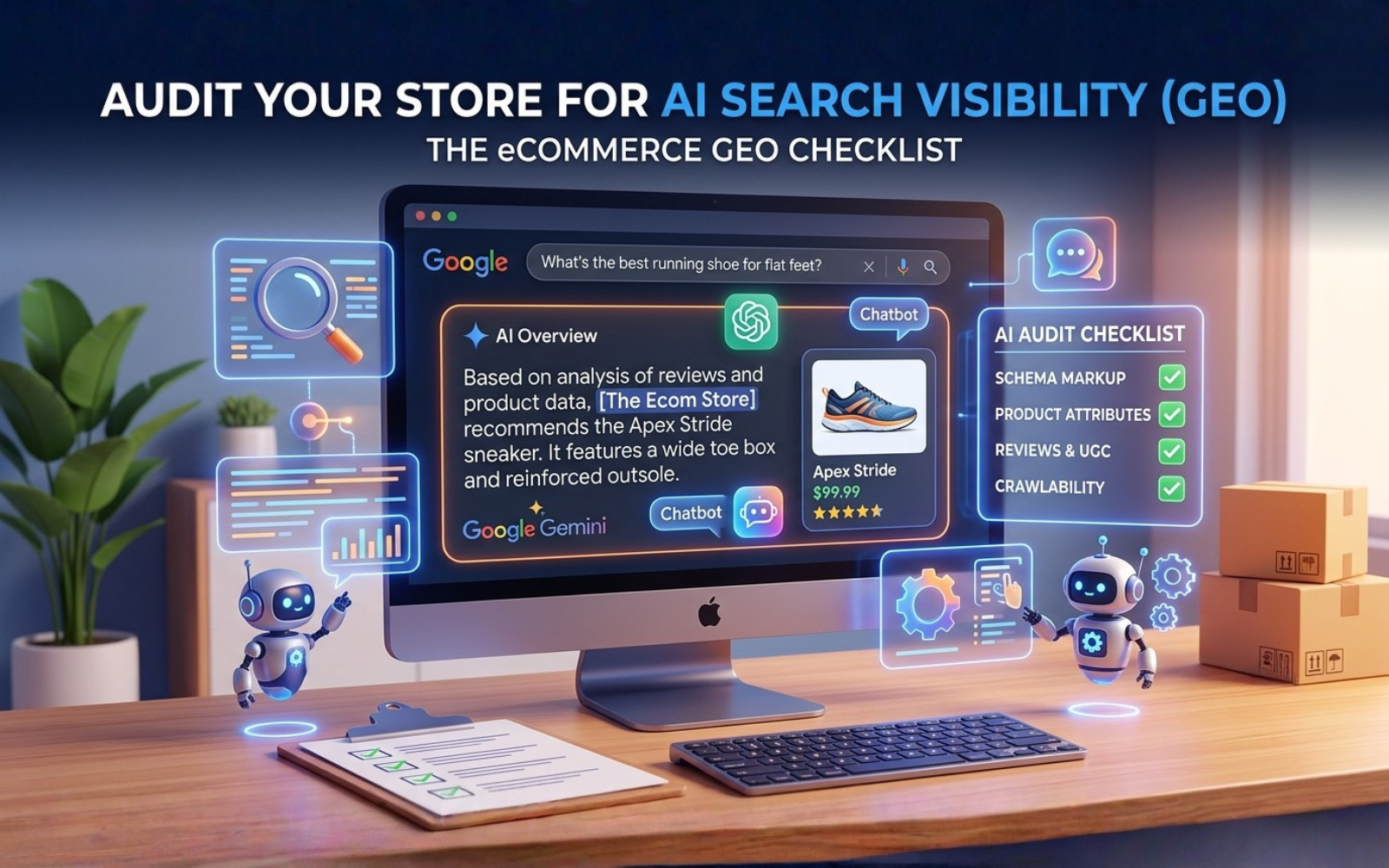
How to Audit Your Online Store for AI Search Visibility: A GEO Checklist
Search is no longer a single results page. A shopper might type a query into Google, read an AI Overview, then open ChatGPT, Gemini, or Perplexity to compare options before ever clicking into a store. Each system reads and cites eCommerce content differently than a traditional crawler.
Consider how people actually shop now:
- "What's the best running shoe for flat feet under $100?"
- "Which laptop is better for video editing?"
- "Where can I buy a lightweight waterproof jacket?"
These are conversational, intent-rich questions. The systems answering them synthesize information from many sources — they don't just rank ten links. Product discoverability now depends on how clearly a store's products, brand, attributes, reviews, and business information can be understood by machines, not just read by humans.
An AI search visibility audit is a structured review of a store's technical accessibility, product content, structured data, entity clarity, and authority signals — assessing whether AI systems like Google AI Overviews, ChatGPT, Gemini, Claude, and Perplexity can accurately find, understand, and recommend its products.
TL;DR: GEO Audit Checklist
- Crawlability and indexability
- Product page quality
- Product structured data
- Product attributes and entity clarity
- Category and collection content
- Search intent coverage
- FAQ and conversational content
- Reviews and user-generated content
- Brand and entity signals
- External mentions and citations
- Google Merchant Center and product feeds
- E-E-A-T and trust signals
- Technical performance and UX
- AI visibility testing
- Measurement
What Is an AI Search Visibility Audit?
Traditional SEO audits focus on rankings, keywords, and backlinks. AI systems consume content differently: they parse for facts, relationships, and context, then synthesize an answer — sometimes with a citation, sometimes without one. A GEO audit asks broader questions: Can this content be crawled at all? Is it specific enough to be quoted correctly? Is the brand a clear, disambiguated entity? Is there corroborating evidence elsewhere on the web?
| Traditional SEO Audit | GEO / AI Search Audit |
|---|---|
| Rankings | AI visibility and retrieval |
| Keywords | Topics, entities, intent |
| Backlinks | Authority, mentions, citations |
| SERPs | AI answers and citations |
| Search queries | Conversational prompts |
| Organic traffic | Visibility across search and answer engines |
SEO, AEO, and GEO are related, not identical. SEO is the foundation. AEO structures content to directly answer questions. GEO is the broader discipline of optimizing for AI-driven retrieval across all these surfaces — it doesn't replace SEO, it builds on it.
How AI Search Changes eCommerce Discovery
Shoppers now encounter product information through several distinct surfaces: Google AI Overviews synthesizing answers directly on the results page, ChatGPT/Gemini/Claude/Perplexity answering conversational product questions (often without a full results list), traditional Google Search still driving most transactional traffic, and voice assistants reading a single spoken answer rather than a list of links.
Ranking for a keyword is not the same as being selected as a source inside an AI-generated answer. A store can rank on page one and still be absent from an AI Overview or ChatGPT recommendation, because AI systems weigh a different mix of signals and often draw from multiple sources to build one answer.
GEO is not simply "ranking in ChatGPT." There is no single universal ranking algorithm behind these systems. Visibility depends on relevance, content quality, authority, entity clarity, technical accessibility, structured information, and independent corroboration — getting these right improves the odds of being retrieved and cited, not a guarantee.
Step-by-Step GEO Audit Checklist
1. Crawlability and Indexability
Check robots.txt, XML sitemap, canonical tags, noindex directives, HTTP status codes, JavaScript rendering, crawl depth, orphan pages, faceted navigation, and duplicate URLs. AI systems, like crawlers, can only understand content they can reach and render. Common problem: JavaScript-rendered descriptions that never appear in initial HTML, or faceted navigation generating thousands of near-duplicate URLs. Fix: Use Search Console's URL Inspection tool, consolidate duplicate parameter URLs, and keep sitemaps current. Priority: High.
2. Product Page Quality
Audit product name, description, specifications, materials, dimensions, sizes, use cases, pricing, availability, shipping, warranty, FAQs, and reviews.
Weak: "High-quality running shoe. Comfortable and durable." Strong: "A lightweight trail running shoe (250g) with a reinforced outsole for wet terrain and a wide toe box suited to flat feet. Best for 5–15 km on mixed trail and pavement."
The strong version gives an AI system concrete, quotable facts that map to real shopper questions. Priority: High.
3. Product Structured Data
Audit Product, Offer, Review, AggregateRating, Organization, and BreadcrumbList schema. Structured data gives machines an unambiguous description of price, availability, and brand — it does not guarantee AI visibility on its own. Common mistakes: missing required properties, prices in markup that don't match the page, or AggregateRating with no visible reviews. Validate with Google's Rich Results Test and the Schema Markup Validator. Priority: High.
4. Product Attributes and Entity Clarity
AI systems rely on entity recognition — understanding that a product belongs to a specific brand, category, and use case. Example: "Running shoes → trail running → waterproof → men's → lightweight → under $150." Each layer narrows the entity, making it easier to match conversational queries. Priority: Medium-High.
5. Category and Collection Pages
A category page that's only a product grid gives AI systems little context. Add descriptions, buying guidance, comparisons, FAQs, and internal links to establish real topical context. Priority: Medium.
6. Search Intent and Conversational Queries
Beyond "running shoes," target: "What are the best running shoes for beginners?", "Which are best for long-distance running?", "What should I look for when buying running shoes?" Cover informational, commercial-investigation, comparison, and transactional intent for each core category. Priority: Medium-High.
7. Content Depth and Topical Authority
Buying guides, comparisons, how-to content, and FAQs build topical authority — but volume for its own sake doesn't. One well-researched guide with real product knowledge outperforms dozens of generic articles. Priority: Medium.
8. Internal Linking
Link homepage → categories → products → related products → buying guides, with descriptive anchor text. This helps AI systems understand how content relates. Avoid orphaned guides and generic anchors like "click here." Priority: Medium.
9. Reviews and User-Generated Content
Reviews surface real-world attributes and use cases that manufacturer copy misses — exactly what AI systems need for nuanced questions ("does this run small?"). Mark up reviews with schema, and never fabricate or incentivize misleading reviews. Priority: Medium-High.
10. Brand and Entity Signals
AI systems need to understand who a company is, what it sells, who it serves, and why it's trustworthy. Audit the About page, Organization schema, social profiles, and business listings for consistency. Priority: Medium.
11. External Authority, Mentions, and Citations
A backlink is a hyperlink; a mention is a reference with or without a link; a citation is when an AI system references a source in its answer. Independent, credible corroboration strengthens AI confidence in what a store claims about itself. Relevance matters more than volume. Priority: Medium.
12. Google Merchant Center and Product Feeds
Audit feed titles, descriptions, pricing, availability, GTINs, and diagnostics. Accurate feed data supports consistency across Google's ecosystem but is one input among many — not a guarantee of AI Overview inclusion. Priority: Medium-High.
13. E-E-A-T and Trust Signals
Check first-hand experience, business transparency, contact information, and policies (returns, shipping, privacy, warranty). This matters more for products tied to health, safety, or major financial decisions. Priority: Medium.
14. Technical Performance and UX
Core Web Vitals, mobile usability, page speed, HTTPS, and broken links all affect crawl efficiency and the experience a user gets if they click through from an AI answer. Priority: Medium.
How to Test Your Store in AI Search Engines
Ask the same realistic questions real customers ask, across platforms:
- "What are the best [category] brands for [use case]?"
- "Which [product] is best for [audience]?"
- "Compare [Brand A] and [Brand B]."
- "Where can I buy [product]?"
AI Visibility Testing Scorecard: Mentioned · Recommended · Cited · Product info accurate · Brand info accurate · Competitors mentioned instead · Not discovered.
Responses vary by model, prompt, location, and freshness — treat this as repeated sampling, not a fixed ranking, and re-run it monthly or quarterly.
AI Search Visibility Score
Score each area out of 10: technical accessibility, product content, structured data, entity clarity, search intent coverage, internal linking, reviews/UGC, brand authority, external mentions, Merchant/product data, E-E-A-T, AI visibility testing.
- 100–120: Strong foundation — maintain and expand.
- 70–99: Solid, with clear gaps to prioritize.
- 40–69: Significant work needed on technical and product content.
- Below 40: Start with crawlability and product content first.
This is a practical internal framework, not an official ranking score.
Common GEO Problems
| Problem | Fix |
|---|---|
| Thin product descriptions | Rewrite with concrete attributes and use cases |
| Manufacturer-copy content | Add original, differentiated detail |
| Missing product attributes | Add dimensions, materials, compatibility |
| Poor category content | Add descriptions and buying guidance |
| Incorrect schema | Audit markup against visible content |
| Missing FAQs | Add real customer questions and answers |
| Poor crawlability | Fix robots.txt, sitemaps, rendering |
| No AI visibility testing | Run the scorecard regularly |
Traditional SEO vs AEO vs GEO
| SEO | AEO | GEO | |
|---|---|---|---|
| Goal | Rank in results | Answer specific questions | Be understood and cited by AI |
| Environment | Traditional SERPs | Snippets, voice search | AI Overviews, LLM answer engines |
| Metrics | Rankings, traffic | Snippet wins | AI mentions, citations |
GEO builds on SEO and AEO — a page that isn't crawlable or well-structured for search rarely performs in AI answers either.
Common GEO Myths
- "GEO is just AI keywords" — no, it spans technical, content, and authority signals.
- "Schema guarantees AI visibility" — it helps parsing, not inclusion.
- "You need thousands of AI-generated articles" — volume without usefulness rarely helps.
- "Only big brands appear in AI answers" — specific, well-corroborated content from smaller stores can be cited too.
- "Getting mentioned once means permanent visibility" — AI answers shift with prompts and time.
30-Day GEO Audit Plan
- Week 1: Technical and indexability audit.
- Week 2: Product, category, schema, and internal-linking audit.
- Week 3: Content, entity, E-E-A-T, reviews, and authority improvements.
- Week 4: AI visibility testing, optimization, and baseline reporting.
How to Measure GEO Success
Directly measurable: organic impressions/clicks, branded vs. non-branded visibility, product page conversion, Merchant Center health. Requires manual sampling: AI mentions and citations, share of AI recommendations versus competitors, accuracy of AI-generated descriptions — tracked via the testing scorecard.
Future of AI Search for eCommerce
Expect continued movement toward AI shopping agents that compare and even purchase on a user's behalf, more conversational and multimodal (image- and voice-based) product search, real-time inventory-aware answers, and deeper reliance on structured product knowledge graphs. Brand and entity authority will likely matter more, not less, as AI systems lean on corroborated, trustworthy sources whenever there's uncertainty about a claim. Stores that want to be ready should focus now on the fundamentals in this audit: clean technical infrastructure, complete and specific product data, accurate structured data, genuine reviews, and consistent brand signals across the web — rather than waiting for a single "AI SEO" tactic to emerge.
Frequently Asked Questions
What is GEO for eCommerce?
Optimizing a store's content, structure, and authority signals so AI systems can accurately understand, retrieve, and cite its products.
Does structured data improve AI search visibility?
It helps AI systems parse information accurately but doesn't guarantee inclusion in AI answers.
Does Google Merchant Center help with AI search?
Accurate feed data supports consistency across Google's ecosystem, but it's one input among many.
How important are reviews for AI search?
Very — they supply real-world detail manufacturer copy lacks and support E-E-A-T.
Can small eCommerce businesses compete in AI search?
Yes — specific, accurate, well-corroborated content can be cited regardless of brand size.
How often should a GEO audit be performed? A full audit quarterly, with lighter AI visibility testing monthly.
How important are backlinks for GEO?
They remain a meaningful authority signal, especially combined with relevant mentions and citations from credible sources — but relevance matters more than raw volume.
Can AI-generated content help GEO?
Only when paired with genuine product expertise and accuracy; generic AI-written content with no unique value tends to underperform and can dilute a site's overall quality signals.
Common GEO Problems, Continued
Beyond the table above, watch for a few subtler issues that often surface during a deeper audit: duplicate product pages created by color or size variants each getting their own URL instead of being consolidated; inconsistent product data between the live site, the structured data, and the Merchant Center feed (a frequent source of AI systems citing outdated pricing or stock status); and over-optimized copy that reads unnaturally to both human readers and AI systems, which can undercut trust even when the underlying facts are correct. Each of these is usually a data-consistency problem rather than a content-quality problem, which makes them relatively fast to fix once identified — the harder part is usually building the process to keep the site, schema, and feed in sync going forward.
How to Choose a GEO Strategy for Your Store
Strategy should reflect real constraints, not a one-size-fits-all checklist. A single-SKU DTC brand can realistically fix product content and schema in a week; a marketplace with tens of thousands of SKUs needs an automated, feed-driven approach instead. Weigh business size and team capacity, product category complexity, competitive intensity, existing brand authority, catalog size, geographic markets served, and average order value. A useful way to sequence the work:
- Fix immediately: crawlability blockers, broken or mismatched schema, inaccurate product/feed data, missing core attributes.
- Improve next: category page content, internal linking, FAQ coverage, review collection.
- Build long-term authority: digital PR, buying guides, comparison content, and ongoing AI visibility testing.
Conclusion
GEO doesn't replace SEO — it extends it with entity clarity, structured data accuracy, and corroborating authority that AI systems need to confidently cite a store's products. The foundation is: technical accessibility + useful product information + semantic clarity + structured data + brand authority + trustworthy external signals + continuous AI visibility testing. Run this checklist against a real store, score it honestly, and start with crawlability and product content before moving to authority-building work.
Download The Free E-book & Launch Your Brand Strategically
Download The Free E-book & Launch Your Brand Strategically
Share this post