How Much Does a Custom AI Recommendation Engine Cost to Build?
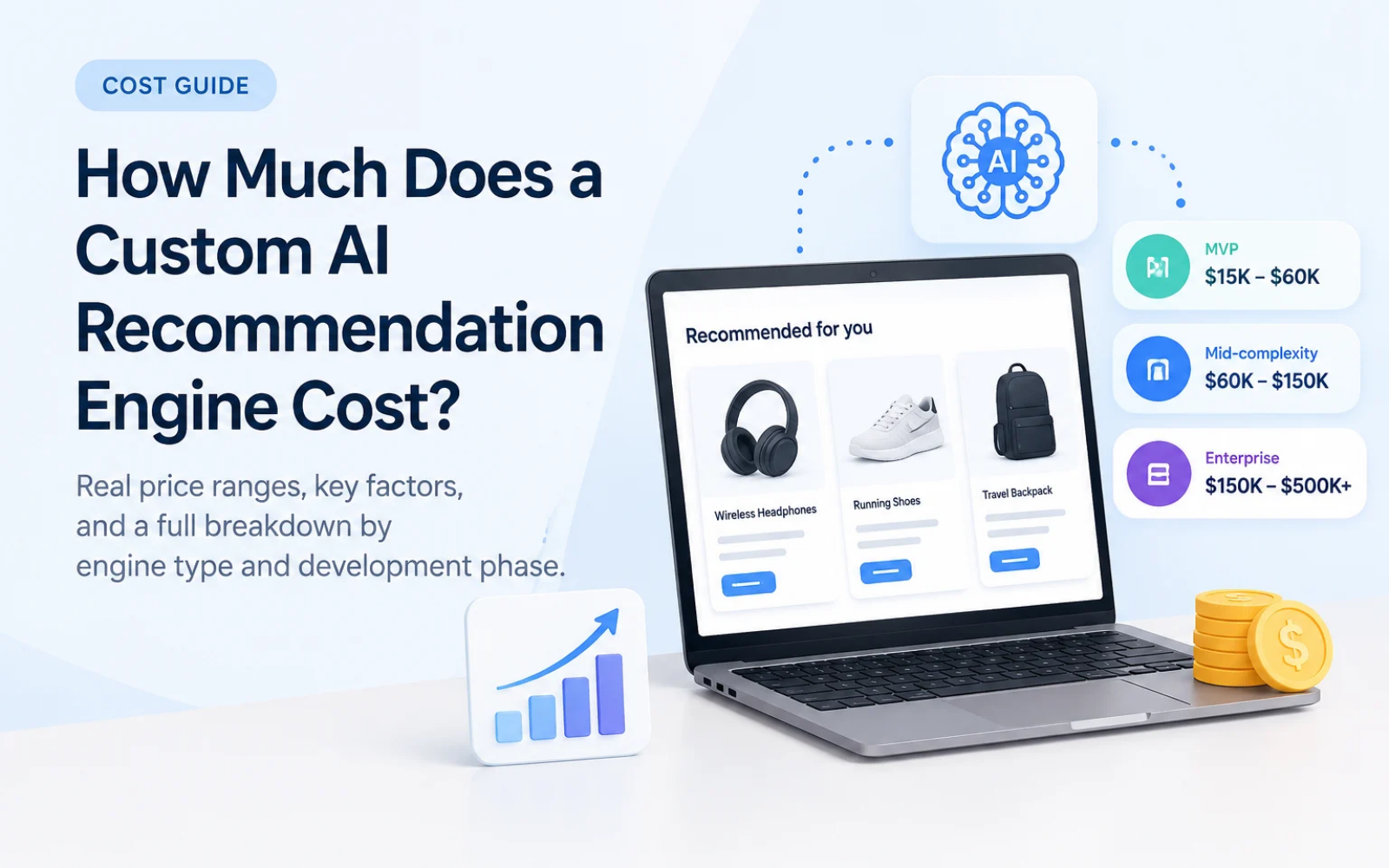
Quick answer: A custom AI recommendation engine typically costs $15,000–$60,000 for a basic MVP, $60,000–$150,000 for a mid-complexity system with collaborative filtering, and $150,000–$500,000+ for an enterprise-grade, deep-learning-powered engine like the ones running Amazon or Netflix. Ongoing hosting, retraining, and maintenance usually add another 15–25% of the build cost per year.
The exact number depends on five things: how much data you already have, which algorithm approach you need, whether you build in-house or outsource, where your development team is located, and how deeply the engine has to integrate with your existing product. This guide breaks each of those down with real ranges so you can budget accurately before you request a quote.
What Is a Custom AI Recommendation Engine?
A custom AI recommendation engine is a machine-learning system built specifically for your product's data, users, and catalog. It predicts what a user is most likely to want next — a product, a video, a song, an article, a job listing — and ranks results accordingly.
This is different from off-the-shelf recommendation widgets (like a generic "customers also bought" plugin) or SaaS recommendation tools (like Nosto, Dynamic Yield, or Recombee). Those tools are fast to install and cheap upfront, but they run on shared, generalized models, offer limited control over ranking logic, and charge ongoing per-usage fees that scale with your traffic.
A custom engine, by contrast, is trained on your own first-party data, can factor in business rules unique to your company (margin, inventory, compliance), and becomes a long-term asset you own outright rather than rent. The trade-off is a higher upfront investment and a need for ongoing MLOps support — which is exactly what this article prices out.
Key Factors That Drive the Cost
- Data readiness — Clean, structured, well-tagged historical data (purchases, clicks, ratings, watch time) is cheaper to work with than raw, scattered logs that need a data pipeline built from scratch.
- Algorithm complexity — Simple rule-based logic costs far less than collaborative filtering, which costs less than a hybrid or deep-learning/transformer-based model.
- Catalog and user scale — A catalog of a few hundred SKUs and a few thousand users trains faster and cheaper than millions of items and users at real-time scale.
- Real-time vs. batch delivery — Recommendations generated overnight in batch are cheaper than sub-100-millisecond, real-time personalization at high traffic volume.
- Integration depth — Connecting to your app, CMS, CRM, mobile app, and analytics stack adds engineering hours beyond the model itself.
- Team location and structure — In-house teams, agencies, freelancers, and offshore development shops carry very different hourly rates.
- Compliance and privacy requirements — GDPR, CCPA, HIPAA, or PCI-DSS obligations add legal review, anonymization, and audit work.
- Ongoing retraining cadence — A model retrained weekly needs more MLOps investment than one retrained quarterly.
Cost by Recommendation Engine Type
The algorithm approach is the single biggest cost driver. Here's how the main types compare:
|
Engine Type |
What It Does |
Typical Cost |
Best For |
|---|---|---|---|
|
Rule-based / simple |
Fixed logic like "top sellers" or "same category" |
$10,000–$25,000 |
Early-stage products, thin catalogs |
|
Content-based filtering |
Recommends items similar in attributes (genre, tags, specs) |
$25,000–$60,000 |
Media, editorial, niche catalogs |
|
Collaborative filtering |
Learns from user-item interaction patterns |
$50,000–$120,000 |
E-commerce, marketplaces with behavioral data |
|
Hybrid (content + collaborative) |
Combines both approaches for better cold-start handling |
$80,000–$180,000 |
Mid-to-large platforms needing accuracy at scale |
|
Deep learning / transformer-based |
Neural networks modeling complex, non-linear preferences |
$150,000–$400,000+ |
Large-scale platforms (streaming, big retail) |
|
Generative/LLM-powered |
Uses large language models for conversational or context-aware recommendations |
$200,000–$500,000+ |
Next-gen personalization, chat-based shopping assistants |
Most mid-sized businesses land in the collaborative-filtering-to-hybrid range. Deep learning and generative approaches are usually only justified once you have millions of user interactions to train on — otherwise the added cost outpaces the accuracy gain.
Cost Breakdown by Development Phase
Beyond algorithm type, cost also breaks down by the work required at each stage of the build:
|
Phase |
What's Involved |
% of Total Budget |
|---|---|---|
|
Discovery & data audit |
Defining use cases, auditing existing data quality, choosing an approach |
5–10% |
|
Data pipeline engineering |
ETL, cleaning, labeling, feature engineering, warehouse setup |
20–25% |
|
Model development & training |
Algorithm selection, training, tuning, offline evaluation |
25–35% |
|
Infrastructure & MLOps |
Cloud compute, model-serving infrastructure, CI/CD for ML |
10–15% |
|
Front-end/product integration |
APIs, UI surfaces for recommendations, A/B test scaffolding |
10–15% |
|
QA & testing |
Accuracy testing, bias checks, load testing |
5–10% |
|
Deployment & handover |
Production rollout, documentation, training your team |
5% |
Data pipeline work is consistently underestimated. Businesses with messy or siloed data often find this phase costs as much as the model development itself.
In-House vs. Outsourcing vs. No-Code Platforms
|
Approach |
Typical Cost |
Timeline |
Trade-offs |
|---|---|---|---|
|
In-house team |
$150,000–$400,000+ per year (salaries) |
4–9 months to first launch |
Full control and IP ownership, but highest fixed cost and hardest to staff (ML engineers are scarce) |
|
Development agency |
$50,000–$300,000 project fee |
3–6 months |
Predictable scope and cost, proven process, but less flexibility mid-project |
|
Freelancers/contractors |
$30,000–$120,000 |
2–5 months |
Lower cost, but higher coordination overhead and variable quality |
|
No-code/SaaS recommendation tools |
$500–$5,000/month subscription |
Days to weeks |
Fast and cheap to start, but limited customization, recurring fees that scale with traffic, and you don't own the model |
Many companies start with a SaaS tool to validate demand, then commission a custom engine once recommendation-driven revenue justifies the investment.
Cost by Developer Region and Team Composition
Hourly rates for ML engineers and data scientists vary significantly by region:
|
Region |
Typical Hourly Rate |
Notes |
|---|---|---|
|
United States / Canada |
$100–$250/hr |
Highest cost, strongest access to senior ML talent |
|
Western Europe |
$80–$180/hr |
Comparable quality to North America, slightly lower cost |
|
Eastern Europe |
$40–$90/hr |
Strong technical talent pool, popular for outsourcing |
|
South Asia / Southeast Asia |
$20–$50/hr |
Lowest cost, wider quality variance, requires careful vetting |
A typical build team includes a project manager, one to two data engineers, one to two ML engineers, a backend developer, and a QA engineer — roughly 4–6 people for 3–6 months. At blended offshore rates, that team costs roughly $60,000–$150,000 in labor alone; at U.S. rates, the same scope can run $250,000–$500,000.
Hidden and Ongoing Costs to Budget For
The build price is rarely the full story. Plan for these recurring costs too:
- Cloud compute — GPU/TPU training and inference infrastructure (AWS, GCP, Azure) typically runs $500–$10,000+ per month depending on scale and retraining frequency.
- Model retraining and monitoring — Data drifts as user behavior changes; expect ongoing engineering time to retrain and validate models, often 10–20% of one engineer's time year-round.
- Data licensing or acquisition — If you lack sufficient first-party data, third-party datasets or enrichment services add cost.
- Compliance and security audits — Privacy law compliance (GDPR, CCPA) and periodic security reviews, especially for regulated industries.
- A/B testing infrastructure — Tooling and analyst time to measure whether recommendations actually lift revenue.
- Maintenance and bug fixes — Standard software maintenance, usually 15–25% of the original build cost annually.
Companies that budget only for the initial build are frequently surprised by year-two costs. Treat a recommendation engine as a product with a lifecycle, not a one-time project.
Real-World Cost Examples by Business Size
|
Business Stage |
Example Scenario |
Approximate Total Cost |
|---|---|---|
|
Startup MVP |
Small e-commerce site, 500–5,000 SKUs, basic "related products" logic |
$15,000–$40,000 |
|
Growth-stage company |
Mid-sized retailer or content platform with collaborative filtering and A/B testing |
$80,000–$200,000 |
|
Established mid-market |
Marketplace or media platform with hybrid model, real-time serving, multiple integrations |
$200,000–$400,000 |
|
Enterprise |
Large-scale platform (comparable in ambition to Amazon, Netflix, or Spotify's engines) with deep learning, real-time personalization, global scale |
$500,000–$2,000,000+ |
These figures cover initial build only. Enterprise-scale engines like Netflix's or Amazon's represent years of continuous investment by dedicated internal teams, not a single project cost — so "building the next Netflix algorithm" isn't a realistic first milestone for most businesses.
ROI: Why the Investment Usually Pays Off
Recommendation engines are one of the higher-ROI investments in e-commerce and content platforms because they directly influence conversion and retention rather than just awareness.
- E-commerce sites commonly report that personalized recommendations drive 10–30% of total revenue.
- Streaming and content platforms use recommendations to reduce churn, since users who find relevant content faster stay subscribed longer.
- Even a modest 2–5% lift in conversion rate from better recommendations can repay a $100,000 build within the first year for a mid-sized e-commerce business doing several million dollars in annual revenue.
The ROI calculation should weigh the build cost against incremental revenue per user, not just against the sticker price. A cheaper, generic recommendation widget that lifts conversion by 1% may cost less upfront but deliver far less value over three years than a custom engine that lifts conversion by 5%.
How to Reduce Costs Without Sacrificing Quality
- Start with a narrower use case. Launch one recommendation surface (e.g., product page "similar items") before building homepage-wide personalization.
- Use pre-trained models and open-source frameworks (like TensorFlow Recommenders or open-source collaborative filtering libraries) instead of building algorithms from scratch.
- Clean your data before scoping the project. Agencies and freelancers price in the uncertainty of messy data; a clean, documented dataset lowers quotes significantly.
- Choose batch processing over real-time serving where a few hours of latency is acceptable — it cuts infrastructure cost substantially.
- Pilot with a SaaS tool first to validate that recommendations move your metrics before committing to a custom build.
- Negotiate a phased contract with agencies: pay for an MVP first, then commission the next phase once results are proven.
Key Takeaway
A custom AI recommendation engine costs anywhere from $15,000 for a simple MVP to $500,000+ for an enterprise-grade system, with most mid-sized businesses landing in the $60,000–$200,000 range for a collaborative or hybrid model. The real cost driver isn't the algorithm itself — it's data readiness, integration depth, and your team's location. Budget for ongoing maintenance at 15–25% of build cost annually, and consider starting with a narrower use case or a SaaS tool to validate impact before committing to a full custom build.
If you're ready to scope a project, come with your data volume, catalog size, and integration requirements documented — that alone will tighten any quote you receive by a wide margin.
Download The Free E-book & Launch Your Brand Strategically
Download The Free E-book & Launch Your Brand Strategically
Frequently Asked Questions
Share this post