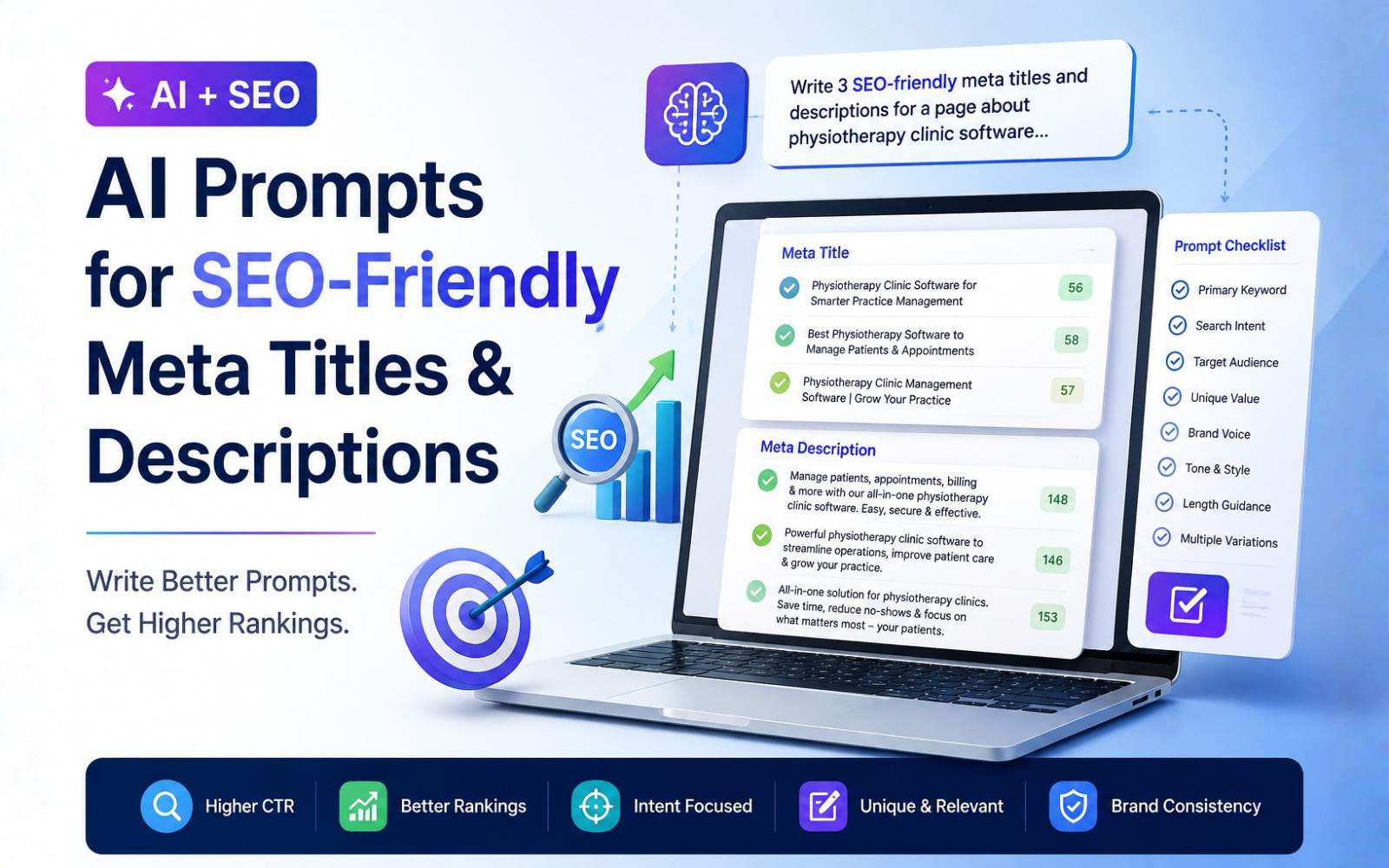
How to Write AI Prompts That Generate SEO-Friendly Meta Titles and Descriptions
An AI prompt for SEO is a structured instruction that tells an AI tool how to create or optimize search engine metadata, such as meta titles and meta descriptions, based on keywords, search intent, audience, page content, and SEO requirements. The output is only as good as the input: vague prompts produce vague metadata, while detailed prompts produce metadata that reflects real search intent and page value.
This matters because meta titles and descriptions still shape click-through rate (CTR) in organic search, even as Google AI Overviews and other answer engines summarize content directly. A well-written prompt turns a generic AI writing tool into a repeatable SEO workflow.
What Is an AI Prompt for SEO?
An SEO prompt is an instruction set — not just a request — that gives an AI model the context it needs to write metadata aligned with search intent and on-page content. Basic prompts ("write a title for this page") produce generic, interchangeable results because the model has no keyword, audience, or intent signal to work from. Structured prompts supply that missing context, so the output reflects the actual page rather than a generic template.
Direct answer: The stronger the context in the prompt, the more relevant and unique the metadata the AI produces.
Why Prompt Quality Matters for Meta Titles and Descriptions
Prompt quality directly affects:
- Keyword relevance and alignment with search intent
- CTR potential in the SERP
- Brand voice consistency across pages
- Readability and uniqueness
- Whether the metadata matches what a user actually finds on the page
A prompt like "Write an SEO title for this page" gives the model almost nothing to differentiate the page from thousands of similar ones. Adding keyword, intent, audience, and differentiator turns a generic instruction into a usable brief.
Anatomy of a High-Quality SEO Prompt
1. Page Topic
Describe what the page actually covers in one or two sentences — not just a URL or keyword.
2. Primary Keyword
State the exact primary keyword and where it should appear (ideally near the front of the title).
3. Secondary Keywords
Include one or two supporting terms only where they fit naturally; don't force every variation in.
4. Search Intent
Specify informational, commercial, transactional, or navigational intent — this changes the wording strategy entirely.
5. Target Audience
A line like "clinic owners evaluating scheduling software" changes tone and vocabulary versus "general consumers."
6. Brand Voice
Professional, friendly, technical, authoritative, conversational, or premium.
7. Character and SERP Constraints
Prompts can include length targets, but treat these as guidance, not hard rules — search engines render titles and descriptions dynamically, and pixel-based display limits change over time. Always validate the final output against current SERP behavior rather than a fixed character count.
8. Unique Value Proposition
What makes this specific page different from competing results?
9. Call to Action
Useful in descriptions for commercial and transactional pages; less useful for purely informational content.
10. Output Format
Ask for a specific structure (e.g., "3 title options + 3 description options, each under 60/155 characters") so results are consistent and easy to compare.
How to Write an AI Prompt for an SEO Meta Title
Reusable template:
Write 3 SEO-friendly meta titles for a page about [PAGE TOPIC].
Primary keyword: [PRIMARY KEYWORD]
Secondary keywords: [SECONDARY KEYWORDS]
Search intent: [SEARCH INTENT]
Target audience: [TARGET AUDIENCE]
Brand name: [BRAND NAME]
Unique value proposition: [UNIQUE VALUE PROPOSITION]
Tone: [DESIRED TONE]
Requirements: place the primary keyword near the beginning, keep titles concise,
avoid clickbait, avoid duplicate phrasing across variations, and briefly
explain why each title works.
Example: Page topic: physiotherapy practice management software. Primary keyword: "physiotherapy clinic software." Intent: commercial. Output: "Physiotherapy Clinic Software for Growing Practices | [Brand]."
Basic Prompt vs. Advanced SEO Prompt
| Basic Prompt | Advanced SEO Prompt |
|---|---|
| Generic instructions | Detailed SEO context |
| No search intent | Defined search intent |
| No audience | Defined audience |
| No keyword guidance | Primary and secondary keywords |
| One output | Multiple variations |
| No validation | SEO review criteria included |
The advanced prompt produces metadata closer to a first draft an SEO strategist would actually publish, because the model isn't guessing at context it was never given.
How to Write an AI Prompt for an SEO Meta Description
Meta descriptions should summarize the page's real value, not just restate the title. Include:
- Page context and main benefit
- Primary keyword (used naturally, once)
- Search intent
- Audience
- Differentiator
- CTA (for commercial/transactional pages)
- Brand tone
- Approximate length guidance
Reusable template:
Write 3 SEO-friendly meta descriptions for a page about [PAGE TOPIC].
Primary keyword: [PRIMARY KEYWORD]
Search intent: [SEARCH INTENT]
Audience: [TARGET AUDIENCE]
Main benefit: [MAIN BENEFIT]
Differentiator: [UNIQUE VALUE PROPOSITION]
CTA (if relevant): [CTA]
Tone: [DESIRED TONE]
Requirements: summarize the actual page content, use the keyword naturally
without stuffing, keep each description concise, and avoid making claims
not supported by the page.
Master Prompt for Meta Titles and Descriptions
Act as an SEO strategist. Analyze the page topic and search intent below,
then generate SEO metadata.

Page topic: [PAGE TOPIC]
Primary keyword: [PRIMARY KEYWORD]
Secondary keywords: [SECONDARY KEYWORDS]
Search intent: [SEARCH INTENT]
Audience: [TARGET AUDIENCE]
Brand: [BRAND NAME]
Differentiator: [UNIQUE VALUE PROPOSITION]
Tone: [DESIRED TONE]

Generate:
1. 3 meta title options
2. 3 meta description options
3. A one-line explanation for why each option works
4. A recommendation for the strongest pairing
5. A check confirming no keyword stuffing, no duplicate phrasing across
   options, and no claims unsupported by the page topic
Practical Prompts by Page Type
| Page Type | Prompt Focus | Example Use Case |
|---|---|---|
| Blog post | Informational, answer-first | "What is X" explainer |
| Service page | Commercial, benefit-led | Local agency service |
| Product page | Transactional, specific attributes | Single ecommerce SKU |
| Category page | Transactional, broad + filters | "Men's running shoes" |
| Local SEO page | Local intent + service + city | "Physiotherapy in Bikaner" |
| Landing page | Conversion-focused, CTA-led | Paid campaign page |
| Homepage | Brand + core offering | Company homepage |
| Comparison page | Evaluation-focused | "X vs Y" |
| SaaS page | Feature + outcome | Software product page |
| Low-CTR existing page | Data-driven rewrite | GSC-flagged underperformer |
Each prompt should still follow the anatomy above — page type just determines which variables matter most.
How to Prompt ChatGPT for SEO Meta Titles
If the first output feels generic, refine by adding what's missing rather than starting over:
- "Make the primary keyword appear closer to the start."
- "Make this sound more commercial — the reader is comparing vendors."
- "This still sounds like a template. Add the specific differentiator I gave you."
- "Give me a local-intent version that includes the city name naturally."
The same iterative approach works across Claude, Gemini, and Perplexity — the model needs a correction signal, not a full restart.
AI Prompt Variables Reference
| Variable | Why It Matters | Example |
|---|---|---|
| Primary keyword | Relevance | physiotherapy clinic software |
| Search intent | Sets user expectation | Commercial |
| Audience | Shapes messaging | Clinic owners |
| Location | Local relevance | Jaipur |
| Brand | Consistency | Brand name |
| USP | Differentiation | Multi-tenant SaaS |
| Tone | Voice consistency | Professional |
| CTA | Drives action | Book a demo |
Optimizing Existing Metadata With AI
Workflow:
- Export existing URLs and current metadata.
- Pull target keywords per URL.
- Add search intent per page.
- Provide actual page content or a summary.
- Ask AI to identify specific weaknesses (not just "improve this").
- Generate 2–3 alternatives per page.
- Review manually against the live SERP.
- Publish.
- Monitor performance in Google Search Console.
- Iterate based on CTR and position changes.
For low-CTR pages, feed the AI real data: URL, current title, current description, primary query, impressions, clicks, CTR, and average position from Search Console. CTR is a useful signal, but it shouldn't be the only metric — a low-CTR page ranking for the wrong query needs a keyword fix, not just better copy.
Scaling Metadata for Ecommerce and Local SEO
For ecommerce catalogs, prompts should include product attributes, category, and any relevant differentiators (price tier, availability, brand) to avoid duplicate metadata across similar SKUs. For faceted or filtered pages, be selective — not every filter combination needs unique indexable metadata.
For local SEO, include city, service, and business name, but only when location genuinely affects the page's relevance — adding a city name to a page with no local relevance dilutes intent rather than improving it.
Metadata Strategy by Search Intent
| Search Intent | Metadata Strategy | Example |
|---|---|---|
| Informational | Answer-focused | "What Is Shopify Plus?" |
| Commercial | Evaluation-focused | "Best Shopify Development Services" |
| Transactional | Action-focused | "Hire Shopify Developers" |
| Navigational | Brand-focused | "[Brand] Shopify Services" |
Common Mistakes When Using AI for SEO Metadata
- Reusing the same generic prompt across every URL
- Keyword stuffing instead of natural placement
- Producing near-identical titles across pages
- Ignoring search intent entirely
- Clickbait phrasing that doesn't match the page
- Claims the page doesn't actually support
- Over-optimizing for exact character counts
- Publishing AI output without a human review pass
What Humans Should Review Before Publishing
- Accuracy against the actual page
- Keyword relevance and placement
- Search intent match
- Brand voice consistency
- Uniqueness across the site
- Readability
- Unsupported claims
- CTR appeal versus the current SERP
- Localization accuracy
- Duplicate metadata risk
Human review remains necessary because AI models can't verify a claim against reality — they can only reflect what they're told.
Agency Workflow for AI-Generated Metadata
Keyword Research → Search Intent → Page Analysis → Prompt → AI Generation → Human Review → SERP Validation → Publishing → GSC Monitoring → Iteration
Standardizing this sequence — rather than ad hoc prompting — is what turns AI metadata generation into a repeatable service line.
Can AI-Generated Metadata Hurt SEO?
Direct answer: Using AI is not the risk factor — publishing low-quality, duplicate, or misleading metadata at scale without review is. AI can generate SEO metadata faster than manual workflows, but human review is still necessary to verify search intent, page accuracy, uniqueness, and brand consistency.
Choosing an AI Model for SEO Metadata
No single model is universally best. Compare tools like ChatGPT, Claude, Gemini, and Perplexity on instruction-following, context handling, batch consistency, and API availability for your workflow, and test against your own page types before standardizing on one.
The Future of AI and SEO Metadata
Search engines increasingly understand pages through broader contextual and entity signals, not metadata alone. AI Overviews, entity-based search, and answer engines pull from page content directly, which raises the bar for metadata to be accurate and specific rather than merely keyword-present. Traditional titles and descriptions remain useful for CTR and click-through decisions, but they now work alongside — not instead of — strong on-page content and structured data.
Future-Proof SEO Prompt Framework
Context + Keyword + Intent + Audience + Page Information + Constraints + Brand + Output Format + Validation
This framework applies across industries and content types — only the values change.
FAQ
What is an AI prompt for SEO?
A structured instruction that gives an AI tool the keyword, intent, audience, and page context needed to generate accurate search metadata.
What makes a meta title SEO-friendly?
It includes the primary keyword near the start, matches search intent, stays concise, and accurately represents the page.
What makes a meta description SEO-friendly?
It summarizes real page value, uses the keyword naturally, and gives users a clear reason to click.
How do I stop AI from writing generic titles?
Add specific page context, a genuine differentiator, and audience detail — generic prompts produce generic output.
How do I prevent duplicate meta titles and descriptions?
Vary the input variables (differentiator, audience, product attribute) per page and instruct the AI to avoid repeating prior structures.
Should I include exact character counts in my prompt?
You can as guidance, but validate the final result against how it renders in search rather than treating any number as a hard rule.
Can AI-generated descriptions improve CTR?
Yes, when they're specific and benefit-led rather than generic — always compare against the current SERP for the target query.
How do agencies scale this process?
By standardizing a workflow — keyword research, intent classification, prompt template, human review, and GSC monitoring — rather than prompting ad hoc.
Is one AI model better than the others for SEO?
No single model is universally best; compare based on instruction-following and consistency for your specific workflow.
How does AI Overviews change metadata strategy?
It raises the importance of page accuracy and entity clarity, since answer engines summarize content directly rather than relying solely on metadata.
Conclusion
The strongest AI SEO prompts provide context — keyword, intent, audience, brand voice, and page detail — rather than simply asking AI to "write an SEO title." Treat every prompt as a brief, ask for multiple variations, and review each output against the real page and the live SERP before publishing. Start by auditing your current metadata in Search Console, then build a structured prompt workflow around the framework above.
Download The Free E-book & Launch Your Brand Strategically
Download The Free E-book & Launch Your Brand Strategically
Share this post