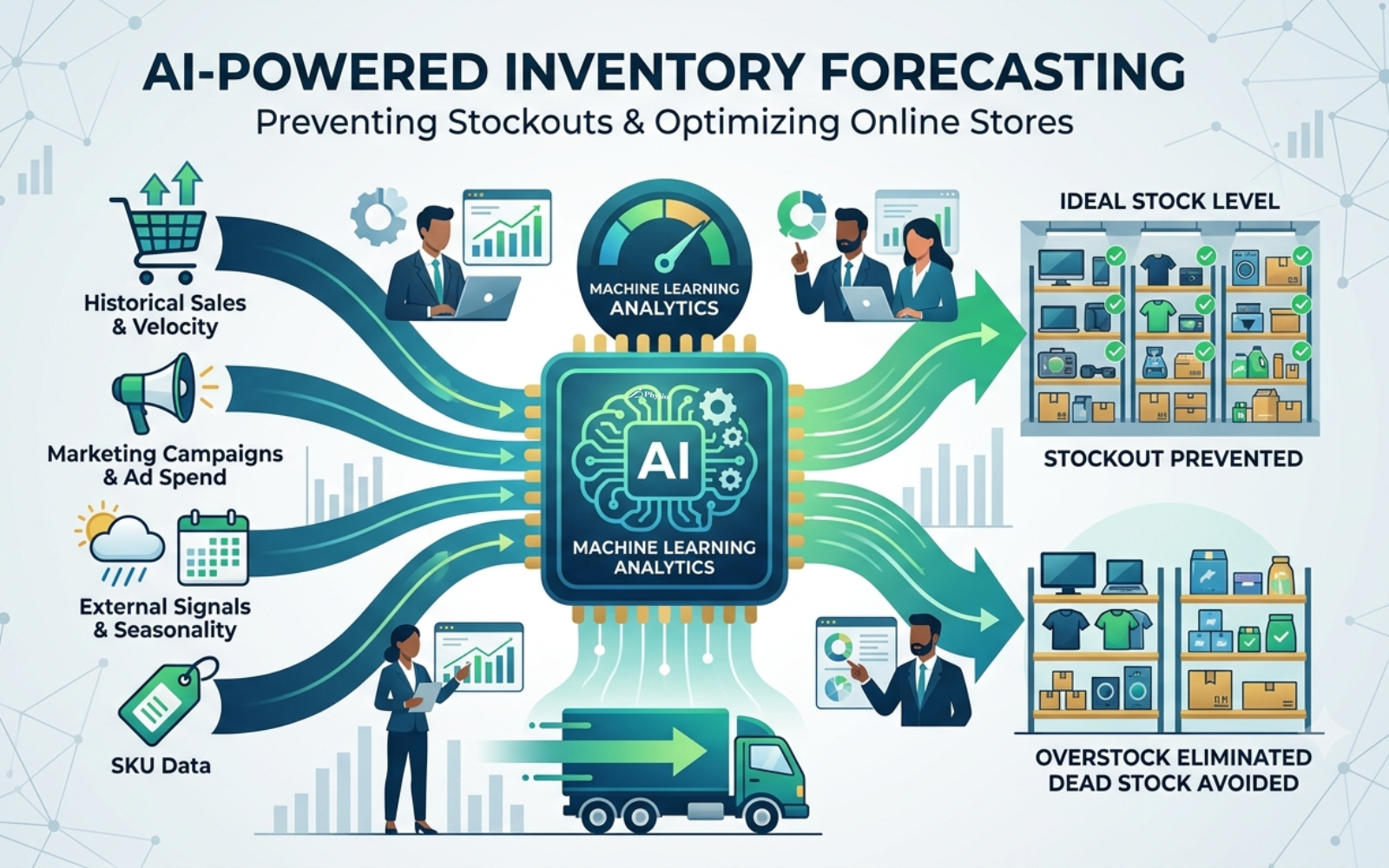
How AI-Powered Inventory Forecasting Helps Online Stores Avoid Stockouts
TL;DR Summary
Stockouts remain one of the most expensive threats to online retailers, destroying ad efficiency, damaging brand loyalty, and eroding organic search engine rankings. Traditional inventory planning—built on manual spreadsheets or simple moving averages—fails to account for multi-channel sales surges, irregular advertising spikes, and erratic supplier lead times.
AI-powered inventory forecasting solves this operational bottleneck by leveraging advanced machine learning algorithms that continuously analyze historical sales, channel-specific velocity, promotional schedules, supplier performance, and external market signals. By dynamically recalculating safety stock levels and automated reorder points at the individual SKU level, AI inventory software empowers online merchants on platforms like Shopify, Magento, and WooCommerce to eliminate out-of-stock events, reduce carrying costs by up to 35%, and free up working capital for predictable business scaling.
What Is AI-Powered Inventory Forecasting?
AI-powered inventory forecasting is an enterprise operational framework that integrates machine learning models into supply chain workflows to predict future consumer demand and streamline stock replenishment.
[ Internal Historical Data ] + [ Real-Time Channel Velocity ] + [ External Market Signals ]
                                         │
                                         ▼
                   [ Machine Learning Demand Engine ]
                                         │
                                         ▼
            [ Dynamic Reorder Points & Automated Purchase Orders ]
Legacy inventory tracking looks backward, calculating inventory needs based on a simple formula like past sales velocity divided by days. In contrast, predictive AI demand planning processes billions of data points simultaneously across three key dimensions:
- Internal Commercial Inputs: Historical transaction logs, promotional calendars, paid ad spending schedules, discount elasticity, cart abandonment trends, and return rates.
- Channel & Logistics Signals: Real-time channel stock levels across storefronts (Shopify, Amazon, TikTok Shop), warehouse processing times, regional stock distribution, and transit logs.
- External Market Factors: Macroeconomic trends, localized weather patterns, search volume shifts, social media momentum, and raw material or shipping port congestion.
By synthesizing these multi-faceted inputs, an AI demand planning engine moves beyond standard guesswork to generate accurate purchase orders (POs), balance multi-location fulfillment centers, and preserve cash flow.
Why Stockouts Happen in Online Stores
Preventing stockouts requires understanding why conventional inventory management fails during growth phases. Out-of-stock situations rarely stem from poor sales; they occur when static planning software fails to process real-time supply chain disruptions.
                    ┌── Viral Growth & Unpredicted Ad Surges
                    ├── Supplier Lead-Time Volatility
Causes of           ├── Multi-Channel Data Fragmentation
Stockouts ──────────┼── Static Safety Stock Calculations
                    ├── Manual Spreadsheet Errors
                    └── Delayed Purchase Order Execution
1. Viral Growth and Marketing Surges
A sudden surge in traffic driven by a viral social media campaign, influencer mention, or scaled paid ad deployment can increase SKU velocity by $300\%$ to $500\%$ overnight. Traditional rule-based tools update forecasts weekly or monthly, leaving inventory completely depleted before an alert is triggered.
2. Supplier Lead-Time Volatility
Factory shipping times fluctuate due to raw material shortages, port backlogs, and customs checks. While an ERP system may record a static "30-day supplier lead time," actual delivery might take 48 days. When baseline planning tools do not factor in supplier variance, inventory runs dry long before shipments arrive.
3. Multi-Channel Data Silos
Brands selling across Shopify Plus, Amazon Seller Central, TikTok Shop, and brick-and-mortar point-of-sale (POS) systems frequently suffer from fragmented data. Without continuous cross-channel synchronization, inventory sold on one platform is not immediately deducted from aggregate warehouse stock, causing overselling and stockouts.
4. Static Safety Stock Formulas
Legacy inventory management tools rely on rigid rules of thumb, such as maintaining a fixed 14-day safety buffer for all products. This treats top-selling hero SKUs the same as slow-moving accessories, leaving fast movers unprotected during peak demand periods.
5. Manual Spreadsheet Human Error
Managing inventory across hundreds or thousands of SKUs using exported CSV files is prone to human error. Formula mistakes, delayed manual purchase orders, and missed seasonal indicators lead directly to operational bottlenecks.
Operational Insight: Global retail inventory distortion—the cumulative loss from stockouts and overstocks—costs businesses over $1.73 trillion annually. Out-of-stock situations account for $1.157 trillion of this loss, causing lost immediate conversions and permanent customer churn.
How AI Inventory Forecasting Works Under the Hood
Modern predictive inventory management software replaces static rules with dynamic, self-learning statistical models.
┌─────────────────────────────┐      ┌─────────────────────────────┐
│  1. Data Ingestion & Clean  │ ────►│  2. Seasonality & Pattern   │
│   (Normalizes Outliers)     │      │         Extraction          │
└─────────────────────────────┘      └─────────────────────────────┘
                                                    │
                                                    ▼
┌─────────────────────────────┐      ┌─────────────────────────────┐
│  4. Continuous Reorder      │ ◄────│  3. Multi-Variable ML Engine│
│    Trigger & PO Automation  │      │   (Lead Time & Elasticity)  │
└─────────────────────────────┘      └─────────────────────────────┘
1. Automated Data Ingestion and Outlier Cleaning
The machine learning pipeline ingests raw transaction logs from storefronts, ERPs, and WMS platforms. Crucially, the AI cleans past anomalies: if an item was out of stock for two weeks last year, the AI adjusts historical baseline sales upward so that past stockouts do not artificially depress future demand forecasts.
2. Multi-Layered Pattern Recognition
Algorithms identify complex seasonal curves, micro-seasons (such as flash sales or regional holidays), and product life cycle stages. The engine clusters SKUs by buying behavior rather than static product categories.
3. Lead Time and Safety Buffer Modeling
Instead of treating supplier delivery times as fixed numbers, AI models lead time as a probabilistic distribution. The mathematical formulation for calculating dynamic safety stock under AI models accounts for both demand variation and lead-time variation:
Where:
- $Z$ = Desired service level factor (e.g., $1.96$ for a $97.5\%$ fulfillment confidence target)
- $\mu_{LT}$ = Average supplier lead time (in days)
- $\sigma_d$ = Standard deviation of daily sales demand
- $\mu_d$ = Average daily sales demand
- $\sigma_{LT}$ = Standard deviation of supplier lead-time variance
By incorporating lead-time standard deviation ($\sigma_{LT}$), the AI automatically expands safety buffers when a vendor demonstrates inconsistent delivery schedules, preventing unexpected out-of-stock scenarios.
4. Real-Time Dynamic Reorder Execution
As actual sales data flows into the system, the AI continuously compares current stock levels against projected demand curves. When stock crosses the dynamic reorder threshold, the software generates automated reorder recommendations or drafts purchase orders for manager approval.
Core Features of AI Inventory Forecasting Software
When evaluating eCommerce inventory management software, operations and finance leaders look for features that deliver direct operational ROI:
| Core Capability | Technical Functionality | Strategic Business Impact |
| Real-Time Demand Sensing | Ingests live traffic, cart additions, and ad spend inputs. | Detects demand surges 14 to 30 days earlier than legacy systems. |
| Dynamic Reorder Calculations | Adjusts reorder triggers daily based on real-time sales velocity. | Eliminates spreadsheet maintenance and prevents stockouts during promotional surges. |
| Attribute-Based ML (Cold-Start) | Maps new product attributes to historical performance of similar items. | Solves the "new product launch" problem by accurately forecasting unreleased SKUs. |
| Multi-Echelon Optimization | Balances inventory levels across primary, regional, and 3PL warehouses. | Minimizes split-shipment rates, lowers ground transit times, and prevents regional stockouts. |
| Assembly & Kitting Tracking | Monitors raw component availability for bundled products. | Prevents overselling product bundles when individual sub-components are depleted. |
| Automated Purchase Orders | Computes Economic Order Quantities (EOQ) while applying vendor MOQs. | Reduces procurement administrative labor and accelerates purchase order execution. |
Key Benefits of AI Inventory Forecasting
Implementing automated demand forecasting delivers quantifiable returns across supply chain operations:
                           ┌── 30-50% Reduction in Forecast Error (MAPE)
                           ├── 28-40% Fewer Stockout Events
Benefits of AI Demand      ├── 20-35% Lower Inventory Carrying Costs
Forecasting Systems ───────┼── 65% Higher Fulfillment Service Levels
                           ├── Extended Working Capital & Improved Liquidity
                           └── Protection of Organic Search Ranks & Paid CAC
- Maximized Revenue Capture: AI models protect revenue by maintaining product availability during peak promotional windows and traffic surges.
- Substantial Working Capital Savings: AI forecasting enables brands to cut total inventory holding levels by 20% to 35% without compromising order fulfillment. This frees up capital for product development and marketing investments.
- Protection of Paid Marketing & Organic Search Performance: Running out of stock hurts performance metrics across digital channels. On marketplaces like Amazon and search platforms like Google, item availability is a ranking factor; stockouts sink search visibility and increase customer acquisition costs (CAC).
- Improved Fulfillment Service Levels: By maintaining optimized inventory levels, brands increase order fill rates and boost fulfillment service levels by up to 65%.
AI vs. Traditional Inventory Forecasting
Traditional inventory planning relies on static metrics and manual updates. Machine learning inventory management uses continuous, multi-variable analysis.
Traditional Planning (Reactive)      │  AI-Powered Planning (Proactive)
─────────────────────────────────────┼──────────────────────────────────────
• Historical moving averages (30-day)│ • Multi-layered machine learning
• Single-channel sales tracking      │ • Omnichannel real-time sync
• Fixed supplier lead-time fields    │ • Dynamic lead-time variance models
• Periodic manual spreadsheet runs   │ • Continuous automated data sync
• Reactive reorder threshold alerts  │ • Predictive demand sensing
Comprehensive Technical Comparison Table
| Feature / Metric | Manual CSV Spreadsheets | Rule-Based Software | AI Inventory Forecasting Software |
| Primary Data Inputs | Past order totals | Storefront sales logs | Multi-channel history + marketing spend + external signals |
| Forecast Accuracy (MAPE) | Poor ($50-60\%$ Error) | Moderate ($30-40\%$ Error) | High ($10-20\%$ Error) |
| Lead-Time Modeling | Static entry | Fixed system field | Dynamic lead-time variance modeling |
| New SKU Forecasting | Pure guessing | Direct duplicate baseline | Attribute-based machine learning |
| Update Frequency | Monthly / Quarterly | Nightly batch run | Real-time continuous analysis |
| Safety Stock Calculation | Static "Days of Supply" | Fixed rule buffers | Dynamic statistical safety stock calculation |
| Scalability Limit | Fails at ~100 SKUs | Struggles with multi-warehouse | Scales to millions of SKU/node combinations |
Industry Vertical Use Cases
While every eCommerce brand relies on inventory visibility, dynamic AI demand planning offers distinct advantages for specific retail verticals:
                             ┌── Fashion & Apparel (Variant Complexity & Short Lifecycles)
                             ├── Consumer Electronics (High Unit Value & Obsolescence Risk)
Vertical-Specific            ├── Health & Beauty (Consumable Subscriptions & Expiration)
Value Drivers ───────────────┼── Perishable Grocery (Short Shelf Life & Spoilage Prevention)
                             ├── Sporting Goods (Weather Sensitivity & Seasonal Spikes)
                             └── Home Goods & Furniture (Long Sea Freight Lead Times)
1. Apparel and Fashion Retail
- Operational Bottleneck: High SKU complexity across size/color/style matrices, rapid trend lifecycles, and high seasonal demand shifts.
- AI Application: Machine learning models group similar historical style attributes to predict demand for unreleased apparel lines, ensuring ideal stock ratios for core sizes (e.g., M, L) while avoiding excess stock in fringe sizes.
2. Consumer Electronics
- Operational Bottleneck: High component costs, rapid product depreciation, and long overseas lead times.
- AI Application: AI tracks velocity degradation curves and supply chain transport logs, adjusting safety buffers to prevent stockouts during major launch windows without over-committing working capital.
3. Health, Beauty & CPG
- Operational Bottleneck: High repeat purchase rates, product shelf-life constraints, and promotional demand spikes.
- AI Application: Integrates subscription renewal metrics, promotional schedules, and repeat purchase frequencies to streamline factory production batches.
4. Perishable Grocery & Quick Commerce
- Operational Bottleneck: Narrow shelf-life windows and high spoilage costs.
- AI Application: Runs micro-demand forecasts at the regional fulfillment center level, balancing daily order availability with waste reduction goals.
5. Sporting Goods & Outdoor Equipment
- Operational Bottleneck: Weather sensitivity and regional seasonal spikes.
- AI Application: Integrates long-range regional weather projections and trend data to route physical stock to regional 3PL nodes ahead of localized surges.
6. Home Goods & Furniture
- Operational Bottleneck: Bulky storage footprints, high carrying costs, and extended container transit times.
- AI Application: Models long-tail freight transit times to automate container booking schedules months before projected out-of-stock events.
Real-World Implementation Case Study
Merchant Profile: Omnichannel Footwear Brand
- Scale: $22M Annual Revenue across Shopify Plus, Amazon, and 120 wholesale accounts.
- Catalog: 850 active SKUs across multiple footwear categories.
- Core Issue: The brand suffered an estimated $680,000 in lost revenue in a single year due to stockouts on core shoe sizes during peak Q4 sales events.
The Operational Challenge
The merchant relied on static 60-day moving sales averages in spreadsheets. When a black-friday ad campaign performed better than expected, core shoe sizes sold out in 6 days. Overseas supplier lead times had stretched from 40 to 62 days, resulting in a six-week out-of-stock period on top-selling SKUs.
The AI Transformation
The brand implemented an AI inventory optimization system connected directly to Shopify Plus, Amazon Seller Central, and their ERP/WMS ecosystem:
[ Data Cleanse Phase ]    ──► Automated filtering of historical stockout periods & promo anomalies.
[ Dynamic Reorder Phase ]  ──► Modeled true supplier lead times at 64 days based on carrier logs.
[ PO Automation Phase ]   ──► Reorder alerts triggered 22 days earlier than manual formulas.
Measured Business Results
- Out-of-Stock Reduction: Stockout events plummeted by 84% during major sales pushes.
- Revenue Protection: Saved an estimated $540,000 in previously lost order volume.
- Working Capital Optimization: Reduced overall safety stock carrying levels by 24% without impacting order fulfillment rates.
Reducing Overstock and Dead Stock ($132 Billion Silent Killer)
Preventing stockouts should not mean over-ordering inventory. Over-buffering leads directly to bloated storage fees, tied-up working capital, and eventual write-offs.
                     ┌── Detects Velocity Slowdowns Early
                     ├── Lowers Reorder Quantities Post-Peak Automatically
AI Dead Stock        ├── Recommends Timely Step-Down Markdowns
Prevention ──────────┼── Prevents Component Over-Procurement
                     └── Rebalances Inventory Across Regional Fulfillment Centers
Industry analysts project that dead stock—inventory that ceases selling and loses commercial value—costs retailers globally over $132 billion.
- Early Velocity Slowdown Alerts: Machine learning algorithms detect subtle drops in consumer demand early, adjusting reorder recommendations downward before excess stock builds up.
- Optimized Liquidation Strategies: When seasonal items reach the end of their lifecycle, the AI recommends step-down markdown pricing to liquidate remaining inventory profitably.
- Balanced Economic Order Quantities (EOQ): AI platforms evaluate bulk order discount tiers against warehouse carrying costs, calculating purchase volumes that protect profit margins.
Selecting the Right AI Inventory Platform
Choosing the right software depends on your store's sales volume, supply chain complexity, and technical ecosystem.
┌──────────────────────────┐    ┌──────────────────────────┐    ┌──────────────────────────┐
│      Growing Brands      │    │    Mid-Market Leaders    │    │    Enterprise Retail     │
│    ($1M - $5M Revenue)   │    │   ($5M - $50M Revenue)   │    │     ($50M+ Revenue)      │
├──────────────────────────┤    ├──────────────────────────┤    ├──────────────────────────┤
│ • Turnkey app store sync │    │ • Omnichannel ingestion  │    │ • Custom ML models       │
│ • Plug-and-play AI rules │    │ • Dynamic lead-time ML   │    │ • Multi-Echelon ERP/WMS  │
│ • Automated PO drafting  │    │ • Multi-3PL split models │    │ • Real-time API execution│
└──────────────────────────┘    └──────────────────────────┘    └──────────────────────────┘
Essential Feature Checklist
- Native Platform Integration: Connects directly with storefronts (Shopify, Magento, WooCommerce, BigCommerce) and ERP/WMS systems.
- Outlier Filtering: Automatically cleans past out-of-stock periods and promotional spikes from historical baseline data.
- Dynamic Lead-Time Tracking: Tracks real-time supplier delivery trends instead of relying on fixed lead-time settings.
- Omnichannel & Multi-Warehouse Allocation: Balances stock split requirements across regional fulfillment centers and channels.
- Assembly & Kitting Support: Manages raw component dependencies for bundled product lines.
- Model Accuracy Tracking: Measures demand prediction accuracy against actual performance (e.g., tracking MAPE over 30/60/90 days).
Step-by-Step Implementation Strategy
Deploying AI inventory software requires a structured rollout process.
Phase 1: Data Audit ──► Phase 2: Parallel Run ──► Phase 3: PO Automation ──► Phase 4: Scale
   (Weeks 1 - 2)           (Weeks 3 - 6)             (Weeks 7 - 10)           (Week 11+)
Step 1: Data Audit and Cleanup (Weeks 1–2)
Ensure product catalogs, SKU tags, past stockout windows, and supplier lead-time histories are accurately cataloged across all sales channels.
Step 2: Parallel Model Testing (Weeks 3–6)
Run the AI inventory engine alongside legacy spreadsheets. Compare AI purchase recommendations against manual calculations to measure forecast accuracy and identify discrepancies.
Step 3: Automated Reorder Workflows (Weeks 7–10)
Shift from manual purchase order creation to AI-generated purchase order drafts. Procurement managers retain final approval while automating calculation workflows.
Step 4: Multi-Node Expansion & Rebalancing (Week 11+)
Enable automated stock rebalancing across regional 3PL locations, ensuring inventory is deployed near centers of consumer demand.
Future Trends: Agentic Commerce & Autonomous Supply Chains
Looking forward, predictive inventory management is evolving toward agentic workflows and automated supply chains:
                               ┌── Autonomous Purchase Order Execution
                               ├── Agentic Commerce Ingestion
Future Trends in               ├── Natural Language Operational Assistants
Supply Chain AI ───────────────┼── Spatial Computing & Computer Vision Stock Audits
                               └── Hyper-Local Micro-Fulfillment Routing
- Autonomous Supply Chain Execution: Advanced AI agents will move beyond basic alerts to negotiate delivery schedules and execute purchase orders autonomously within pre-approved budget limits.
- Agentic Commerce Ingestion: As consumer AI shopping agents increasingly browse and buy on behalf of shoppers, supply chain models will incorporate machine-driven purchasing signals into demand forecasts.
- Conversational Operations Assistants: Supply chain teams can interact with inventory data using natural language queries: "Which SKUs are at risk of stocking out next month due to port congestion?"
- Computer Vision Stock Verification: Autonomous warehouse drones and vision AI will audit physical inventory continuously, reconciling stock level discrepancies in real time.
Frequently Asked Questions
What is AI-powered inventory forecasting?
AI-powered inventory forecasting uses machine learning algorithms, historical transaction data, real-time demand signals, and external variables to project customer demand and optimize replenishment schedules.
How does AI prevent stockouts?
AI prevents stockouts by continuously calculating dynamic reorder points based on real-time sales velocity, promotional schedules, and supplier lead-time variance. When stock reaches the safety threshold, the system automatically triggers purchase order alerts.
Is AI better than traditional inventory forecasting?
Yes. Traditional forecasting uses fixed historical averages that fail to adapt to sudden demand spikes or supply chain delays. AI processes dynamic real-time variables to generate significantly more accurate, adaptive demand forecasts.
How accurate is AI demand forecasting?
AI demand forecasting typically reduces forecast errors by 30% to 50% compared to legacy statistical methods, achieving overall demand prediction accuracy between 85% and 95% depending on underlying data quality.
Can Shopify and Magento stores use AI inventory forecasting?
Yes. Leading AI inventory solutions offer direct, plug-and-play integrations for Shopify Plus, Magento (Adobe Commerce), WooCommerce, BigCommerce, and Amazon Seller Central.
Does AI reduce excess inventory and dead stock?
Yes. By aligning purchase order volumes directly with anticipated demand curves, AI inventory systems prevent over-ordering, reducing carrying costs and dead stock by 20% to 35%.
What data does AI use to forecast inventory?
AI platforms analyze historical sales transactions, traffic data, marketing spend schedules, promotional calendars, regional weather patterns, supplier lead-time variances, and broader macroeconomic indicators.
Is AI inventory forecasting practical for growing brands?
Yes. Growing eCommerce merchants benefit significantly because stockout events and tied-up capital impact cash flow. Cloud-based AI inventory apps provide accessible, scalable pricing tiers for growing businesses.
Final Conclusion
Preventing stockouts while keeping inventory carrying costs low is a core requirement for growth in modern retail. Relying on manual spreadsheets or outdated rules leaves online stores vulnerable to sudden demand shifts, supply chain delays, and lost revenue.
AI-powered inventory forecasting replaces guesswork with automated, data-driven precision. By leveraging machine learning models that continuously adapt to consumer trends, marketing campaigns, and vendor performance, online brands can protect profit margins, maintain search rankings, and deliver dependable fulfillment experiences.
Download The Free E-book & Launch Your Brand Strategically
Download The Free E-book & Launch Your Brand Strategically
Share this post