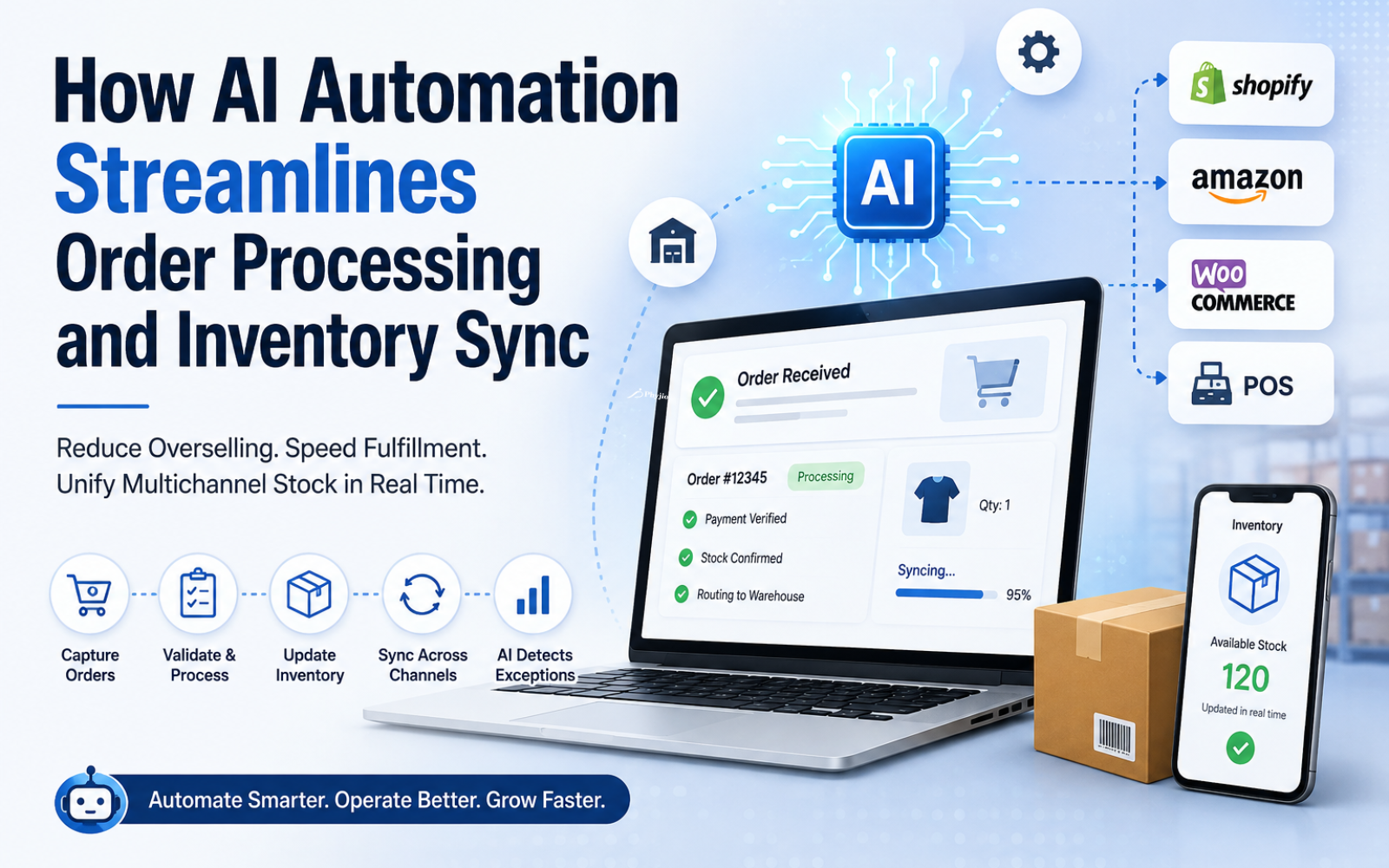
How AI Automation Streamlines Order Processing and Inventory Sync
Modern eCommerce businesses rarely sell through just one channel. A single retailer might manage a Shopify storefront, an Amazon marketplace listing, a wholesale account, and a physical POS system — all drawing from the same pool of inventory. As order volume grows, manual entry, delayed stock updates, and siloed systems create real operational risk: overselling, stockouts, mis-shipped orders, and frustrated customers.
AI automation addresses this by connecting order capture, validation, fulfillment, and inventory updates into one coordinated workflow — one that reacts in real time rather than through end-of-day spreadsheet reconciliation.
What Is AI Automation for Order Processing and Inventory Sync?
Direct Answer: AI automation streamlines order processing and inventory synchronization by automatically capturing orders, validating information, updating stock levels, routing orders, detecting exceptions, and synchronizing inventory across stores, marketplaces, warehouses, and other business systems — reducing manual work and inventory discrepancies.
Order processing automation handles the sequence from order capture to fulfillment initiation without manual re-entry. Inventory synchronization keeps stock counts consistent across every connected sales channel and warehouse. Together, they form a closed loop: an order reduces available stock, which is reflected everywhere else within seconds or minutes, depending on system architecture.
How AI Automation Works: The End-to-End Flow
| Step | What Happens |
|---|---|
| 1 | Customer places an order on a channel (web, app, marketplace, POS) |
| 2 | Order data is captured and standardized via API/webhook |
| 3 | AI validates the order (address, duplicates, fraud signals) |
| 4 | Payment status is verified |
| 5 | Product availability is checked against live inventory |
| 6 | Inventory is decremented or reserved |
| 7 | Order is routed to the optimal warehouse or supplier |
| 8 | Fulfillment workflow is triggered |
| 9 | Shipping data syncs back to the order record |
| 10 | Customer receives automated notifications |
| 11 | Stock levels sync across all connected channels |
| 12 | AI monitors for exceptions (delays, mismatches, anomalies) |
APIs and webhooks push data the moment an event occurs, rather than waiting for scheduled batch jobs — this is what makes near-real-time synchronization possible.
How AI Streamlines Order Processing
Order Data Capture: AI normalizes order fields from different channels (varying formats for names, addresses, SKUs) into one consistent structure, reducing downstream errors.
Order Validation: Automated checks flag incomplete addresses, duplicate orders, or suspicious patterns before they reach fulfillment.
Payment Verification: Orders are held from fulfillment until payment status is confirmed, cutting down on fraud and chargebacks.
Order Routing: Based on warehouse proximity, stock availability, and shipping cost, AI-assisted logic determines the best fulfillment location.
Automated Fulfillment: Once validated, orders trigger picking, packing, and carrier label generation without manual handoffs.
Customer Notifications: Confirmation, shipping, delivery, and exception alerts are sent automatically, reducing support ticket volume.
Returns and Cancellations: Automated workflows adjust inventory and order status the moment a return or cancellation is processed, keeping stock counts accurate.
How AI Automates Inventory Synchronization
Inventory sync keeps stock levels consistent across websites, apps, marketplaces, physical stores, warehouses, ERPs, POS systems, suppliers, and 3PL providers. This includes:
- Stock level and SKU updates
- Product availability status
- Reserved and incoming inventory
- Returned or damaged inventory
- Warehouse transfers and safety stock
- Backorder status
Real-time sync means updates propagate within seconds; near-real-time sync (common with marketplace APIs that have rate limits) may take a few minutes. Both are dramatic improvements over manual spreadsheet updates, which can lag by hours or days.
AI-Automated vs. Manual Order Processing
| Factor | Manual Processing | AI-Automated Processing |
|---|---|---|
| Order entry | Manual | Automated |
| Inventory updates | Manual or delayed | Automated |
| Error rate | Higher | Lower |
| Scalability | Limited | High |
| Order routing | Manual | Intelligent/automated |
| Exception detection | Human-dependent | AI-assisted |
| Multi-channel sync | Difficult | Automated |
| Reporting | Delayed | Real-time/near-real-time |
Manual workflows can still make sense for very low order volumes, highly customized B2B orders, or businesses in early testing phases before scaling automation.
AI Automation vs. Rule-Based Automation
Rule-based automation follows fixed logic: "If inventory falls below 10 units, send an alert." AI-powered automation can weigh multiple variables at once: "Analyze historical sales, seasonality, lead times, and current stock to flag products at high stockout risk."
AI doesn't replace deterministic rules — the two typically work together, with rules handling clear-cut cases and AI handling pattern recognition and prioritization.
Key Benefits
| Benefit | Business Impact |
|---|---|
| Faster order processing | Shorter fulfillment cycles |
| Improved inventory accuracy | Fewer overselling incidents |
| Reduced manual entry | Lower labor cost per order |
| Better exception detection | Fewer missed problems |
| Centralized visibility | Faster decision-making |
| Improved demand forecasting | Smarter replenishment |
Common Problems AI Automation Solves
- Overselling: Synchronized stock counts reduce the chance of selling items that are no longer available.
- Stockouts: Predictive signals can flag products approaching low inventory before they run out.
- Manual order entry: Automation removes repetitive re-keying of order data.
- Inventory mismatch: Centralized sync reduces discrepancies between systems.
- Multiple sales channels: A unified inventory layer keeps every channel aligned.
- High order volumes: Automation scales without a proportional increase in headcount.
Real-World Use Cases
- Shopify stores use app-based integrations to sync inventory with POS and marketplaces in near real time.
- Magento/Adobe Commerce businesses often connect ERP and WMS systems via middleware for B2B and B2C order flows.
- Multi-vendor marketplaces rely on automated routing to send orders to the correct seller.
- Omnichannel retailers with physical and online stores use centralized inventory to avoid in-store/online conflicts.
- Dropshipping businesses depend on automated supplier order forwarding and stock feed updates.
How AI Connects eCommerce, ERP, and Warehouse Systems
A typical data flow moves: eCommerce platform → Order Management → ERP → Warehouse → Shipping → Inventory → Customer. This relies on APIs, webhooks, middleware or iPaaS tools, and ERP/WMS connectors. Poorly mapped SKUs or inconsistent data formats are among the most common causes of failed synchronization — clean, well-structured product data matters as much as the automation logic itself.
Role of AI in Inventory Forecasting
Forecasting is distinct from synchronization. Sync keeps current stock counts accurate; forecasting predicts future demand using historical sales, seasonality, promotions, lead times, and supplier performance. Both are complementary but solve different problems.
AI Agents in Order Management
Emerging AI agents can monitor orders, flag exceptions, investigate inventory discrepancies, and recommend fulfillment locations. Autonomous actions should still operate within defined business rules, permissions, and human oversight — particularly for high-value or high-risk decisions.
Cloud-Based vs. On-Premise Automation
| Factor | Cloud-Based | On-Premise |
|---|---|---|
| Scalability | High | Limited by infrastructure |
| Maintenance | Vendor-managed | Internally managed |
| Integration | Generally easier | Often more complex |
| Cost structure | Subscription-based | Higher upfront cost |
| Accessibility | Remote access | Location-dependent |
Cloud-based solutions typically suit growing eCommerce businesses; on-premise may suit organizations with strict data residency or legacy infrastructure requirements.
How to Choose the Right Solution
Evaluate based on order volume, number of channels, SKU complexity, warehouse structure, ERP requirements, and API availability.
Pricing Considerations
Cost typically depends on order volume, SKU count, number of channels and warehouses, integration complexity, and the depth of AI features used.
Security and Data Considerations
Automation platforms handling customer and payment data should support encryption, access controls, and audit logs. Compliance depends on architecture, jurisdiction, and vendor implementation — not on the platform alone.
Implementation Best Practices
- Map existing processes
- Identify manual bottlenecks
- Define automation goals
- Clean product and inventory data
- Connect core systems
- Start with high-value workflows
- Test synchronization thoroughly
- Build exception handling
- Add AI capabilities incrementally
- Monitor KPIs: order accuracy, inventory accuracy, stockout rate, fulfillment time, automation rate
Common Challenges
Poor-quality inventory data, legacy systems, API limitations, incorrect SKU mapping, and integration complexity are frequent obstacles. Human oversight remains important for high-impact exceptions, since AI-assisted automation can help reduce errors but does not eliminate them entirely.
Future of AI-Powered Order and Inventory Management
Predictive inventory management and AI-assisted exception resolution are already practical today. Fully autonomous order routing, computer vision in warehouses, and advanced robotics are still emerging and vary in maturity by vendor and industry.
FAQ
What is AI automation in order processing?
It's the use of AI and automated workflows to capture, validate, and route orders without manual data entry.
Can AI prevent overselling?
It can significantly reduce the risk by keeping inventory synchronized across channels in real time, though it depends on proper implementation.
How much does AI order automation cost?
Costs vary based on order volume, SKU count, channels, and integration complexity; there's no universal price point.
Is AI automation suitable for small businesses?
Many cloud-based tools scale down to smaller order volumes, though the ROI depends on current manual workload.
Will AI replace order management teams?
Typically, AI automation reduces repetitive tasks rather than replacing oversight roles entirely.
Conclusion
The strongest results come from combining reliable data, solid system integrations, workflow automation, AI intelligence, and human oversight. Businesses evaluating eCommerce automation should start with their highest-friction manual processes and expand from there.
Download The Free E-book & Launch Your Brand Strategically

Download The Free E-book & Launch Your Brand Strategically
Share this post