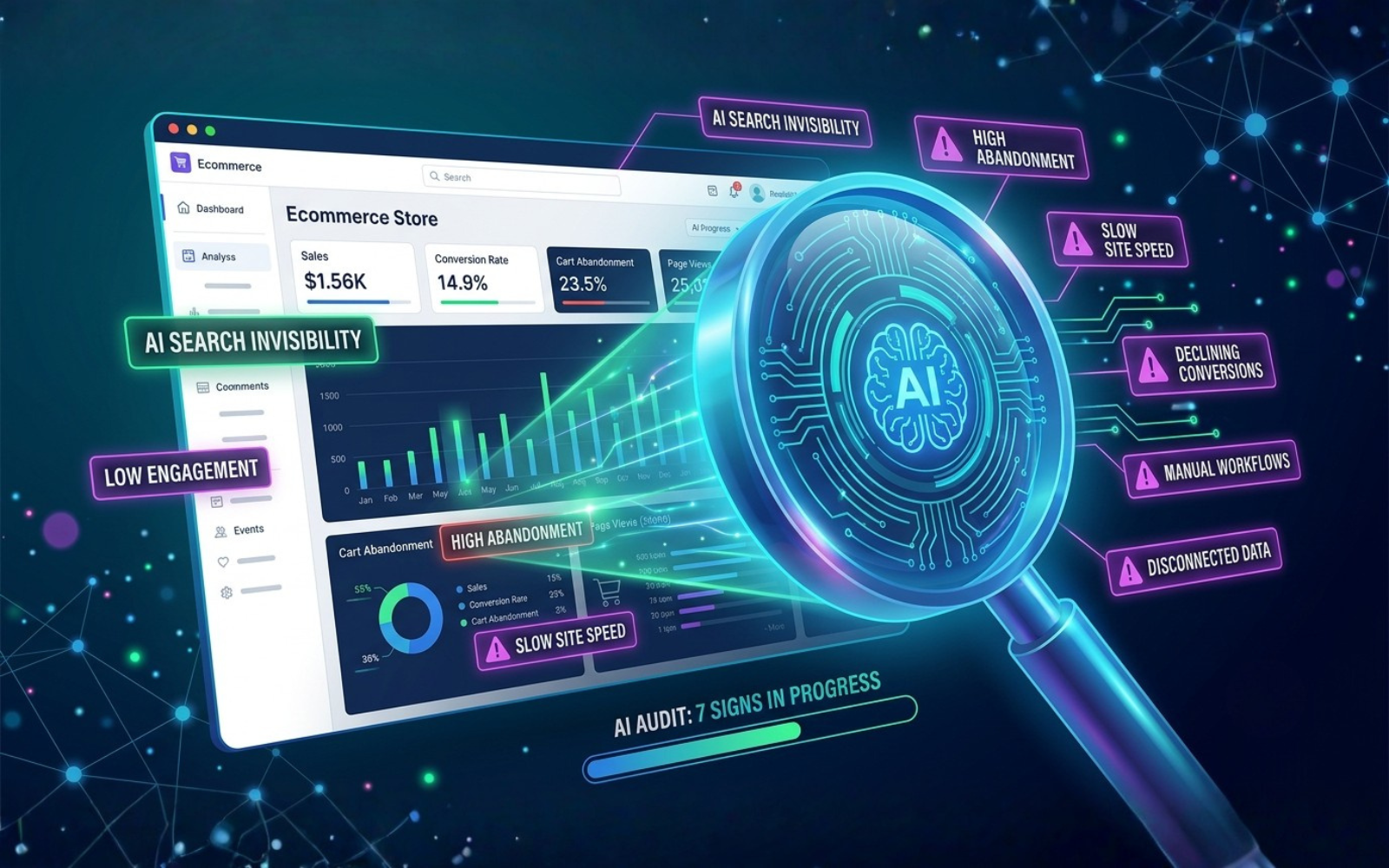
7 Signs Your Store Needs an AI Audit (and What It Costs)
Introduction
Ecommerce buying behavior has changed faster in the last two years than in the previous decade. Shoppers now research products through AI chat tools, expect personalized recommendations in real time, and abandon stores that feel slow or generic. Many merchants haven't updated their tech stack, data practices, or search visibility strategy to match.
An AI audit is how a store finds out where it's falling behind — and what to fix first. This guide walks through the seven clearest warning signs that your store needs one, what the audit actually covers, and realistic pricing so you can budget with confidence.
TL;DR Summary
- An AI audit for ecommerce evaluates your data, personalization, search visibility (including AI search), automation, and technical foundation against what modern AI-powered shopping experiences require.
- Seven common warning signs: declining conversion rates, high cart abandonment, poor AI search visibility, low customer engagement, slow site performance, disconnected marketing data, and inefficient manual workflows.
- Costs typically range from $1,500–$5,000 for small stores, $5,000–$20,000 for growing brands, and $20,000–$75,000+ for enterprise ecommerce, depending on scope.
- Most audits take 1 to 4 weeks and pay for themselves through recovered conversion rate, lower cart abandonment, and reduced manual labor.
What Is an AI Audit?
An AI audit is a structured evaluation of how ready your business, data, and technology are to use artificial intelligence effectively — and, for ecommerce specifically, how well your store performs in AI-driven search and shopping experiences.
Unlike a generic tech audit, an AI audit for ecommerce looks specifically at:
- Whether your product, customer, and behavioral data is clean and structured enough to power AI tools
- Whether your store is discoverable and accurately represented in AI Overviews, ChatGPT, Gemini, Perplexity, and other answer engines
- Where manual processes could be automated with machine learning
- Whether your personalization, recommendations, and customer experience match current AI capabilities
An AI readiness audit is often used as another term for the same process — it answers the question "are we set up to actually benefit from AI, or are we just buying tools?"
Why AI Audits Matter for Ecommerce Stores
Search and shopping discovery are shifting from traditional keyword search to conversational, AI-mediated search. When a shopper asks ChatGPT or Gemini for a product recommendation, the answer engine pulls from structured data, reviews, and content — not just traditional SEO rankings.
This shift is happening quickly, and stores that haven't adapted their data and content structure risk becoming invisible in these new discovery channels, regardless of how well they rank in classic Google search.
At the same time, internal inefficiencies — disconnected platforms, manual reporting, generic product recommendations — quietly erode margin. An AI audit surfaces both problems in one process: external visibility and internal efficiency.
7 Signs Your Store Needs an AI Audit
1. Declining Conversion Rates
If conversion rate has slipped over the last two to three quarters without an obvious cause (pricing, seasonality, ad spend cuts), it often points to a mismatch between what shoppers expect — personalized, fast, relevant experiences — and what the store delivers.
2. High Cart Abandonment
Cart abandonment above industry benchmarks (commonly cited around 70%) is frequently tied to poor checkout UX, lack of dynamic incentives, unclear shipping costs, or absent retargeting logic — all areas AI-driven optimization tools address directly.
3. Poor AI Search Visibility
If your products don't appear when you ask ChatGPT, Gemini, or Perplexity for recommendations in your category, your structured data, product schema, and content likely aren't optimized for AI search. This is a newer but fast-growing revenue risk.
4. Low Customer Engagement
Generic email flows, flat recommendation widgets, and one-size-fits-all product pages signal that customer segmentation and AI personalization are underused or absent entirely.
5. Slow Website Performance
Site speed directly affects both conversion rate and AI crawlability. Stores running on outdated themes, unoptimized images, or bloated apps often see both human and AI visibility suffer together.
6. Disconnected Marketing Data
If Google Analytics 4, your CRM, ad platforms, and Google Merchant Center all tell different stories, predictive analytics and marketing automation can't function properly — because they need one unified, trustworthy dataset.
7. Inefficient Manual Workflows
Manually updating product feeds, writing every product description, or hand-sorting customer segments are all tasks modern AI tools can automate. If your team is still doing this by hand, workflow automation is likely overdue.
What an AI Audit Actually Includes
A thorough ecommerce AI audit typically covers:
- Data audit — quality, structure, and accessibility of product, customer, and behavioral data
- AI search visibility audit — how your store appears (or doesn't) in AI Overviews and LLM answer engines
- Technical SEO and structured data review — product schema, site speed, crawlability
- Personalization and recommendation engine assessment
- Conversion funnel and checkout analysis
- Marketing automation and CRM integration review
- Platform-specific evaluation (Shopify, Magento/Adobe Commerce, WooCommerce, BigCommerce)
- Competitive and opportunity benchmarking
- Prioritized action plan with estimated ROI per recommendation
AI Audit Checklist
Use this as a starting self-assessment before commissioning a full audit:
- Product data is complete, accurate, and consistently structured
- Product schema and structured data are implemented sitewide
- Store appears correctly when queried in ChatGPT, Gemini, or Perplexity
- GA4, CRM, and ad platforms share consistent, unified data
- Personalized product recommendations are live on key pages
- Cart abandonment flows use dynamic, behavior-based triggers
- Site speed meets Core Web Vitals thresholds
- Customer segments are built on real behavioral data, not guesswork
- Manual, repetitive workflows have been mapped for automation potential
- A clear owner exists for AI/data initiatives internally
Benefits of an AI Audit
- Identifies specific, prioritized revenue opportunities rather than generic advice
- Improves visibility in both traditional and AI-driven search
- Reduces manual workload through targeted automation
- Strengthens data foundation for any future AI investment
- Provides a benchmark to measure ROI after implementation
AI Audit vs Traditional Website Audit
| Factor | Traditional Website Audit | AI Audit |
|---|---|---|
| Primary focus | On-page SEO, site structure, backlinks | Data readiness, AI search visibility, personalization, automation |
| Search coverage | Google organic search only | Google search + AI Overviews + LLM answer engines |
| Data evaluation | Limited or none | Core component |
| Personalization review | Rarely included | Central focus |
| Automation opportunities | Not typically assessed | Explicitly mapped |
| Output | SEO fixes and technical issues | Prioritized, ROI-ranked roadmap across data, search, and CX |
How Much Does an AI Audit Cost?
Pricing depends on store size, platform complexity, and audit depth.
| Store Size | Typical Cost Range | What's Usually Included |
|---|---|---|
| Small stores (under $1M revenue) | $1,500 – $5,000 | Core data, AI search visibility, and conversion review |
| Growing brands ($1M–$10M revenue) | $5,000 – $20,000 | Full audit scope, multi-platform integration review, competitive benchmarking |
| Enterprise ecommerce ($10M+ revenue) | $20,000 – $75,000+ | Deep data infrastructure review, custom AI opportunity roadmap, multi-team stakeholder workshops |
Factors that influence pricing:
- Number of sales channels and platforms integrated
- Volume and complexity of product catalog
- Depth of custom development already in place
- Whether implementation support is bundled with the audit
- Timeline urgency
ROI of an AI Audit
Most audits are priced to be recovered within a few months once recommendations are implemented, primarily through improved conversion rate, reduced cart abandonment, and lower manual labor costs. The audit itself functions as a roadmap — ROI depends heavily on how fully its recommendations are executed.
How to Choose the Right AI Audit Provider
- Ecommerce-specific experience — look for a track record with Shopify, Magento/Adobe Commerce, WooCommerce, or BigCommerce specifically, not generic IT consulting
- Transparent methodology — they should be able to explain exactly what they evaluate and how
- Actionable output — a prioritized roadmap, not just a findings report
- AI search expertise — confirm they assess visibility in ChatGPT, Gemini, and Perplexity, not just Google
- References or case studies — evidence of measurable results from past audits
Common Mistakes Businesses Make
- Treating an AI audit as a one-time project instead of an ongoing practice
- Investing in AI tools before fixing underlying data quality
- Ignoring AI search visibility while over-focusing on traditional SEO
- Skipping stakeholder buy-in, so recommendations never get implemented
- Choosing the cheapest provider without ecommerce-specific expertise
Future of AI Audits
As AI-mediated shopping — through chat assistants, AI Overviews, and agentic shopping tools — becomes a larger share of discovery, AI audits are likely to become a standard, recurring part of ecommerce operations, similar to how SEO audits became routine over the past two decades. Expect audits to increasingly include agentic commerce readiness and AI-driven customer service evaluation as these capabilities mature.
Frequently Asked Questions
What is an AI audit for ecommerce?
It's a structured evaluation of a store's data, AI search visibility, personalization, and automation readiness, resulting in a prioritized action plan.
How much does an AI audit cost?
Costs generally range from $1,500 for small stores to $75,000+ for enterprise ecommerce businesses, depending on scope and complexity.
How long does an AI audit take?
Most audits take between one and four weeks, depending on store size and data complexity.
Do I need an AI audit if I already did an SEO audit?
Yes — an SEO audit covers traditional search only. An AI audit adds AI search visibility, data readiness, personalization, and automation, which an SEO audit doesn't address.
Can I do an AI audit myself?
A basic self-assessment (like the checklist above) is possible, but a professional audit typically uncovers deeper data and platform-level issues that are hard to see internally.
Which platforms can be AI-audited?
Shopify, Magento/Adobe Commerce, WooCommerce, BigCommerce, and most custom-built ecommerce platforms.
Final Conclusion
The stores that grow over the next few years will be the ones that treat AI readiness as core infrastructure, not an add-on. If any of the seven signs above sound familiar — declining conversions, high abandonment, poor AI search visibility, low engagement, slow performance, disconnected data, or manual busywork — an AI audit is the fastest way to find out exactly what's costing you revenue and what to fix first.
Download The Free E-book & Launch Your Brand Strategically
Download The Free E-book & Launch Your Brand Strategically
Share this post