AEO vs SEO: What's the Difference for Online Stores in 2026?
Search no longer means a list of blue links. Shoppers now ask Google AI Overviews, ChatGPT, and Perplexity direct questions and expect direct answers — sometimes without ever clicking through to a website. For ecommerce brands, that shift raises a real question: is traditional SEO still worth the investment, or does ranking now depend on a newer discipline called Answer Engine Optimization (AEO)?
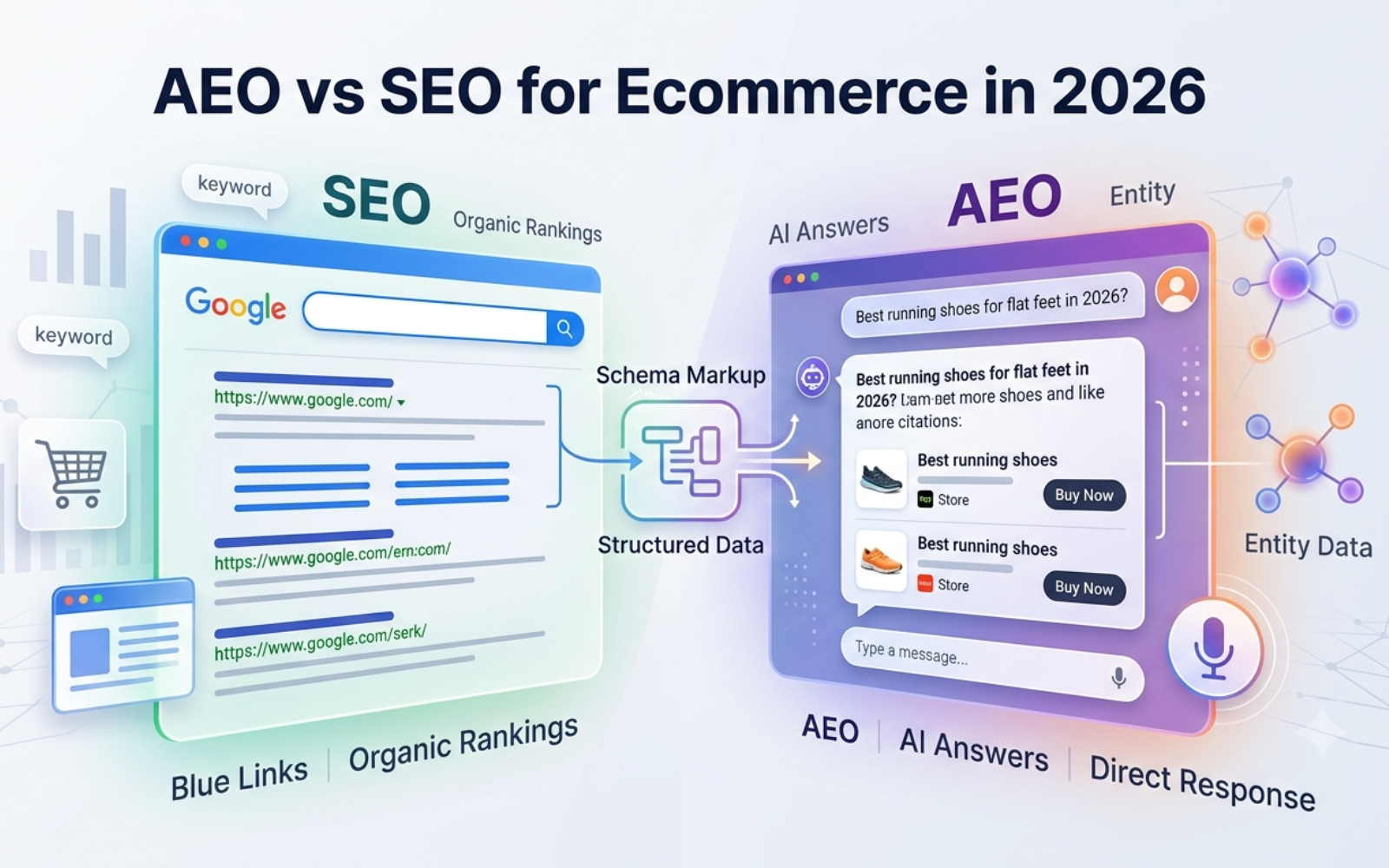
The short answer: you need both. SEO earns visibility in traditional search results: this is the discipline of ranking web pages higher in engines like Google through keywords, backlinks, and technical optimization. AEO earns visibility inside AI-generated answers: this is the discipline of structuring content so AI systems can extract, understand, and cite it directly. This guide breaks down what each one does, where they overlap, and how online stores can build a strategy that works for both.
TL;DR Summary
| Question | Answer |
|---|---|
| What is SEO? | Optimizing web pages to rank in traditional search engine results |
| What is AEO? | Optimizing content so AI tools can extract and present it as a direct answer |
| Main difference | SEO targets rankings and clicks; AEO targets extraction and citations |
| Who needs both? | Any ecommerce store that wants visibility on Google and in AI search tools |
| Key takeaway | SEO is the foundation; AEO is the layer built on top of it |
What is SEO?
SEO (Search Engine Optimization) is the practice of improving a website so it ranks higher in organic search results, primarily on Google. The purpose is to increase qualified traffic by matching content to what people are searching for.
Google ranks pages using hundreds of signals, but the core ones haven't changed much in years:
- Relevance — does the page match the search query and intent?
- Authority — do other trusted sites link to it?
- Technical health — is the site fast, crawlable, and mobile-friendly?
- Experience — does the content reflect real expertise (E-E-A-T)?
Traditional SEO for an online store means optimizing product pages, category pages, site structure, page speed, and Core Web Vitals so both search engines and shoppers can find and trust what they're looking at.
What is AEO?
AEO (Answer Engine Optimization) is the practice of structuring content so AI systems — Google AI Overviews, ChatGPT, Claude, Gemini, Perplexity, and voice assistants — can easily extract, summarize, and cite it as a direct answer.
These systems rely on large language models (LLMs) and semantic search rather than simple keyword matching. They look for content that answers a question clearly, in context, with minimal ambiguity. AEO isn't about tricking an algorithm; it's about writing definition-first, well-structured content that an AI can lift out and repackage into a conversational response.
Where SEO optimizes for ranking, AEO optimizes for retrieval — whether your content gets pulled into someone else's answer.
AEO vs SEO: Key Differences
| Factor | SEO | AEO |
|---|---|---|
| Goal | Rank higher in search results | Get cited or quoted in AI-generated answers |
| Search behavior | Keyword-based queries | Conversational, question-based queries |
| Ranking factors | Backlinks, keywords, technical SEO | Clarity, structure, semantic relevance, entity data |
| Content style | Keyword-optimized, long-form | Definition-first, concise, scannable |
| Structured data | Helpful, not essential | Often critical (FAQ, Product, Organization schema) |
| Output | List of ranked links | Single synthesized answer, sometimes with citations |
| Metrics | Rankings, organic traffic, CTR | Answer inclusion, brand mentions, AI citations |
The two aren't competing systems. AEO builds on the same foundation SEO already requires — crawlable pages, clean structure, credible content — and adds a layer optimized for how AI models parse and quote information.
Why AEO Matters for Online Stores in 2026
Three shifts make AEO relevant for ecommerce specifically:
Zero-click search is growing. More shoppers get their answer directly in the search results or an AI Overview, without visiting a website. If your product isn't structured for extraction, a competitor's might be the one AI recommends instead.
Voice and conversational search are product-discovery moments. "What's the best running shoe for flat feet" is a purchase-intent query increasingly answered by an assistant, not a search results page.
AI shopping tools are emerging as a discovery channel. Tools like ChatGPT and Perplexity increasingly surface product comparisons and recommendations pulled from ecommerce content — meaning a well-structured product page can influence a purchase decision before the shopper ever lands on your site.
None of this replaces the need to rank on Google. It adds a second surface where visibility now matters.
How AI Search Is Changing Ecommerce
AI-driven search tools change how products get discovered, not just where:
- AI Overviews summarize buying advice at the top of Google, often pulling from structured, well-cited pages.
- Conversational shopping assistants answer multi-step questions ("show me waterproof jackets under $150 with good reviews") that traditional keyword search struggles to handle.
- AI product comparisons synthesize specs and reviews from multiple sites rather than sending a user to any single page.
For store owners, this means product data — specs, pricing, reviews, availability — needs to be explicit, structured, and consistent, not buried in marketing copy.
SEO Strategies for Ecommerce
A strong technical foundation is still non-negotiable:
- Technical SEO — fast load times, clean URL structure, mobile optimization, crawlable navigation
- Product SEO — unique, detailed product descriptions (not manufacturer copy-paste)
- Category SEO — clear category pages with supporting content, not just product grids
- Internal linking — connecting related products, guides, and categories to build topical relevance
- Content clusters — buying guides and comparison content that support commercial pages
- Schema markup — Product, Review, and Breadcrumb schema for rich results
- Core Web Vitals — page speed and stability, which affect both rankings and conversions
AEO Strategies for Ecommerce
Layer these on top of solid SEO:
- Definition-first content — open sections with a direct, quotable answer before elaborating
- FAQ optimization — answer real customer questions in plain language, with FAQ schema
- Entity optimization — clearly identify brands, materials, sizes, and specifications as distinct entities
- Structured data — Product, FAQ, and Organization schema help AI systems parse your data accurately
- Conversational formatting — write the way a person would ask a question, then answer it directly
- AI-friendly formatting — short paragraphs, bullet points, and tables that are easy to extract
Can SEO and AEO Work Together?
Yes — and for most stores, they should be treated as one connected system rather than separate projects.
SEO Foundation → Semantic SEO → Schema Markup → Entity Optimization → AEO → AI Visibility
Start with technical SEO and content quality. Layer in semantic relationships between topics. Add structured data. Clarify entities (brand, product, category). The result is content that ranks in Google and is retrievable by AI systems — because both increasingly reward the same underlying signals: clarity, structure, and trustworthiness.
Common Mistakes to Avoid
- Keyword stuffing that makes content hard to read (or extract)
- Ignoring AI search entirely and optimizing only for classic rankings
- Thin, templated product descriptions
- Missing or incorrect schema markup
- Weak internal linking between related products and guides
- No FAQ content addressing real buying questions
- Duplicate content across product variants
- No clear topical authority around a product category
Best Practices Checklist
- Product and category pages load fast and are mobile-optimized
- Every product has a unique, detailed description
- FAQ, Product, and Organization schema implemented sitewide
- Content opens with a direct, definition-first answer
- Internal links connect products, guides, and categories
- Buying guides answer real conversational queries
- Reviews and specs are structured, not just narrative text
- Content is scannable: short paragraphs, bullets, tables
Future of Ecommerce Search
Expect search to keep moving toward AI-first, conversational, and multimodal experiences: shopping assistants that compare products across brands, predictive search that surfaces items before a full query is typed, voice commerce, and AI agents that complete purchases on a shopper's behalf. Stores that treat structured, trustworthy content as core infrastructure — not an afterthought — will be positioned for whichever interface shoppers use next.
Frequently Asked Questions
Is AEO replacing SEO?
No. AEO adds a new visibility channel; it doesn't eliminate the need to rank in traditional search.
Do ecommerce stores need AEO?
Increasingly, yes — especially for categories where shoppers research using conversational or voice queries.
Can Shopify or WooCommerce stores rank in AI search?
Yes, provided the site has clean structure, schema markup, and clear, well-organized content.
Does structured data help AI tools like ChatGPT?
Yes. Schema markup helps AI systems parse product details, pricing, and reviews accurately.
Is SEO still worth investing in?
Yes. It remains the foundation that both traditional rankings and AI visibility are built on.
What is semantic SEO?
Optimizing content around meaning and topic relationships, not just exact-match keywords.
Final Takeaway
SEO isn't dead, and AEO isn't replacing it — they're complementary. AI search rewards the same fundamentals good SEO always has: structured, trustworthy, user-focused content. The stores that win in 2026 will be the ones optimizing for both the search engine and the answer engine.
Consider auditing your store's technical SEO, schema markup, and content structure to see how ready it is for both traditional and AI-driven search.
Download The Free E-book & Launch Your Brand Strategically
Download The Free E-book & Launch Your Brand Strategically
Share this post