

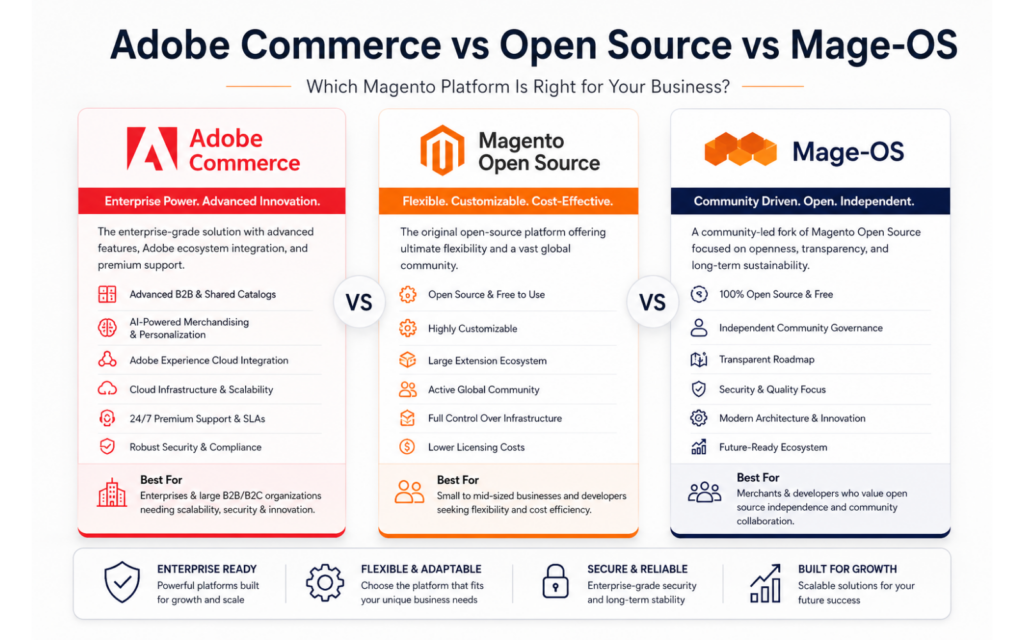
Adobe Commerce vs Magento Open Source vs Mage-OS: Which Platform Should You Choose?
The Magento ecosystem has never been more complex — or more interesting — to navigate. For years, merchants faced a relatively simple binary: pay for Magento Enterprise, or use the free Community Edition. That choice has since expanded into three distinct paths, each with its own governance model, cost structure, roadmap, and strategic trade-offs.
Today, eCommerce directors, CTOs, and digital agencies evaluating Magento-based platforms must choose between Adobe Commerce (the enterprise-tier, Adobe-controlled product), Magento Open Source (the free, community-backed codebase), and Mage-OS (a newer, community-governed distribution that challenges the status quo).
Each platform shares the same PHP foundation. But the similarities end there. The differences in features, support, licensing costs, long-term roadmap, and governance philosophy have real consequences for merchants making five-year technology decisions.
This guide gives you the definitive comparison. It covers every dimension that matters — including total cost of ownership, B2B capabilities, scalability, and future platform sustainability — so you can make the right call for your business.
Summary
| Platform | Best For | License Cost | Key Advantage |
|---|---|---|---|
| Adobe Commerce | Enterprise, complex B2B, Adobe stack | $22,000–$190,000+/year | Native B2B suite, AI personalization, Adobe integrations |
| Magento Open Source | Mid-market, developers, flexible builds | Free | Maximum flexibility, large extension ecosystem |
| Mage-OS | Developers, agencies, merchants wanting community governance | Free | Faster security patches, transparent roadmap, no vendor lock-in |
Quick Verdict:
- Choose Adobe Commerce if you need enterprise-grade B2B features, Adobe Experience Cloud integration, and managed cloud infrastructure out of the box.
- Choose Magento Open Source if you want maximum customization freedom and are comfortable self-managing infrastructure and development.
- Choose Mage-OS if you believe in open-source governance, want freedom from Adobe’s product roadmap decisions, and need faster security response times.
What Are Adobe Commerce, Magento Open Source, and Mage-OS?
Adobe Commerce is the paid, enterprise edition of the Magento 2 platform. It is owned and developed by Adobe and includes advanced B2B functionality, AI-powered merchandising, cloud infrastructure options, and native Adobe Experience Cloud integrations. Previously known as Magento Commerce and Magento Enterprise Edition, it is priced based on Gross Merchandise Value (GMV).
Magento Open Source is the free, downloadable version of the Magento 2 platform. It provides core eCommerce functionality — catalog management, order processing, checkout, and basic marketing tools — and is available to download and host anywhere. Adobe maintains it with quarterly security patches but no longer adds new features.
Mage-OS is a community-driven, open-source distribution built on top of Magento Open Source 2.4.x. Governed by the Mage-OS Association, an independent non-profit, it is fully compatible with Magento Open Source extensions and themes while adding community-developed enhancements, faster security patches, and a transparent public roadmap.
All three platforms share the same core Magento 2 PHP codebase. The differences lie in who controls the roadmap, what features are included, how the platform is governed, and what it costs.
Understanding the Magento Ecosystem
From Community Edition to a Three-Platform Ecosystem
Magento launched as an open-source project in 2008. Over time, it split into two editions: Magento Community Edition (free) and Magento Enterprise Edition (paid). In 2018, Adobe acquired Magento for approximately $1.68 billion and rebranded the products as Magento Open Source and Magento Commerce, later consolidating everything under the Adobe Commerce brand.
The acquisition brought significant investment in cloud infrastructure, AI personalization tools (via Adobe Sensei), and deep integration with Adobe Experience Cloud. But it also changed the governance model. Development priorities shifted toward Adobe’s enterprise customers, and Magento Open Source saw progressively fewer new features.
Why Mage-OS Was Created
By 2021, a growing segment of the Magento developer community had concerns about the direction of the ecosystem. Adobe was no longer investing meaningfully in Magento Open Source’s feature development. Security patch timelines were tied to Adobe’s corporate release schedules. The community felt that Magento’s open-source future was uncertain under Adobe’s control.
The Mage-OS Association was formed to address this. Led by experienced Magento community members and agencies, Mage-OS launched its distribution as an upstream-compatible alternative — preserving full compatibility with the existing Magento extension and theme ecosystem while restoring community-led governance. Today, the platform includes PCI DSS 4.0 compliance features, AI-powered translation tools, and enhanced performance optimizations developed by community contributors.
Platform Overview: Adobe Commerce
What Adobe Commerce Is
Adobe Commerce is Adobe’s enterprise eCommerce platform, built on the Magento 2 core with a substantial layer of proprietary features on top. It is available in two primary deployment models: Adobe Commerce on Cloud (a managed PaaS hosted on AWS) and Adobe Commerce on-premise (a self-hosted installation).
In 2025, Adobe also launched Adobe Commerce as a Cloud Service (ACCS), a multi-tenant SaaS model with monthly releases and automatic updates, aimed at reducing infrastructure management overhead.
Core Enterprise Capabilities
Adobe Commerce delivers features that go well beyond what Magento Open Source provides:
- B2B Suite: Company accounts, purchase orders, requisition lists, negotiated quotes, and shared catalogs — all bundled natively.
- Page Builder: A drag-and-drop content management interface for non-technical merchandisers.
- Customer Segmentation: Rule-based customer grouping to power personalized pricing, promotions, and content.
- Content Staging and Preview: Schedule content and campaign changes in advance, with preview tools.
- Live Search: Adobe Sensei-powered search with real-time result ranking and synonym management.
- Product Recommendations: AI-driven recommendation widgets that adapt to buyer behavior.
- Business Intelligence (MBI): Advanced analytics with pre-built and customizable dashboards.
- Adobe Experience Cloud integrations: Native connectors to Adobe Analytics, Adobe Target, Adobe Experience Manager, and the broader DXP stack.
- Cloud Infrastructure: Managed environment on AWS with auto-scaling, CDN, New Relic monitoring, and automated security patching.
Pros and Cons
Pros:
- Comprehensive enterprise feature set out of the box
- Native B2B functionality without third-party extensions
- Managed cloud infrastructure reduces DevOps overhead
- Adobe ecosystem integrations for data, personalization, and content
- Dedicated 24/7 enterprise support
Cons:
- High licensing costs, scaled by GMV
- Vendor lock-in within Adobe’s ecosystem
- Less flexibility than pure open-source builds
- Long release cycles for core updates
- Heavier codebase can increase development complexity
Platform Overview: Magento Open Source
What Magento Open Source Is
Magento Open Source is the free-to-download, self-hosted version of the Magento 2 platform. It provides the foundational Magento capabilities: product catalog, shopping cart, checkout, basic promotions, multi-store architecture, and a large extension marketplace.
Adobe maintains it with quarterly security patches and bug fixes. However, since the Adobe acquisition, feature development for Open Source has slowed significantly. New capabilities are almost exclusively reserved for Adobe Commerce.
Core Capabilities
- Full product catalog management (simple, configurable, grouped, bundle, virtual, downloadable products)
- Native multi-store and multi-website architecture
- Flexible layered navigation and search
- Configurable checkout and payment integrations
- SEO fundamentals (canonical URLs, XML sitemaps, meta tag management)
- Large ecosystem of third-party extensions via Adobe Commerce Marketplace and direct vendors
Developer and Community Ecosystem
Magento Open Source benefits from over a decade of community development. There are hundreds of thousands of Magento-certified developers worldwide. The extension ecosystem covers virtually every eCommerce use case, from ERP integration to advanced B2B workflows to Hyvä Themes, which has become the performance-focused frontend standard for modern Magento builds.
Pros and Cons
Pros:
- No licensing fees
- Maximum code flexibility and customization
- Massive developer community and extension ecosystem
- Self-host anywhere — cloud, dedicated, managed Magento hosting
- Hyvä Themes integration for high-performance frontends
Cons:
- No built-in B2B features (require extensions)
- No built-in AI personalization or Live Search
- Self-managed infrastructure, security, and upgrades
- Adobe no longer adds new features to this edition
- Support is community-driven, not enterprise-tier
Platform Overview: Mage-OS
What Mage-OS Is
Mage-OS is a community-governed, fully open-source eCommerce distribution built on Magento Open Source 2.4.x. It is maintained by the Mage-OS Association, an independent non-profit organization, and is available free of charge under the OSL 3.0 and AFL 3.0 licenses.
The project maintains 100% compatibility with existing Magento 2 extensions, themes, and integrations. Merchants can migrate from Magento Open Source to Mage-OS by updating their composer.json to point to the Mage-OS repository and running a single composer update command — a process that typically takes 15 to 30 minutes.
Community Governance Model
Unlike Magento Open Source, where Adobe controls all roadmap and release decisions, Mage-OS operates transparently through the Mage-OS Association. All decisions, releases, and roadmap discussions are public. Community contributors — developers, agencies, and merchants — can actively influence the platform’s direction.
The Mage-OS Lab is an innovation space on GitHub where community members experiment with and develop new features before they are considered for inclusion in the core distribution.
What Mage-OS Adds Over Magento Open Source
- Faster security patches: Critical security fixes are released as soon as they are community-validated, not tied to Adobe’s quarterly schedule.
- PCI DSS 4.0 compliance features: Developed as a Lab project and now part of the core.
- AI-powered translation tools: Reducing localization costs for international merchants.
- Enhanced performance optimizations: Improved caching and Core Web Vitals improvements.
- Transparent governance: Every decision is publicly documented.
Pros and Cons
Pros:
- Free and fully open-source
- Full Magento extension and theme compatibility
- Faster, community-validated security patches
- Transparent, independent governance
- No vendor lock-in
- Active innovation pipeline via Mage-OS Lab
Cons:
- Younger platform with smaller community than Magento Open Source
- No enterprise support contract option (yet)
- Some merchants and agencies are still unfamiliar with the distribution
- Enterprise-tier B2B features still require third-party extensions
- Adoption trajectory depends on ongoing community contributions
Adobe Commerce vs Magento Open Source vs Mage-OS: Comprehensive Comparison
Feature Comparison Table
| Feature | Adobe Commerce | Magento Open Source | Mage-OS |
|---|---|---|---|
| License Cost | $22K–$190K+/year | Free | Free |
| Hosting | Adobe Cloud (PaaS/SaaS) or self-hosted | Self-hosted | Self-hosted |
| B2B Suite (native) | ✅ Full | ❌ Extensions required | ❌ Extensions required |
| Live Search (AI) | ✅ Adobe Sensei | ❌ | ❌ |
| Product Recommendations | ✅ AI-powered | ❌ Extensions required | ❌ Extensions required |
| Page Builder | ✅ | ❌ | ❌ |
| Content Staging | ✅ | ❌ | ❌ |
| Customer Segmentation | ✅ | ❌ | ❌ |
| Business Intelligence | ✅ | ❌ | ❌ |
| Adobe Experience Cloud | ✅ Native | Limited | Limited |
| Security Patches | Adobe quarterly schedule | Adobe quarterly schedule | Community-expedited |
| PCI DSS 4.0 | ✅ | Manual configuration | ✅ (built-in) |
| Governance | Adobe-controlled | Adobe-controlled | Community (Mage-OS Association) |
| Extension Compatibility | Magento Marketplace | Magento Marketplace | Full Magento 2 compatibility |
| Headless / GraphQL | ✅ | ✅ | ✅ |
| Hyvä Theme Support | ✅ (with caveats) | ✅ | ✅ |
| 24/7 Enterprise Support | ✅ | ❌ | ❌ |
| Open Roadmap | ❌ | ❌ | ✅ |
| Migration Complexity (from Magento OS) | High | N/A | Very low (15–30 min) |
Pricing Comparison
Adobe Commerce licensing is not publicly listed. Costs are quote-based and tied to your annual Gross Merchandise Value (GMV):
| GMV Tier | Adobe Commerce On-Premise | Adobe Commerce Cloud (PaaS) |
|---|---|---|
| Under $1M | ~$22,000/year | ~$40,000/year |
| $1M–$5M | ~$32,000–$49,000/year | ~$55,000–$80,000/year |
| $5M–$25M | ~$49,000–$125,000/year | ~$80,000–$190,000/year |
| $25M+ | $125,000+/year | $190,000+/year |
Figures are industry estimates widely referenced by Magento agencies and partners for planning purposes.
Total Cost of Ownership for Adobe Commerce is typically 2–3x the license fee when you add hosting (for on-premise), development, extensions, and ongoing maintenance. Realistic annual TCO ranges from $122,000 to $450,000+ depending on business complexity.
Magento Open Source carries no licensing fees. However, it is not genuinely “free”:
- Hosting: $175–$350/month for smaller stores; $1,000–$5,000+/month for enterprise-scale managed hosting
- Initial development and launch: $12,000–$70,000+ depending on complexity
- Annual maintenance and development: typically 20–40% of initial build cost
- Extensions: $500–$5,000+ each for premium extensions
Mage-OS has an identical cost profile to Magento Open Source from a licensing standpoint — it is free. Infrastructure, development, and extension costs are the same. The only meaningful cost difference is the potential reduction in emergency security patching costs due to faster community response times.
Scalability
Adobe Commerce on Cloud is purpose-built for scale, with auto-scaling infrastructure, built-in CDN, New Relic APM monitoring, and performance tooling. It is the lowest-complexity path to global, high-traffic commerce.
Magento Open Source can scale very effectively, but performance is entirely infrastructure-dependent. With the right managed hosting provider, CDN, and Hyvä-powered frontend, Open Source builds can achieve excellent Core Web Vitals and handle significant transaction volumes. The complexity of achieving this lies with the merchant’s development team.
Mage-OS inherits Magento’s scalability architecture and adds community-developed performance optimizations. It scales comparably to Magento Open Source with the same infrastructure investment.
Security
Adobe Commerce benefits from Adobe’s security team, automated patching on Cloud deployments, a read-only file system in cloud environments, and hourly encrypted backups. The managed Cloud infrastructure significantly reduces the security surface area for merchants.
Magento Open Source places full security responsibility on the merchant. Regular patching, server hardening, WAF configuration, and PCI compliance are self-managed. Reputable managed Magento hosting providers (such as PCI Level 1 compliant hosts) can close much of this gap.
Mage-OS addresses one of Magento Open Source’s most notable limitations: slow security patching tied to Adobe’s corporate release cycle. The Mage-OS community publishes critical fixes as soon as they are validated — not on a quarterly schedule. PCI DSS 4.0 compliance features are also included in the core distribution.
Which Platform Is Best for Different Business Types?
Small Businesses and Startups
Best choice: Magento Open Source or Mage-OS
Adobe Commerce’s licensing costs make it economically irrational for businesses under $5M GMV in most cases. Small merchants are best served by Magento Open Source or Mage-OS combined with quality managed hosting and a Hyvä-powered storefront. The extension ecosystem covers most functionality needs. Mage-OS is increasingly the better default for new builds due to its faster security patches and community momentum.
Mid-Market Retailers ($5M–$50M GMV)
Best choice: Magento Open Source or Mage-OS (with Adobe Commerce worth evaluating)
At this tier, the Adobe Commerce feature set starts to create genuine value — particularly the native B2B suite and customer segmentation. However, many mid-market merchants find that Magento Open Source with well-chosen extensions delivers equivalent functionality at significantly lower total cost. The key question is whether the native Adobe Commerce features justify the licensing premium versus assembling a best-of-breed stack on Open Source or Mage-OS.
Enterprise Retailers ($50M+ GMV)
Best choice: Adobe Commerce (or composable/headless builds)
At enterprise scale, the economics of Adobe Commerce become more favorable — the license cost as a percentage of GMV decreases, the native B2B suite and Adobe DXP integrations deliver real operational leverage, and the managed Cloud infrastructure reduces DevOps burden. Enterprises running complex multi-site, multi-brand, or hybrid B2B/B2C operations typically benefit from the native capabilities Adobe Commerce provides.
B2B Organizations and Manufacturers
Best choice: Adobe Commerce
Adobe Commerce’s B2B Suite is purpose-built for complex B2B commerce: company account hierarchies, negotiated quoting, purchase orders, requisition lists, shared catalogs, and role-based permissions. While third-party B2B extensions exist for Open Source and Mage-OS, the native implementation in Adobe Commerce is the most mature and deeply integrated solution in the Magento ecosystem. B2B organizations with $10M+ in annual online revenue typically find Adobe Commerce ROI straightforward.
Global Brands and Multi-Market Merchants
Best choice: Adobe Commerce (for tightly managed operations) or Magento Open Source/Mage-OS (for flexibility-first approaches)
Multi-market operations benefit from Adobe Commerce’s Cloud infrastructure, content staging, and Adobe Experience Cloud integrations for managing localized content and campaigns at scale. However, Magento Open Source or Mage-OS with Hyvä Themes and careful architecture can support multi-market deployments effectively, particularly where data sovereignty or GDPR compliance creates a preference for self-hosted infrastructure.
Agencies and Development Teams
Best choice: Mage-OS or Magento Open Source
Agencies and developers who are building on Magento’s foundation typically prefer the freedom of open-source deployments. Mage-OS is gaining traction among technically sophisticated agencies who value community governance and faster security response. The 15–30 minute migration path from Magento Open Source to Mage-OS makes it an easy choice for new builds and straightforward migrations.
Adobe Commerce Advantages in Depth
The case for Adobe Commerce rests on four pillars:
1. Native Enterprise Features Without Assembly Cost The B2B Suite, Live Search, Product Recommendations, Content Staging, and Customer Segmentation are available immediately, without purchasing, configuring, or maintaining third-party extensions. For large organizations where developer time is expensive, this reduces both build time and ongoing maintenance complexity.
2. Adobe Experience Cloud Integration Organizations invested in Adobe Analytics, Adobe Target, Adobe Experience Manager, or Adobe Real-Time CDP benefit from native connectors that reduce integration development and maintenance overhead. For enterprise digital teams already operating within the Adobe ecosystem, this integration depth is a genuine differentiator.
3. Managed Cloud Infrastructure Adobe Commerce on Cloud eliminates a significant category of infrastructure management work. Auto-scaling, CDN, automated security patching, and New Relic monitoring are included. For businesses without mature DevOps capabilities, this is a meaningful reduction in operational risk.
4. Enterprise Support A 24/7 enterprise support contract with access to Adobe’s technical teams provides a level of SLA assurance that self-hosted open-source deployments cannot match without investing in third-party managed services.
Mage-OS Advantages in Depth
Mage-OS makes a compelling case on three dimensions:
1. Community Governance and Roadmap Transparency Adobe’s control of Magento Open Source’s roadmap means merchants and developers have no formal input into the platform’s direction. Mage-OS changes this. The Mage-OS Association operates transparently, with public roadmap discussions and contributor influence over development priorities. For agencies and merchants building long-term strategies on the Magento stack, this governance model significantly reduces roadmap risk.
2. Faster Security Response Quarterly corporate security release cycles are a known vulnerability window. Mage-OS publishes critical patches as soon as community validation is complete — potentially weeks faster than Adobe’s scheduled releases. For merchants in regulated industries or with high security requirements, this is a meaningful operational improvement.
3. Zero Vendor Lock-In with Full Ecosystem Compatibility Mage-OS maintains 100% compatibility with the Magento 2 extension and theme ecosystem. Merchants get the full benefit of the existing community investment — thousands of extensions, Hyvä Themes, and a global developer pool — without any dependency on Adobe’s commercial priorities. Migration back to Magento Open Source is fully supported and documented.
Magento Open Source Advantages in Depth
Magento Open Source’s core strength remains what it has always been: freedom and flexibility.
1. Maximum Customization Without Constraints Full code access with no proprietary layers means developers can build exactly what a merchant needs, without working around enterprise software constraints. For businesses with unusual requirements or tight integration needs, this flexibility is irreplaceable.
2. Mature, Proven Ecosystem Over a decade of community development has produced an exceptionally deep extension and integration ecosystem. Virtually every eCommerce use case — advanced B2B workflows, ERP integrations, PIM connectivity, OMS connectivity — has one or more mature third-party solutions available.
3. Hosting Freedom Self-host on AWS, Google Cloud, Azure, or specialized Magento managed hosting providers. Merchants can optimize cost, compliance, and performance independently of a vendor’s infrastructure decisions.
Potential Limitations of Each Platform
Adobe Commerce Limitations
The primary risk of Adobe Commerce is cost and lock-in. Licensing costs scale with revenue, meaning your platform expenses grow as your business grows. Dependence on Adobe’s roadmap and commercial priorities introduces product risk. The enterprise codebase can be complex and expensive to customize beyond what the platform natively supports. Total cost of ownership regularly surprises merchants who underestimate development, extension, and infrastructure costs on top of the license fee.
Magento Open Source Limitations
Adobe has effectively stopped investing in Open Source feature development. The feature gap between Magento Open Source and Adobe Commerce will only widen over time. Merchants who outgrow the extension ecosystem’s capabilities and need native enterprise features will face either significant third-party extension costs or a migration to Adobe Commerce. Security patching is tied to Adobe’s schedule, and all infrastructure management falls to the merchant.
Mage-OS Limitations
Mage-OS is a younger, smaller project relative to Magento Open Source’s community. Enterprise-tier support contracts are not yet available in the same form as Adobe’s offerings. Some hosting providers, agencies, and enterprise procurement processes may have less familiarity with the Mage-OS distribution. The project’s long-term success depends on sustained community contributions and financial support from its partner ecosystem.
Future of the Magento Ecosystem
Adobe’s Direction
Adobe is clearly moving toward SaaS delivery with the 2025 launch of Adobe Commerce as a Cloud Service (ACCS). This multi-tenant SaaS model represents Adobe’s long-term vision for the platform — a versionless, continuously updated service that reduces the upgrade burden for enterprise customers. Adobe is also continuing to invest in AI-powered commerce capabilities through Adobe Sensei and the broader Experience Cloud stack.
The on-premise and PaaS Cloud models are not disappearing immediately, but the strategic direction is unambiguous: Adobe is building toward a SaaS-first commerce platform that is deeply integrated with its DXP suite.
Mage-OS Direction
Mage-OS is building an increasingly capable open-source alternative with a genuinely independent roadmap. Key priorities include performance improvements, PCI DSS compliance tooling, localization capabilities, and expanding the Mage-OS Lab’s innovation pipeline. As enterprise support options mature and the partner ecosystem grows, Mage-OS is positioning itself as the open-source Magento distribution of record for the community.
The Open-Source Opportunity
The divergence between Adobe’s enterprise SaaS direction and the community’s preference for open-source flexibility creates a clear opportunity for Mage-OS. Merchants and agencies who want Magento’s architecture without Adobe’s pricing and governance model have a credible, well-maintained alternative that is only getting stronger.
Decision Framework: Which Platform Should You Choose?
Use this checklist to map your requirements to the right platform:
Choose Adobe Commerce if:
- Your annual GMV is $10M+ and you need native B2B features
- You are already invested in Adobe Experience Cloud (Analytics, Target, AEM)
- You want managed cloud infrastructure with enterprise SLAs
- Your business requires content staging, customer segmentation, or advanced personalization out of the box
- You have a dedicated technical team capable of managing an enterprise platform
Choose Magento Open Source if:
- You want maximum flexibility without paying an enterprise license
- Your team has strong Magento development capability
- You need a proven, battle-tested codebase with a deep extension ecosystem
- You prefer self-hosted infrastructure for compliance or sovereignty reasons
- You are not yet ready to commit to Mage-OS’s newer ecosystem
Choose Mage-OS if:
- You support the open-source governance model and want community influence over your platform’s roadmap
- You want faster security patches than Adobe’s quarterly schedule provides
- You are starting a new Magento-based project and want the best open-source foundation
- You are migrating from Magento Open Source and want a low-risk upgrade with meaningful improvements
- Your agency or development team values transparent, community-driven development
Real-World Scenarios
Scenario 1: Global B2B Manufacturer ($30M GMV)
A European industrial manufacturer needed company account management, negotiated pricing, purchase order workflows, and ERP integration for their online dealer portal. After evaluating Magento Open Source with third-party B2B extensions versus Adobe Commerce’s native B2B Suite, they chose Adobe Commerce on Cloud. The native B2B functionality reduced their development timeline by four months, and the Adobe Cloud infrastructure met their IT governance requirements. TCO over three years was significantly higher than Open Source, but the business case held on reduced development cost and faster time to market.