Adobe Commerce AI Roadmap: What's Coming Next
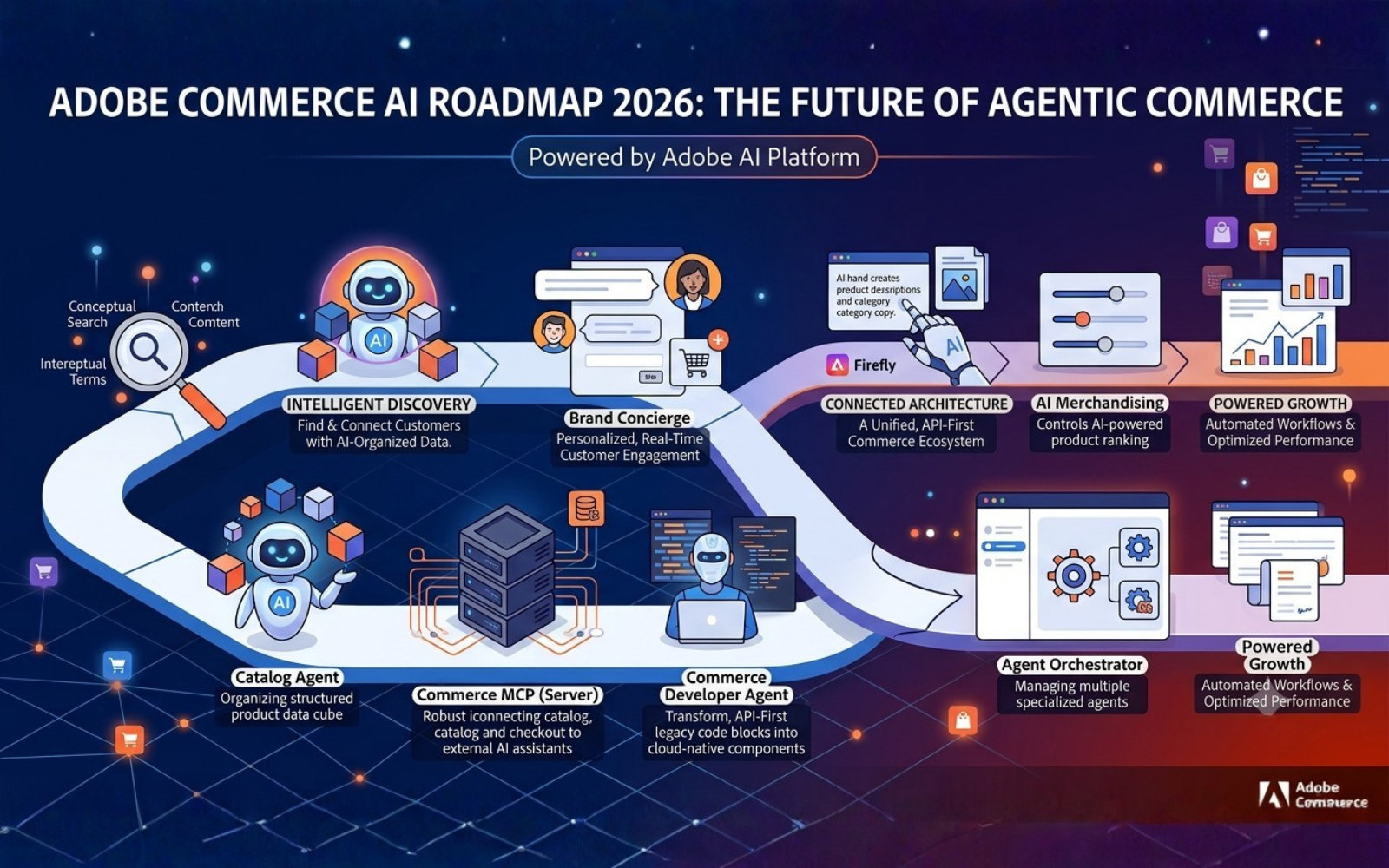
Adobe Commerce's AI roadmap centers on agentic commerce — AI agents that can search, recommend, and transact on a merchant's behalf. As of mid-2026, Adobe has shipped a Commerce MCP (Model Context Protocol) server, a Catalog Agent for product discovery, native Brand Concierge conversational shopping, and semantic AI-powered search. A Commerce Developer Agent for migration and code modernization is rolling out. Everything sits on Adobe Experience Platform and the newer Adobe AI Platform, announced at Adobe Summit 2026.
What Is Adobe Commerce's AI Roadmap?
Adobe Commerce's AI roadmap is Adobe's published and announced plan for embedding artificial intelligence — generative AI, semantic search, and autonomous AI agents — directly into the Adobe Commerce (formerly Magento) platform. It covers product discovery, merchandising, customer conversations, developer tooling, and how stores show up in AI-driven shopping surfaces like ChatGPT and Perplexity.
The roadmap has shifted noticeably in the past year: earlier Adobe Commerce AI messaging focused on personalization and recommendations. Since Adobe Summit 2026, the framing is agentic AI — systems that don't just suggest, but act.
Why AI Matters for Adobe Commerce Merchants
Shopping behavior is moving upstream, into AI assistants, before shoppers ever reach a storefront. Adobe's own data shows AI-driven traffic to US retail sites climbed sharply through 2026, building on a surge during the 2025 holiday season. For merchants, that means product visibility inside AI answers is becoming as important as search engine rankings.
Current AI Features Available in Adobe Commerce (Confirmed)
These are shipped or in active rollout, not speculative:
- Semantic / AI-powered search — interprets shopper intent and meaning rather than exact keyword matches, reducing zero-result searches.
- Catalog Agent — builds a structured, AI-readable "product knowledge layer" so LLM shopping assistants can accurately understand and recommend items.
- Brand Concierge — a native, brand-governed conversational shopping experience with real-time pricing, inventory, comparisons, and checkout in one chat interface.
- Commerce MCP (Model Context Protocol) Server — gives developers secure, real-time programmatic access to catalog, cart, pricing, inventory, promotions, checkout, and order data so any AI agent can be built on top of a store.
- Commerce Developer Agent — analyzes existing implementations and helps map migrations to Adobe Commerce as a Cloud Service, converting legacy code into modern components.
- Support for agentic commerce protocols (UCP, ACP) — lets Adobe Commerce instances transact with third-party AI shopping agents from providers like OpenAI and Google.
- Adobe LLM Optimizer integration — helps merchants monitor and improve how their brand and products appear in AI-generated answers.
Adobe Sensei and Adobe Experience Platform
Adobe Sensei is Adobe's long-standing AI and machine learning layer, historically powering things like automated image tagging, content recommendations, and predictive analytics across Adobe Experience Cloud. Adobe Commerce's newer agentic features build on top of Adobe Experience Platform — the customer data and orchestration backbone — rather than replacing it. In 2026, Adobe repositioned much of this under a broader "Adobe AI Platform," organized around brand visibility, customer engagement, and content supply chain, with Sensei-era capabilities feeding into it rather than standing alone.
What's Expected Next in Adobe Commerce's AI Roadmap
Adobe has signaled — but not fully shipped — continued expansion in these areas. Treat these as directional, not guaranteed:
AI Content Generation
Broader generative tools for product descriptions, category copy, and marketing content, extending Adobe's Firefly and content-generation investments into commerce workflows.
AI Product Recommendations
Deeper personalization tied to real-time customer segmentation and behavior signals from Adobe Experience Platform.
AI Merchandising
More merchant control and transparency over how AI ranks and surfaces products — a stated priority following early search relevance feedback.
AI Customer Segmentation & Marketing Automation
Tighter integration between commerce data and Adobe's marketing automation stack for predictive, trigger-based campaigns.
AI Analytics
Expanded predictive commerce reporting, building on Adobe Analytics and Adobe Digital Insights data.
AI Agents & Copilots
Continued build-out of the "agent stack" — Catalog Agent, Developer Agent, Brand Concierge, and an emerging Agent Orchestrator layer to manage them together, plus expanded B2B-specific agent capabilities (quoting, requisitions, approvals).
Current vs. Upcoming AI Capabilities
| Capability | Status | Notes |
|---|---|---|
| Semantic AI search | Available | Understands intent, not just keywords |
| Catalog Agent | Available | AI-readable product data layer |
| Brand Concierge | Available (rolling out) | Conversational storefront shopping |
| Commerce MCP Server | Available | Developer access layer for agents |
| Commerce Developer Agent | Rolling out | Migration & modernization tooling |
| Agent Orchestrator | Announced | Coordinates multiple commerce agents |
| Deeper AI merchandising controls | Roadmap | Merchant transparency focus |
| Expanded generative content tools | Roadmap | Extends Firefly into commerce |
How Adobe Commerce AI Benefits Merchants
- Better discoverability in both traditional search and AI answer engines
- Higher conversion through conversational, real-time product guidance
- Lower zero-result search rates via semantic understanding
- Faster migrations and development using the Developer Agent and MCP server
- Reduced manual merchandising work as agents handle more first-pass decisions
Real-World Enterprise Use Cases
Enterprise brands with large, complex catalogs — multi-brand manufacturers, B2B distributors with negotiated pricing, and high-SKU retailers — are early adopters of Catalog Agent and MCP-based integrations, since these tools directly address the two hardest problems at scale: making thousands of SKUs machine-legible for AI agents, and exposing live pricing/inventory without custom point-to-point integrations for every new AI surface.
Adobe Commerce AI vs. Competitors
| Platform | AI Approach | Notable Strength |
|---|---|---|
| Adobe Commerce | Agentic AI (MCP, Catalog Agent, Brand Concierge) | Deep enterprise data integration, protocol-first |
| Shopify Magic | Generative AI tools for merchants (copy, images) | Fast, easy for SMB/mid-market |
| Salesforce Commerce Cloud | Agentforce, Headless 360, AI-driven personalization | Strong CRM/marketing tie-in |
| BigCommerce AI | AI product descriptions, catalog tools | Simpler setup, mid-market focus |
Adobe Commerce's differentiator is architectural: it's positioning its instance as a queryable "agentic surface" other AI systems can plug into, not just a store with AI features bolted on.
Challenges and Considerations
- Fragmented timelines — some capabilities are generally available; others are "coming months," per Adobe's own Summit messaging.
- Data readiness — Catalog Agent and Brand Concierge only perform as well as the structured product data feeding them.
- Protocol complexity — merchants now need a position on MCP, UCP, and ACP, not just REST or GraphQL.
- Governance — conversational agents need brand-approved guardrails to avoid inaccurate or off-brand responses.
How Businesses Can Prepare
- Audit and clean product catalog data — attributes, descriptions, structured specs.
- Evaluate current search relevance and zero-result rates.
- Pilot Brand Concierge or MCP-based agents in a low-risk category.
- Assign ownership for AI-answer monitoring (brand visibility in ChatGPT, Perplexity, Google AI Overviews).
- Build a migration-readiness assessment if still on older Adobe Commerce/Magento versions.
People Also Ask
What AI tools does Adobe Commerce use?
Semantic search, Catalog Agent, Brand Concierge, the Commerce MCP server, and a Developer Agent, built on Adobe Experience Platform.
Does Magento have AI?
Yes — Magento is now Adobe Commerce, and AI capabilities are native to the current platform, not a separate add-on.
Is Adobe Sensei included in Adobe Commerce?
Sensei's underlying ML capabilities feed into Adobe's broader AI platform that Commerce draws on, though Adobe's 2026 messaging emphasizes the newer Adobe AI Platform branding over standalone Sensei.
What is Adobe Commerce Copilot?
Adobe's current commerce-specific offerings are branded Catalog Agent, Brand Concierge, and Commerce Developer Agent rather than a single "Copilot" product.
Can AI generate product descriptions in Adobe Commerce?
Generative content tooling is an active roadmap area, extending Adobe's Firefly generative AI investments into commerce content workflows.
Is Adobe Commerce better than Shopify for AI?
It depends on scale: Adobe Commerce leans into deep, protocol-based enterprise integration; Shopify Magic favors speed and simplicity for smaller catalogs.
Final Thoughts
Adobe Commerce's AI direction in 2026 is less about adding chatbots and more about rebuilding the platform as something AI agents can natively read, query, and transact against. Merchants that get product data structured and governance in place now will be positioned to adopt each new capability — from Brand Concierge to the emerging Agent Orchestrator — as it ships.
Download The Free E-book & Launch Your Brand Strategically
Download The Free E-book & Launch Your Brand Strategically
Share this post